
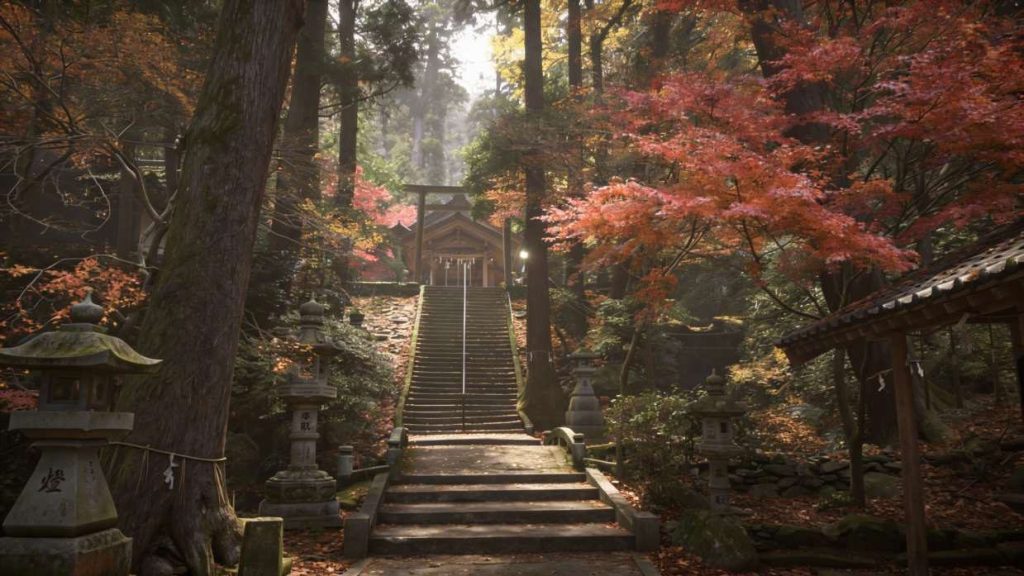
What we project onto permanence
The Ship of Theseus asks whether an object remains the same after its material is replaced. Ise Jingu gives the question a striking real-world form: at intervals of about twenty years, new principal sanctuaries are constructed on adjacent sites according to inherited designs and techniques.
I read this three times before I understood the sequence. The new sanctuary is first built on the adjacent plot. The deity is then transferred to it in the Sengyo ceremony, after which the previous sanctuary is dismantled and some of its timber is reused. The 62nd cycle was completed in 2013. Ceremonies for the 63rd began in May 2025 and are scheduled to culminate in 2033.
What stopped me wasn't the practice itself but the quiet confidence of that Wikipedia phrasing: "The continuity is considered spiritual." As though that settled something. As though naming the continuity spiritual answered the question rather than deepened it.
Ise Jingu is not a UNESCO World Heritage Site.
Ise Jingu is not on the UNESCO World Heritage List, but it is not accurate to infer that material renewal automatically fails UNESCO's test. UNESCO says authenticity may be expressed through form and design, materials, use, traditions, techniques, management systems, setting, spirit and other attributes. A property's case is evaluated in its cultural context.
The Long Now Foundation, which studies long-term thinking, sent a co-founder to the 2013 ceremony. Its account emphasised cultural continuity rather than structural over-engineering. Ise therefore presents a different preservation model: the current principal buildings date to 2013, while continuity also resides in design, ritual, craft and repeated transmission.
Next to every shrine at Ise stands an empty plot. This is where the next shrine will be built. Both sites have always been there, one holding the building, one holding its future replacement. The shrine exists in a state of perpetual adjacency to its own renewal.
The exception
Here's the complication no one mentions in the admiring accounts of Ise's "eternal renewal": the practice is exceptional even within Japan.
Many shrines once observed shikinen sengu, the periodic reconstruction. Most stopped centuries ago. Kamigamo Shrine in Kyoto held reconstructions every 21 years until many of its buildings were designated National Treasures— at which point, preservation law prohibited tearing them down. Other shrines simply couldn't sustain the expense, or lost the craftsmen who knew the techniques, or decided that permanence meant something different than it once did. Ise continued. But Ise is not typical. It's the spiritual center of Japan's imperial mythology, home to the sun goddess Amaterasu, repository of the Sacred Mirror—one of the three Imperial Regalia. Emperor Tenmu institutionalized the 20-year cycle around 690 CE, possibly as a national unification project during a period of political upheaval.
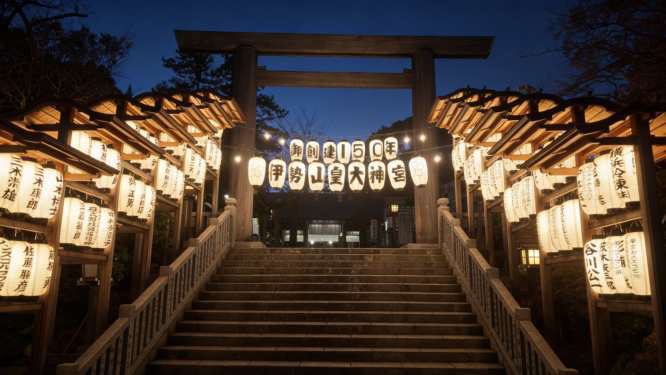
After World War II, the American occupation fundamentally restructured the relationship between the Japanese state and Shinto practice. The Shinto Directive of December 1945 ordered the separation of religion and state, stripping the government's authority to fund religious ceremonies. On the last day he had the legal authority to do so, Emperor Hirohito issued a final state authorization for Shikinen Sengu—an act that reads, in retrospect, as both religious devotion and institutional defiance. The 1953 reconstruction proceeded anyway, funded entirely by private donations. It has continued that way since, at costs now estimated at $550 million or more per cycle.
So when we hold up Ise as a model of sustainability, we should be honest about what we're looking at. This is not a replicable system. It's a 1,300-year-old exception, sustained by religious devotion, imperial symbolism, and the willingness of millions of donors to fund something most of them will never fully witness.
What survives disruption? I think about this more than I probably should. My family left Indonesia for Singapore in the 1990s, during a period of anti-Chinese sentiment. I was young enough that the displacement registered as impressions rather than narrative: my mother's tense phone calls, the hurried sorting of belongings, the strange new apartment where nothing was where it should be. The answer my parents gave, through action rather than words, was: the things you practice. The recipes you keep making even when the ingredients are different. The language you speak at home even when no one outside understands it. The rituals that structure time even when time feels formless.
What the goddess eats
Twice daily, every day, for approximately 1,500 years, priests have prepared offerings and presented them to the deities. Rice grown in paddies along the Isuzu River, fertilized with dried sardines and soybean patties. Vegetables from dedicated gardens. Salt produced at a nearby shrine using methods unchanged for two millennia. Fire kindled by friction with ancient tools called hikirigu. This ritual has never been interrupted—not during civil wars, not during World War II.
Twice daily for 1,500 years is over a million ceremonies.
And yet: visitors can't watch them. The inner sanctuary can't be photographed. The most sacred spaces are closed. Millions of people visit Ise Jingu annually, and most experience only the approach—the massive torii gates, the Uji Bridge crossing the Isuzu River, the gravel paths through ancient forest. The thing they came to see remains hidden. The daily food ritual isn't content. It isn't heritage tourism. It's closer to what happens in my kitchen on Sunday afternoons, when I'm prepping meals for the week and no one is watching and the repetition itself is the point. The tofu rendang that approximates my mother's recipe without ever quite matching it. Feeding as continuity with the women who fed me.
The practices in my life that have actually lasted are the ones no one sees. They survive because they're not performances. They're just what I do.
One theory for why the Shikinen Sengu happens every twenty years is that the cycle matches the shelf life of stored rice. The shrine's architectural style evolved from Yayoi-period grain warehouses, raised on wooden posts to protect seed stock from floods and pests. The buildings that house the sun goddess began as structures designed to keep rice from rotting.
The second ship
Thomas Hobbes extended Plutarch's paradox by imagining someone who collected all the discarded planks and built a second ship from them. Now there are two vessels, one rebuilt with new materials, one reconstructed from the original wood. Which is the "real" ship?
Ise creates exactly this scenario.
After each cycle, roof-support pillars from the old principal sanctuaries are reused as the torii gates at Uji Bridge. The shrine's official account says those gates are 7.44 metres high, not 111 metres; after another twenty years they are reused again at sites in Kameyama and Kuwana. Other old timber is also distributed for reuse at shrines around Japan.
A talisman in Hokkaido contains wood that once supported Amaterasu's sanctuary. Is that talisman part of Ise Jingu? The timber at regional shrines will stand for another twenty years, then cascade further. At what point does the shrine's identity dilute beyond recognition? Where does Ise end? The shrine's answer seems to be that the question assumes a boundary that doesn't exist. The timber was never exclusively Ise's. It came from the Kiso Mountains, 200 kilometers away, harvested from a forest the shrine doesn't own. When it leaves Ise, it doesn't stop being sacred. It becomes part of a network of shrines, a distributed sacredness that doesn't require localization.
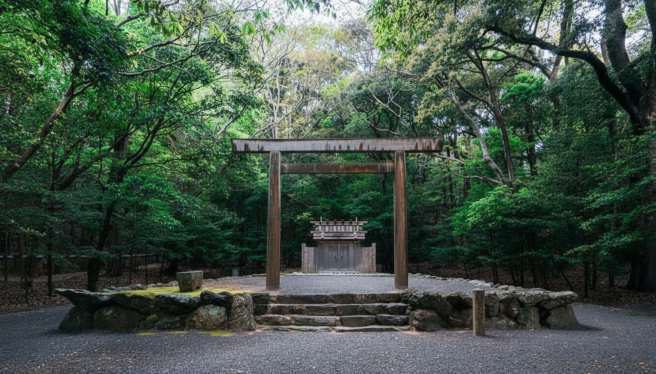
In 1923, administrators began planting hinoki cypress in the shrine's own forest because local timber had been depleted for centuries. These trees won't be ready for the shrine's main pillars until 2123— 200 years to mature, 400 for the ridgepoles. The project is now at its halfway point.
In 2013, roughly a quarter of the timber came from this forest—the first use of local wood in nearly 700 years. The people who planted those seedlings in the 1920s never saw their trees used. The people planting seedlings now won't either. They are growing wood for great-great-grandchildren who don't exist yet.
But here's what troubles me. When we praise Ise's sustainability, are we seeing the practice or projecting onto it? Is "circular economy" a useful lens or a foreign imposition on something that means nothing of the kind? I'm suspicious of my own desire to find a lesson here.
What the song forgot
In 2013, a ceremonial song was performed at Ise that hadn't been heard in sixty years.
Yoshisuke Ohkawa had sung the kiyari-uta during the 1953 reconstruction, when he was eight years old. The song coordinated cart-pullers during processions. In the decades after, no one remembered the melody. The 20-year intervals meant knowledge holders died or forgot before they could transmit what they knew.
But Ohkawa remembered. At sixty-eight, working with his wife, he reconstructed the tune into a music score. The song was performed during the Oshiraishi-mochi ceremony, as participants carried white stones to the new shrine grounds.
This story gets told as a triumph of cultural preservation. And it is. But it's also a story about failure. The system that was supposed to transmit knowledge across generations didn't work. The song survived by accident—one man's childhood memory, his wife's musical literacy, their willingness to spend the time. A different configuration of circumstances and it would have been lost permanently.
Junko Edahiro, who documented the ceremony for Japan for Sustainability, wrote that she realized the Shikinen Sengu "plays a role as a 'device' to preserve the foundations of traditions that contribute to happiness in people's lives." A device. A mechanism. As though tradition were a technology, engineered for outcomes.
The civil wars of the 15th and 16th centuries interrupted reconstruction for roughly a century. The practice resumed when stability returned. What was lost during that century? We don't know. We can't inventory what we've forgotten. The continuity we celebrate is the continuity that survived. The parts that didn't make it leave no record.
The tokowaka concept, which the shrine embodies— permanence through renewal, eternity through change—is something I recognize not from philosophy but from mornings when the old architecture of thought tries to reassemble itself and I have to take it apart, plank by plank, and build the day from scratch. Not as a triumph. As a practice. The recognition that nothing stays fixed. That the structure holds only as long as you keep rebuilding it.
The adjacent site
The 63rd Shikinen Sengu began in May 2025 with the Yamaguchisai ceremony. In June, priests felled the first timber in the Japanese Alps—three axes striking a 300-year-old cypress from three directions until it crashed down. Over the next eight years, 125 shrine buildings will be reconstructed, along with more than 1,500 ritual garments and sacred objects. In October 2033, the climactic nighttime ceremony will transfer the sacred mirror from old sanctuary to new.
Then the just-completed buildings will begin their slow decline toward the next demolition. I went looking for a lesson about what lasts. What I found was more unsettling: a practice that has continued for 1,300 years without anyone being entirely sure why, that most of Japan abandoned centuries ago, that depends on skills and funds that may not always be available, that preserves some things and loses others according to logics no one fully controls.
The shrine does not answer the question of what makes something endure. It refuses the question, or maybe it reframes it. Not what lasts, but how you relate to the certainty that nothing does.
Somewhere in the Outer Shrine, priests are preparing the evening offering. Rice grown in the paddies along the Isuzu River. Vegetables from the shrine gardens. Salt made the way it has been made for two thousand years. Fire kindled by friction. Tonight, and tomorrow morning, and the morning after that.
The empty plot waits. It has always been waiting. The workers shout as they consecrate the construction: A building for 1,000 years. What they are building will not last. What they are doing might.
Correction (14 September 2026): The reconstruction sequence, UNESCO authenticity framework and size of the reused Uji Bridge torii pillars were corrected.