Control feels safer when you learned safety depended on being the one in charge. For some people, the passenger seat resurrects an old powerlessness that the steering wheel finally resolved.
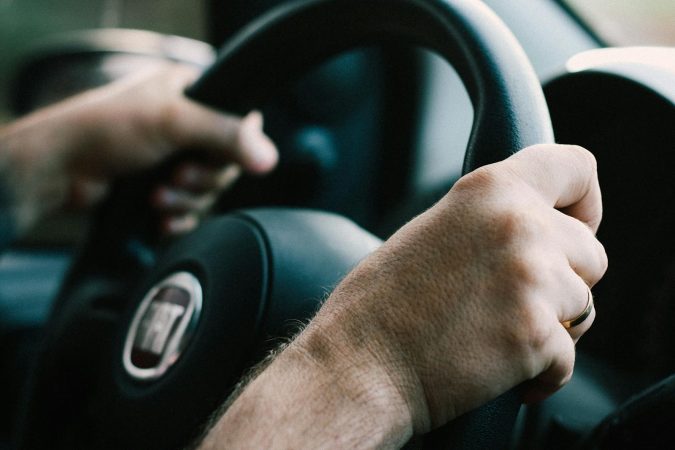
The adult who white-knuckles the steering wheel through every road trip will tell you they just prefer driving. The same person, riding shotgun, becomes someone they don't recognize: quiet, scanning the dashboard, tracking the speedometer, gripping the door handle at every yellow light.
Both things are true, and the gap between them is the whole story.
I've been thinking about this since a friend told me, almost casually, that she'd never let her husband drive on highways. Not because he was a bad driver. Because being a passenger made her feel something close to drowning. Her father, she said, used to drive angry. Take corners too fast when he was upset with her mother. Brake hard to make a point. The car was where the family's emotional weather happened, and she was always strapped into the back seat watching it.
She didn't call this trauma. She called it "a thing." Most people who carry it call it a thing.
The car as a closed system
A car is one of the few spaces in childhood where you cannot leave. You can shut a bedroom door. You can hide in a bathroom. You can walk to a neighbor's house. But once the doors lock and the engine turns over, you are inside whatever the driver decides to make happen: speed, music volume, conversation, silence, tone.
The driver controls the temperature. The driver controls how long you're in there. The driver decides whether the next forty-five minutes feel like a family outing or a hostage situation.
For kids in calm households, this barely registers. The car is just transportation. For kids in volatile ones, the car becomes a kind of laboratory for understanding that safety is something other people grant you, or don't.
Early caregiving experiences shape how someone interprets social situations throughout their life — the lens through which they understand what to expect from the world and how they fit into it. The car is one of the earliest places those patterns get built.
Control isn't the same as controlling
The cultural shorthand for the friend who always drives is "control freak." It's a tidy diagnosis. It also misses almost everything.
Clinicians draw a careful line between control-seeking behavior that comes from anxiety and control as a personality trait. University of Utah Health notes that anxiety becomes clinically significant when it disrupts daily life for weeks at a time, and that the strategies people develop to manage it are often invisible to outsiders. They look like preferences, habits, quirks.
Insisting on driving is one of those quirks. It looks like preference. It functions like a seatbelt for the nervous system.
The person who drives everywhere isn't trying to control you. They're trying to opt out of a specific feeling: the feeling of being inside a moving vehicle whose pace, mood, and trajectory belong to someone else. That feeling, for them, has a history.
What the body remembers
I don't own a car. I live in Brooklyn and take the subway everywhere, which is a choice as much as a circumstance. But I grew up between São Paulo and Miami, in two passenger seats that taught me very different things. My father drove the way he designed buildings: minimalist, deliberate, hands at ten and two, never a wasted gesture. My mother drove like someone who'd been told her whole life she was running behind. Same kid in the passenger seat. Two completely different cars.
I didn't think about this for years. Then a friend in Brooklyn asked if she could drive my rental on a weekend trip upstate, and I said yes, and within twenty minutes I was doing the thing: the dashboard-scanning, the imaginary brake-pedal pressing, the small involuntary inhale at every merge. She wasn't a bad driver. I just couldn't be a passenger to a particular kind of confidence.
The body keeps a ledger the mind has long since closed.
The autonomy-safety dialectic
There's a tension between wanting to feel in control and wanting to feel safe. It often comes up in the context of aging parents and adult caregivers, where the question is how much independence to grant someone whose judgment may be slipping.
But the same tension plays out in every passenger seat. To be a passenger is to trade autonomy for trust. You're agreeing, briefly, that someone else's judgment is good enough to bet your physical safety on. For most people, that trade is unconscious. For people who grew up in cars where the driver's mood determined the ride's danger, it's a transaction they can no longer make automatically.
So they drive. Not because they don't trust their friends, partners, or siblings, but because their nervous system learned to associate being a passenger with waiting to see what happens to them a long time ago.
Why this gets misread
The behavior gets read as controlling because it inconveniences other people. Someone always wants to drive. Someone always wants to pick the route. Someone always wants to leave at a specific time so the traffic works out a specific way.
From the outside, this looks like a person who can't relinquish power. From the inside, it's often a person trying to manage a baseline level of dread that other people don't have to manage at all.
Anxiety-driven behaviors often get pathologized as personality flaws, particularly when the underlying anxiety is invisible to observers. The driver isn't telling you they're scared. They might not even know they're scared. They just know they feel better with their hands on the wheel.
This is the same dynamic I wrote about recently in a piece about friends who always organize the plans. Behaviors that look bossy from the outside are often load-bearing on the inside. The person isn't grabbing the wheel because they want power. They're grabbing it because letting go has a cost they learned, very young, not to pay.
The driver who didn't yell
Not every kid who grew up in a tense car had a parent who screamed. Sometimes the driver was just unpredictable. Sometimes silent in a way that felt like a held breath. Sometimes a parent who used the radio to communicate things they couldn't say directly, turning the volume up to end a conversation, turning it off to start one.
What these households shared wasn't volume. It was the lesson that the person at the wheel decided how safe everyone else got to feel. And that you, in the passenger seat or the back, were a small actor in someone else's emotional movie.
Kids don't have language for this. They just develop preferences, later, that look unrelated. Wanting to drive. Wanting to leave parties on their own timeline. Wanting an aisle seat on planes. Wanting to know where the exits are.
What helps
The work, for adults who recognize themselves here, isn't to force themselves into the passenger seat as some kind of exposure therapy. White-knuckling a feeling rarely changes it.
The work is more like noticing. Recognizing that the preference for driving isn't a character flaw or a quirky habit, but information. It's the body telling you something about a room you used to be locked inside. You can honor that without organizing your whole adult life around it.
Sometimes that means driving, gladly, without apologizing for it. Sometimes it means telling a partner that you need to drive on highways even if you can't fully explain why. Sometimes it means letting someone else drive on a route you don't care about, and watching what your body does, with curiosity instead of judgment.
Healing here isn't about becoming a better passenger. It's about understanding why you became this kind of driver.
The intergenerational piece
For parents reading this and recognizing their own kids in it, the work is harder, and more worth doing. Research on family estrangement suggests that adult children are increasingly naming childhood experiences their parents considered unremarkable as formative, and asking for acknowledgment.
The car is often one of those places. The parent remembers driving the family to soccer practice. The kid remembers being unable to breathe until they got out of the car. Both memories are real. Only one of them shapes the adult.
I've written before about parents whose adult children actually want to be around them, and the pattern is consistent: it's not the parents who did everything right. It's the parents who can hear, without defensiveness, what a particular Tuesday felt like from the back seat.
What the wheel is really about
The friend who always drives isn't trying to dominate the road trip. They're trying to ride in a car that feels different from the cars they grew up in. They're using the only tool they have, their hands on the wheel, to make sure that this time, in this car, with these people, no one in the passenger seat has to feel what they once felt.
It's a strange, tender form of love, if you know what you're looking at. The driver is, in their own way, trying to be the safest version of the person their parent wasn't. They're driving for the kid in the back seat they used to be, and for everyone else in the car who doesn't have to know.
That's not control. That's a thirty-year-old promise being kept, one careful left turn at a time.