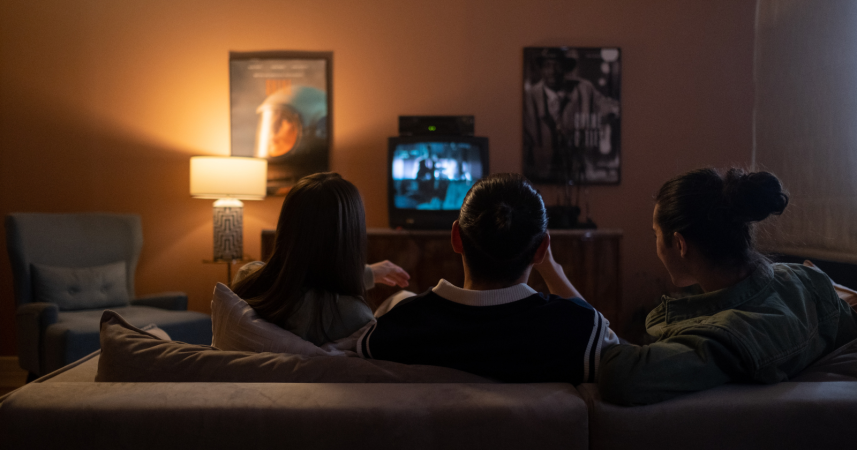
From forced patience during commercial breaks to appointment-viewing discipline, those who survived the three-channel era unknowingly trained their brains in ways that make them attention ninjas in our notification-saturated world.
Remember when Saturday morning meant three hours of cartoons, and if you missed your favorite show, that was it? No streaming, no YouTube, no catching it later. You either sat there at the right time, or you missed out entirely.
I've been thinking a lot about this lately, especially as I watch people struggle to finish a two-minute video without checking their phones. There's something fundamentally different about how those of us who grew up with limited TV channels learned to pay attention, and psychology research is finally catching up to what many of us have suspected all along.
Growing up in an era of scarcity taught us something that abundance seems to have erased: the art of deep, sustained attention. And while I love having endless entertainment options now, I can't help but notice that the attention skills we developed back then have become surprisingly rare superpowers in today's world.
1. The ability to commit fully to one thing
When your favorite show came on once a week, you gave it everything. No second screen, no scrolling Instagram during commercial breaks. You sat there, fully present, because this was your one shot.
I remember planning my entire evening around specific shows. If it was Thursday at 8 PM, nothing else mattered. That level of commitment to a single activity feels almost foreign now, doesn't it?
Research from Microsoft shows that the average attention span has dropped from 12 seconds in 2000 to just 8 seconds today. But here's what's fascinating: people who grew up with limited media choices consistently score higher on sustained attention tasks. We learned to invest deeply because switching channels meant potentially missing something important.
This skill translates beautifully into work and relationships. When I schedule my writing blocks, I channel that same single-minded focus I used to have watching my favorite shows. No tabs open, no notifications, just me and the task at hand for 90 minutes straight.
2. Patience for slow narrative builds
Shows back then took their sweet time. Character development happened over seasons, not seconds. Plot twists were earned through careful storytelling, not thrown at you every five minutes to keep you from clicking away.
We learned to wait. To trust that the payoff would come. To enjoy the journey rather than demanding instant gratification.
A colleague recently complained that her teenage daughter couldn't sit through classic movies because "nothing happens for the first 20 minutes." Meanwhile, those of us raised on limited channels learned that sometimes the best parts come to those who wait. This patience extends far beyond entertainment. It's the same skill that helps us stick with challenging projects at work or navigate the slow seasons in relationships.
3. Active imagination during "boring" moments
What did you do during those endless commercial breaks? Or when programming ended for the night and that test pattern came on?
We daydreamed. We created stories in our heads. We let our minds wander in ways that modern constant stimulation simply doesn't allow.
Psychologist Jerome Singer's research on daydreaming shows that this "default mode" thinking is crucial for creativity and problem-solving. Those forced pauses in entertainment taught us to be comfortable with our own thoughts, to fill empty spaces with imagination rather than immediately reaching for external stimulation.
During my digital detox weekends, I'm always amazed at how quickly my brain remembers how to do this. Within hours of putting away my devices, I'm back to that childhood state of creative mental wandering.
4. Deep listening skills
Without subtitles, rewind buttons, or the ability to look up plot summaries online, you had to actually listen. Miss a crucial piece of dialogue? Too bad. The show moved on without you.
This trained us to pay attention the first time. To pick up on vocal nuances, background sounds, and subtle audio cues that told the real story.
I notice this skill most in meetings now. While others ask for things to be repeated or seem to half-listen while multitasking, those of us from the three-channel generation often catch details others miss. We learned early that listening isn't passive; it's an active skill that requires full engagement.
5. Appointment-based discipline
If your show aired at 7 PM on Tuesday, you structured your life around it. Homework got done early. Dinner was planned accordingly. You developed the discipline to show up on time because there was no pause button, no "watch later" option.
This might sound restrictive, but it actually taught us incredible time management skills. We learned to prioritize, to make choices, to commit to schedules.
We learned that good things come to those who plan ahead and show up consistently.
6. Tolerance for repetition
Summer meant reruns. Lots of them. And you know what? We watched them anyway. We found new details in familiar stories, developed deeper appreciation for craftsmanship, and learned that repetition could be comforting rather than boring.
This skill is gold in today's world where people abandon anything that doesn't provide constant novelty. Whether it's sticking with meditation practice, exercise routines, or professional skill development, the ability to find value in repetition sets you apart.
When I read the same philosophy books multiple times, pulling new insights with each pass, I'm using that same skill I developed rewatching the same episodes every summer.
7. Communal attention experiences
Everyone watched the same shows, which meant everyone could talk about them the next day. This created shared cultural experiences and taught us to pay attention not just for ourselves, but so we could participate in community discussions.
You couldn't just watch passively. You needed to form opinions, remember details, and be ready to discuss what happened. This developed critical thinking skills and the ability to engage meaningfully with shared content.
Modern fragmented media consumption has largely eliminated these water cooler moments, but those of us who experienced them know the value of collective attention and shared cultural touchstones.
8. Acceptance of "nothing good is on"
Sometimes, genuinely nothing interesting was on TV. And that was okay. We learned to be comfortable with not being entertained every second of every day.
This might be the rarest skill of all now. The ability to simply exist without constant input, to be okay with quiet, to not immediately fill every moment of potential boredom with stimulation.
Neuroscience research shows that these unstimulated moments are when our brains do their best processing, consolidating memories and making creative connections. By learning early that entertainment wasn't always available, we developed the ability to find contentment in stillness.
The lasting impact
These eight attention skills might seem quaint in our age of infinite content, but they're actually becoming more valuable as they become more rare. The ability to focus deeply, wait patiently, and engage fully gives us an enormous advantage in a distracted world.
I'm not saying we should go back to three channels. But recognizing what we gained from that limitation helps us understand what we might be losing now. And more importantly, it reminds us that these skills can be practiced and preserved.
Next time you find yourself unable to focus, constantly switching between apps, or feeling anxious without stimulation, remember that attention isn't just about willpower. It's a set of skills that can be developed, just like we developed them all those years ago, waiting for our favorite show to come on.
The question is: are you willing to practice them?