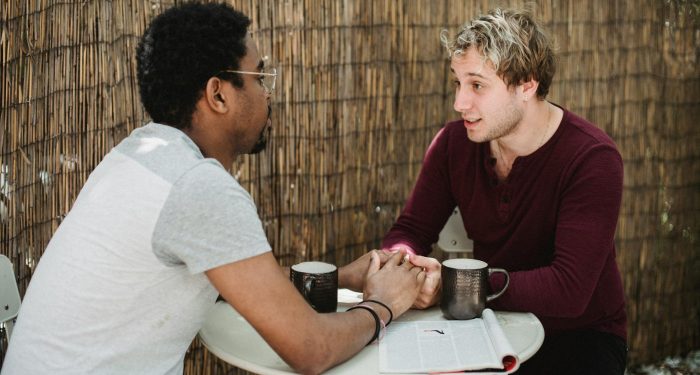
The families that look close from the outside are often the ones where nobody knows what anyone is actually carrying — and the cost of that performance doesn't come due until decades later.
Sharing a childhood is not the same as knowing each other. It looks like the same thing from the outside, which is why the confusion has so much staying power, but the two are different operations entirely. One is logistics. The other is a kind of attention almost no family ever learns to give.
My siblings could fill out a form about me. Date of birth, employer, spouse's name, the city I live in, the names and ages of the kids. They'd get all of it right on the first try. And if you pulled any one of them aside at a holiday and asked them what I'm genuinely afraid of, not the surface answer, not the joke version, but the fear that actually keeps me awake, they'd stare at you like you'd asked them to recite a language they never learned.
That's the gap. Most people never notice it because they've been told their entire lives that sharing a house is the same as sharing a self. The conventional wisdom says family is where you're most yourself. What I've watched, in my own life and in the lives of almost everyone I've talked to seriously about this, is the opposite. Family is often the last place the real self ever gets to show up. The roles are assigned too early, the scripts get too rehearsed, and by the time you're an adult capable of being known, everyone's already decided who you are.
The difference nobody names out loud
Proximity is logistical. It's the information that gets exchanged because it has to be exchanged. Addresses for Christmas cards, job titles for small talk at weddings, kids' names so gifts can be labeled correctly. Proximity runs on data. It keeps the machinery of a family functioning. It doesn't require either person to be vulnerable, and it doesn't ask anyone to risk being seen.
Closeness is different. Closeness is the willingness to say the thing you're not sure how to say, to someone you're not sure will respond well, because the relationship has enough ground underneath it to hold the weight. Relationship experts have observed that connection that looks stable from the outside can still be hollow underneath, because presence and intimacy aren't the same variable.
A lot of families mistake one for the other because the one is easier and the other is terrifying.
What travels through a family — and what doesn't
Think about what actually moves through a family of origin. Facts travel easily. Grades, promotions, engagements, moves, diagnoses. Those get passed around the phone tree within hours. Fears don't. Shame doesn't. The quiet, specific dread that shapes how a person moves through their day almost never makes it into a family conversation, because most families don't have the vocabulary for it and don't know how to receive it if it showed up. Observers of sibling dynamics have noted that adult siblings often discover, once the parents are gone, that the relationship was being held together by logistics nobody ever named. Mom's birthday. Dad's retirement party. Christmas Eve at the house. When those structures disappear, the relationship either reveals a foundation underneath or reveals that there wasn't one. And a lot of people find out which it was only in their fifties, which is a brutal timeline for that kind of information.
I grew up in a house where the highest compliment was being described as fine. Are you fine? Yes, fine. How's work? Fine. How are the kids? Fine. The word did so much work it practically had a union. It covered everything from mild inconvenience to quiet catastrophe, and everyone understood that asking a follow-up question was, itself, a minor violation of the unspoken treaty.
That treaty is what most families run on. You don't ask, I don't tell, and we stay close by staying on the surface. It works. It works for decades. It keeps holidays pleasant and phone calls short and nobody has to be uncomfortable. The cost is that by the time anyone actually needs to be known, when the marriage cracks, when the diagnosis comes, when the depression finally stops being manageable, the channels for that kind of conversation have never been built, and there's no time to build them in a crisis.

The reason siblings so often become the last to know anything real about each other is that the childhood version of each other is sticky. Your younger brother is always, on some level, eleven years old to you. Your older sister is always the one who was in charge. The adults you've become get filed underneath those earlier versions rather than replacing them. So you share updated facts, the job title, the new house, the kids' names, but the emotional picture stays frozen at whatever age the family stopped doing the work of looking at each other fresh.
Which is most families. Most families stop around twelve.
The performance that looks like a family
There's a particular version of this that hurts the most, which is the family that looks, from the outside, like a closeness masterclass. Everyone shows up to the gatherings. The group chat is active. Birthdays get acknowledged. Photos get shared. On paper, on Instagram, on the neighbor's assessment over the fence, it's an enviable family.
Inside that family, nobody knows what anyone is actually afraid of.
That's not a contradiction. That's a specific kind of family culture, and it's more common than anyone admits. The performance is the point. The performance is what's being protected. Admitting that you don't actually know your brother, that he could walk into your house and you'd have to guess at what's currently breaking his heart, would require dismantling a story everyone's been maintaining together for decades. Nobody wants to be the one to put the first crack in the glass.
Research on emotional intimacy in long-term bonds keeps landing on the same unglamorous finding: comfort and closeness drift apart over time unless someone deliberately keeps them tethered. Families almost never do that deliberate work. They assume the proximity will do it for them. It won't.
Why the untangling takes a lifetime
Figuring out the difference between how you were raised and what you actually got is the longest project of adult life. Partly because the signal is so quiet. Nobody hits you, nobody screams at you, the family dinners happen, the photos get taken, and the only evidence that something was missing is a feeling in your chest you can't quite name until you're about thirty-five and someone asks you a real question and you notice you don't know how to answer it.
The untangling happens in layers. First you notice the gap. Then you try to close it with the family you have, usually by initiating a deeper conversation with a sibling or a parent, and you find out very quickly whether the machinery can handle it. Sometimes it can. More often it can't, and the conversation gets smoothed over, redirected, or turned into a joke, and you learn that the surface you grew up on wasn't incidental. It was the foundation itself, and pressing on it too hard makes everyone wobble.
Then you start looking for the closeness elsewhere. Friends, partners, chosen family, the two or three people who, through some combination of luck and effort, actually ask you what you're afraid of and wait for the real answer. For a lot of people, the small handful of people who truly know them aren't biological relatives at all. They're the ones the person built closeness with on purpose, because the early training in proximity-as-closeness taught them that deep knowing is something you have to choose rather than something you inherit.
What the absence actually costs
The cost of proximity-without-closeness doesn't arrive as a single bill. It arrives as a slow drip over decades. It's the reason the most competent person in the family is often the loneliest. They learned to be useful before they learned to be known, and the usefulness got rewarded so thoroughly that the knowing never got built. It's the reason the ones who stayed and did the work often feel emptier in their sixties than the ones who left. Proximity without closeness isn't connection, it's a logistics arrangement, and logistics arrangements don't feed the part of a human being that needs to be seen.
Writers have covered what actually keeps relationships healthy: mutual responsiveness, a willingness to see the other person as they currently are rather than as they were, and the basic practice of asking questions you don't already know the answer to. None of those things are automatic. Families rarely install them in childhood. So adult children either learn to do them on purpose, in their thirties and forties and fifties, or they don't, and they live out the rest of their lives mistaking proximity for the real thing.
The invitation that hides in the gap
The gap between what your family knows about your life and what they know about your interior is not a verdict. It's a starting place, at least in theory. The siblings who know the job title and the address don't have to stay at that level. They chose it by default, not by conviction, and a different default is theoretically available any time someone is willing to risk the first real question.
Usually nobody is.
Usually the treaty holds until somebody dies or somebody gets sick or somebody hits a limit and decides they'd rather be uncomfortable than unknown. And even then, the asking doesn't always produce the answer you were hoping for. Some siblings, asked a real question for the first time at fifty, simply don't have the equipment to respond. Some parents, given a genuine opening, retreat into the same fine they've been using for decades. The gap doesn't always close just because one person finally tries to close it. Sometimes the thread you pull comes out in your hand, attached to nothing, and you find out the surface was the whole structure.
That's the part nobody wants to say out loud. Naming the difference between proximity and closeness is the beginning of something, but not always the beginning of repair. Sometimes it's just the beginning of knowing, with more clarity than before, what was never there. Whether that knowing is a gift or a wound depends on the day, and on the family, and on how much capacity the people involved still have for being changed by each other. I don't know which one it'll be for you. I'm not sure I know which one it's been for me.