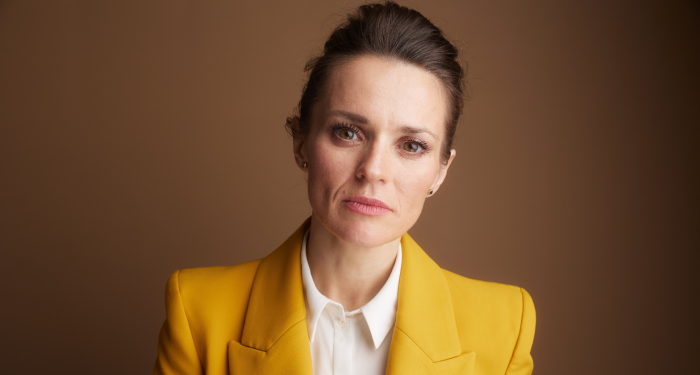
The composed adult everyone admires for being so easy to be around is often harboring a secret: they're the same intense, sensitive child they always were, just expertly compressed into a more palatable version that's slowly suffocating inside.
At the dinner party, she laughed at exactly the right volume. She offered to help clear plates before anyone asked. When someone interrupted her mid-sentence, she yielded without a flicker, then picked up her fork and continued eating as though the thought she'd been forming hadn't mattered at all. Later, driving home alone, she gripped the steering wheel and screamed into the silence of her car — not because anything had gone wrong, but because nothing had. She'd performed flawlessly again.
This is what compression looks like from the outside: composure. From the inside, it's something else entirely. According to Yellow Chair Collective, "These painful self-judgments don't appear out of nowhere. They form in childhood environments where emotional needs weren't welcomed, mirrored, or understood."
The child who talks too excitedly about their interests learns to monitor their enthusiasm. The one who cries too easily learns to swallow their tears. The one who needs too much attention learns to need nothing at all.
That energy, that sensitivity, that need for connection? It doesn't disappear. It just goes underground.
I spent years perfecting this act. In meetings, I'd have passionate ideas but deliver them in measured tones. In friendships, I'd feel deeply but express carefully. I became so good at taking up less space that people started praising me for being "low maintenance" and "easy to work with." What they didn't see was the constant calculation happening beneath the surface — every interaction requiring careful calibration. How much emotion is acceptable here? How much of myself can I show without being rejected? These aren't questions most people ask themselves while ordering coffee or sitting in a team standup. But for those of us who learned early that our natural frequency was unwelcome, they run on a loop so constant it becomes indistinguishable from thought itself.
The invisible cost of composure
You know what nobody tells you about being the "composed" adult?
It's exhausting.
Dr. Erin McKnew, PsyD, captures this perfectly: "Over time, this way of adapting can leave you appearing steady on the outside while carrying constant tension beneath the surface. Rest may feel unfamiliar or earned, and slowing down can feel more unsettling than staying busy."
This hit home for me when I discovered trail running at 28. What started as a way to cope with work stress became my lifeline, 20 to 30 miles a week of finally feeling like I could take up space, breathe fully, move without monitoring myself. Out on the trails, nobody cared if I was too loud or too intense. The trees didn't mind if I cried. The mountains didn't need me to be smaller.
But even this healthy outlet revealed something darker. I realized I'd been performing not just at work but everywhere, even in my closest friendships. I'd been so focused on being palatable that I'd forgotten what it felt like to be real.
Research backs this up. A study found that children who experienced maternal psychological control were more likely to develop anxiety symptoms and had greater difficulties with emotion regulation in adulthood.
We become walking contradictions. Seemingly confident but internally uncertain. Appearing relaxed while constantly vigilant. Looking independent while desperately craving authentic connection. Does anyone actually admire composure, or do they just find it convenient?
Breaking the pattern of suppression
So how do we stop folding ourselves in half?
First, we need to understand what's actually happening when we suppress our emotions. Simply Psychology explains that "Suppressed emotions don't actually vanish; they 'sit in the background' and can resurface later, sometimes more intensely."
Every time we push down our feelings to make others comfortable, we're not eliminating those feelings. We're storing them. And eventually, that storage unit gets full.
Dr. Rubin, a psychologist, notes that people who felt like too much as children "may learn to inhibit or shut down emotional expression due to a fear that this may overwhelm others and lead to interpersonal rejection."
I want to believe the people who truly matter won't be overwhelmed by your full self. But I'm not sure that's always true. Sometimes the full self is genuinely a lot — not because something is wrong with it, but because decades of compression create a pressure that doesn't release evenly. It comes out in bursts, in wrong rooms, at wrong volumes.
I discovered this when I started letting my guard down with select friends. Instead of the carefully curated version of myself, I showed them the messy, intense, sometimes needy person I'd been hiding. You know what happened? They didn't run. They actually moved closer. One friend even said, "I always felt like there was a glass wall between us. Now you're finally here."
Reclaiming your full size
If you recognize yourself in these words, if you're the adult who seems so easy-going that nobody knows you're drowning, here's what I want you to know: Your full size was always welcome. You just weren't in the right rooms.
Center for Mindful Therapy points out that "Adults who experienced emotional neglect in childhood may find it challenging to express their emotions openly or struggle to connect emotionally with others."
The work isn't about becoming louder or taking up more physical space. It's about slowly, carefully, unfurling yourself. It's about recognizing when you're performing composure versus actually feeling calm.
Start small. Notice when you're minimizing your needs or dampening your enthusiasm. Pay attention to the moments when you say "I'm fine" when you're not, or "It doesn't matter" when it does.
Research indicates that children who faced emotional maltreatment are at a higher risk of psychological distress in adulthood, with emotional inhibition playing a mediating role in this relationship.
The path forward isn't about suddenly becoming a different person. It's about gradually giving yourself permission to be who you always were.
Final thoughts
The journey from being "too much" to being just enough isn't linear. Some days, you'll catch yourself mid-fold, automatically making yourself smaller before you even realize what's happening. Other days, you'll surprise yourself with your own authenticity.
What matters is that you're aware now. You understand that your composure might be a survival strategy that's outlived its purpose. But awareness and change aren't the same thing, are they? You can see the fold and still not know how to straighten it. You can name the pattern and watch yourself repeat it in the same breath.
The child who learned to fold themselves in half did what they needed to survive. Whether the adult can actually unfold — fully, permanently, without eventually retreating back into that familiar compression — is a question I don't have a clean answer to. Some days the unfolding holds. Some days the old rooms win. Maybe that's the honest version of progress: not a door flung open, but a hinge that moves a little more freely than it used to, still creaking, still stiff, still not sure how far it's meant to go.