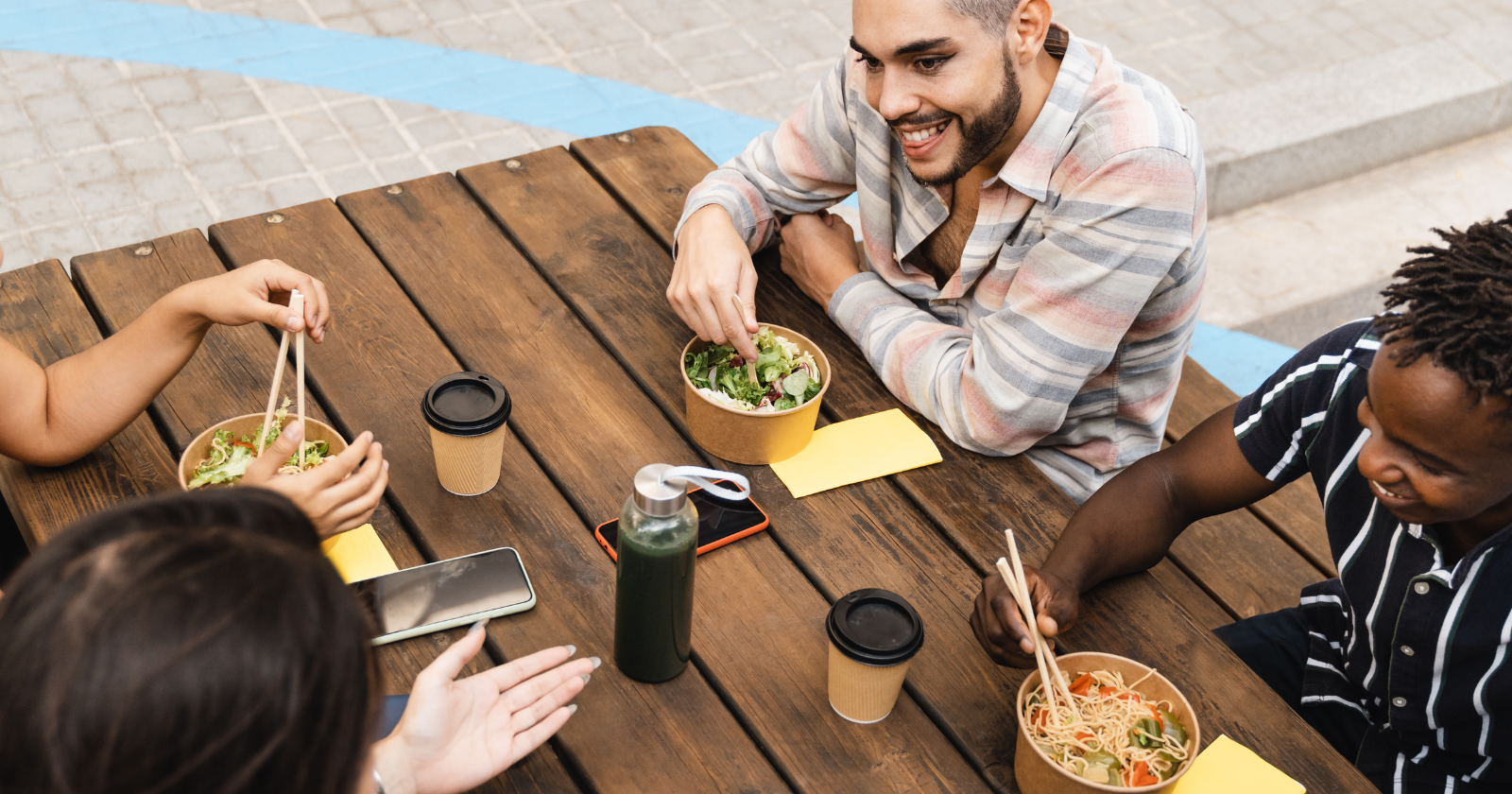
When did you last eat a meal with someone you actually know? Not at your desk, not scrolling through your phone, but sitting down with another person — a friend, a partner, a family member, whoever — and sharing something to eat?
I've been thinking about this since reading a chapter from the 2025 World Happiness Report that focuses entirely on the act of sharing meals. The researchers weren't asking what people eat or how much. They were asking who they eat with. And the answer, it turns out, tells us a surprising amount about how happy people are.
Using data from the Gallup World Poll — over 150,000 people across 142 countries — they found that people who share more meals with others consistently report higher life satisfaction, more positive emotions, and fewer negative ones. This held true across genders, ages, countries, and cultures.
What I found most striking was the scale of the effect. Meal sharing was compared directly to income and unemployment — two well-established predictors of happiness — and it was found that sharing meals was on par with both. For positive emotions specifically, knowing how many meals someone shares each week was actually a better predictor of how they feel day-to-day than knowing their income. That's not a throwaway finding. These researchers are careful about what they claim, and they called it "the most striking" result of the whole analysis.
There's a linguistic thread in the chapeter that I found myself thinking about long after I'd put it down. In French, "copain" — the word for friend — comes from the Latin "cum pānis," literally "with bread." In Italian, "compagno" (mate) has the same root. The Chinese term for companion, 伙伴, originally translated to "fire mate" — a reference to sharing meals over a campfire. The idea that eating together and being close to someone are, at some level, the same thing seems to have been baked into how humans talk about relationships for a very long time. It's a bit humbling to see it showing up in global survey data as clearly as it does.
The American data is perhaps the part that stayed with me most. Using a large time-use survey that has tracked how Americans spend their days since 2003, the researchers found that dining alone has risen by 53% in two decades. Roughly one in four Americans now reports eating all of their daily meals alone. Among adults aged 25 to 34, the figure has gone up by more than 180% since 2003. That's not a gradual drift — it's a significant change in how people are spending what used to be a social part of the day.
I find myself wondering how much of this is just not noticed because it's so incremental. You eat lunch at your desk. You have dinner in front of something on a screen. Neither feels like a big decision. But across millions of people, across years, it adds up to something the data suggests to be quite meaningful.
The chapter also touches on loneliness and social support — two factors that are themselves linked to life satisfaction. People who share more meals consistently report feeling less lonely and having more people they can count on when things get hard.
The honest caveat — and the researchers are upfront about it "At present, it remains unclear whether sharing meals leads to greater wellbeing or whether greater wellbeing leads to more shared meals. In all likelihood, both are probably true, at least to some extent."What the data can't yet fully resolve, it does point clearly in one direction. Former US Surgeon General Dr. Vivek Murthy, who has written extensively on loneliness, put it this way: "When we gather with others around food, we not only feed our bodies but also nourish our spirits." That reads like something you'd put on a wall, but the data makes it feel considerably less like a platitude.