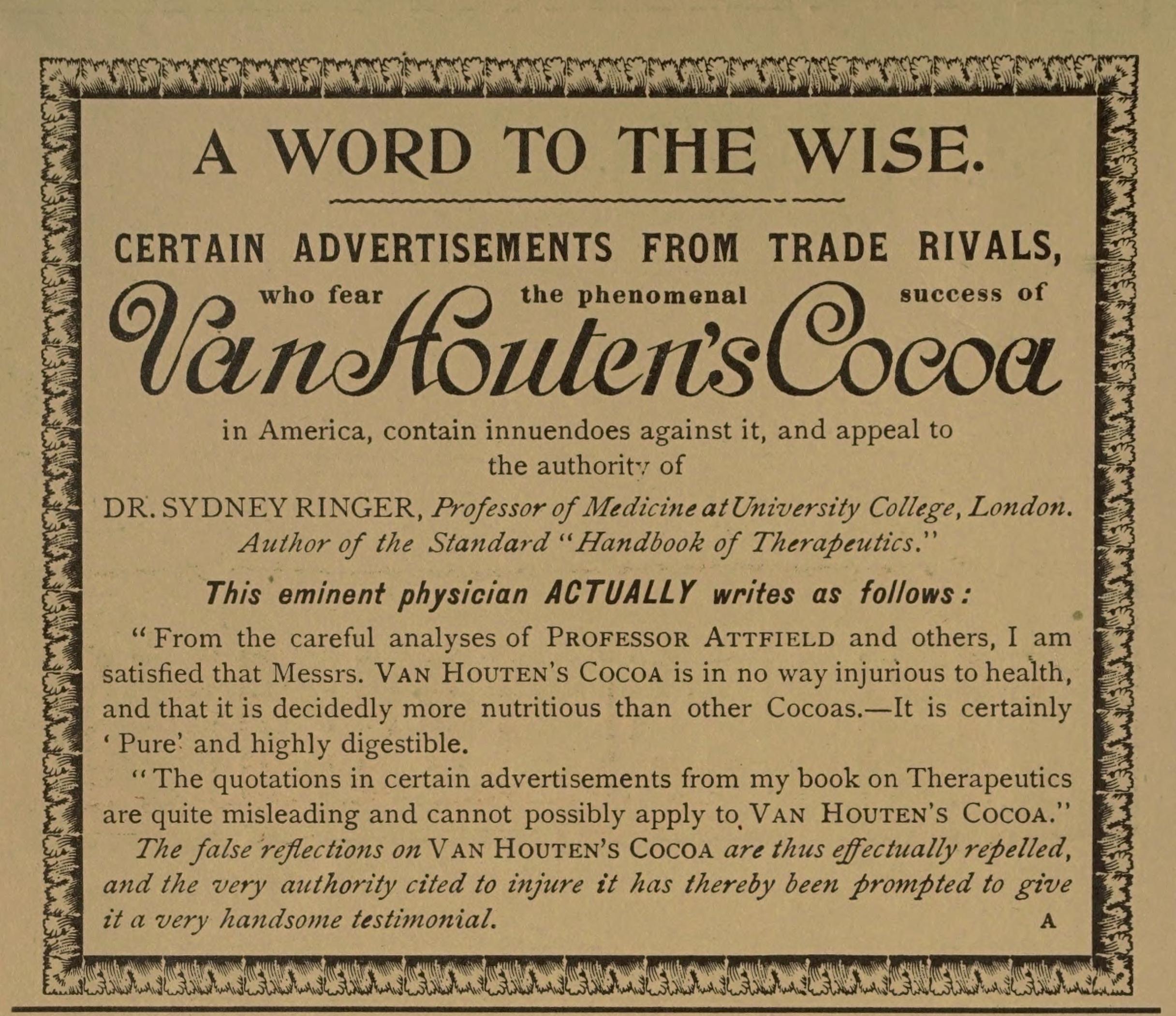
Photo: a Van Houten's Cocoa advertisement from Lippincott's magazine, 1893, not a photograph of the 1828 press. Public domain, via Wikimedia Commons
Cocoa powder as most kitchens know it begins with two patents from the Van Houten firm in Amsterdam. The first, in 1828, covered a hydraulic cocoa press that cut cocoa butter by nearly half and left a lighter powder that dissolved more readily. The second, in 1846, covered Dutching, in which cocoa is mixed with alkaline salts for a rich, chocolatey taste and a powder that blends more easily with water.
The second patent changed the chemistry of the powder. Cocoa treated with alkali carries far fewer flavanols than natural cocoa, and the size of the drop tracks how hard the treatment was, according to a survey of commercial powders published in the Journal of Agricultural and Food Chemistry in 2008.
From a coffee and spice shop to a hydraulic press
The company timeline starts in 1806, when the father of the family opened "a coffee & spice shop in Amsterdam". The firm spells his name Caspardus; many English-language accounts use Casparus. Cacao and chocolate production under the Van Houten name began in 1815.
The 1828 patent appears on that timeline under the company name rather than under any one member of the family. It is described as a hydraulic cocoa press that "reduces cocoa butter by nearly half for a lighter, more nutritious and dissolvable cocoa powder". The words "more nutritious" are the company's, not an independent nutrition finding. Elsewhere the same page calls the family's patent a vertical cocoa press.
Coenraad, Caspardus' son, entered the business in 1835, and the Dutching patent followed in 1846, credited on the timeline to him. The third generation arrived in 1864, when the official name became C. J. Van Houten & Zoon, and the firm began packing its cocoa in tins the year after. Van Houten took the brand to the United States in 1889.
Dutch trade in colonial crops long predated the press, from the nutmeg monopoly imposed on the Banda Islands in 1621 onwards. What the press added was a way to turn a fatty paste into a powder that would mix with hot water.
What the 2008 flavanol survey measured
Miller and colleagues surveyed representative natural cocoas alongside lightly, medium and heavily alkalised commercial powders. The authors work for the Hershey Center for Health and Nutrition at The Hershey Company in Pennsylvania, a point worth weighing in an industry survey of an industry process.
The powders were sorted by extractable pH. Natural cocoa powders measured pH 5.3 to 5.8. Alkalised powders were grouped as lightly treated at pH 6.50 to 7.20, medium-treated at 7.21 to 7.60, and heavily treated at 7.61 and higher.
Average total flavanol content fell at each step up that scale: 34.6 plus or minus 6.8 mg/g for the natural cocoas, 13.8 plus or minus 7.3 mg/g for the lightly processed, 7.8 plus or minus 4.0 mg/g for the medium processed and 3.9 plus or minus 1.8 mg/g for the heavily processed powders. "These chemical measurements showed a linear decrease as the extractable pH of the cocoa powder increased," the paper says. Flavanol monomers, oligomers and polymers each fell the same way.
Set against the natural average, the light-treatment figure works out at roughly 40 per cent of the starting amount and the heavy-treatment figure at about 11 per cent. Both are arithmetic from the published averages rather than separate measurements. Flavanols are reduced, not erased.
Colour does not sort the powders either. Brown and black alkali-processed cocoas were compared with red ones, and similar decreases in flavanols showed up in both as alkalisation increased. The survey measured powders in a laboratory rather than people who ate them, and the paper discusses what the results may imply for diet and food manufacturing.
Reading the pack and what changes in a bowl
Extractable pH, the figure the survey sorted by, does not appear on a tin. Food labels tend to name an ingredient or a process rather than a measurement, a gap that turns up with newer ingredients too, such as the soy leghemoglobin that drew a no-questions letter from the FDA in 2018.
What the alkali was for is set out in the 1846 patent itself: a rich, chocolatey flavour and a powder that blends more easily with water. The flavanol figures do not settle which powder belongs in a recipe; they describe what the alkali does to one group of compounds.
The spread within each group is wide. Lightly processed powders averaged 13.8 mg/g with a standard deviation of 7.3, overlapping the medium-processed band, so two tins described the same way on the shelf can differ. Without a pH figure or a flavanol number on the pack, a buyer has no way to tell which is which.