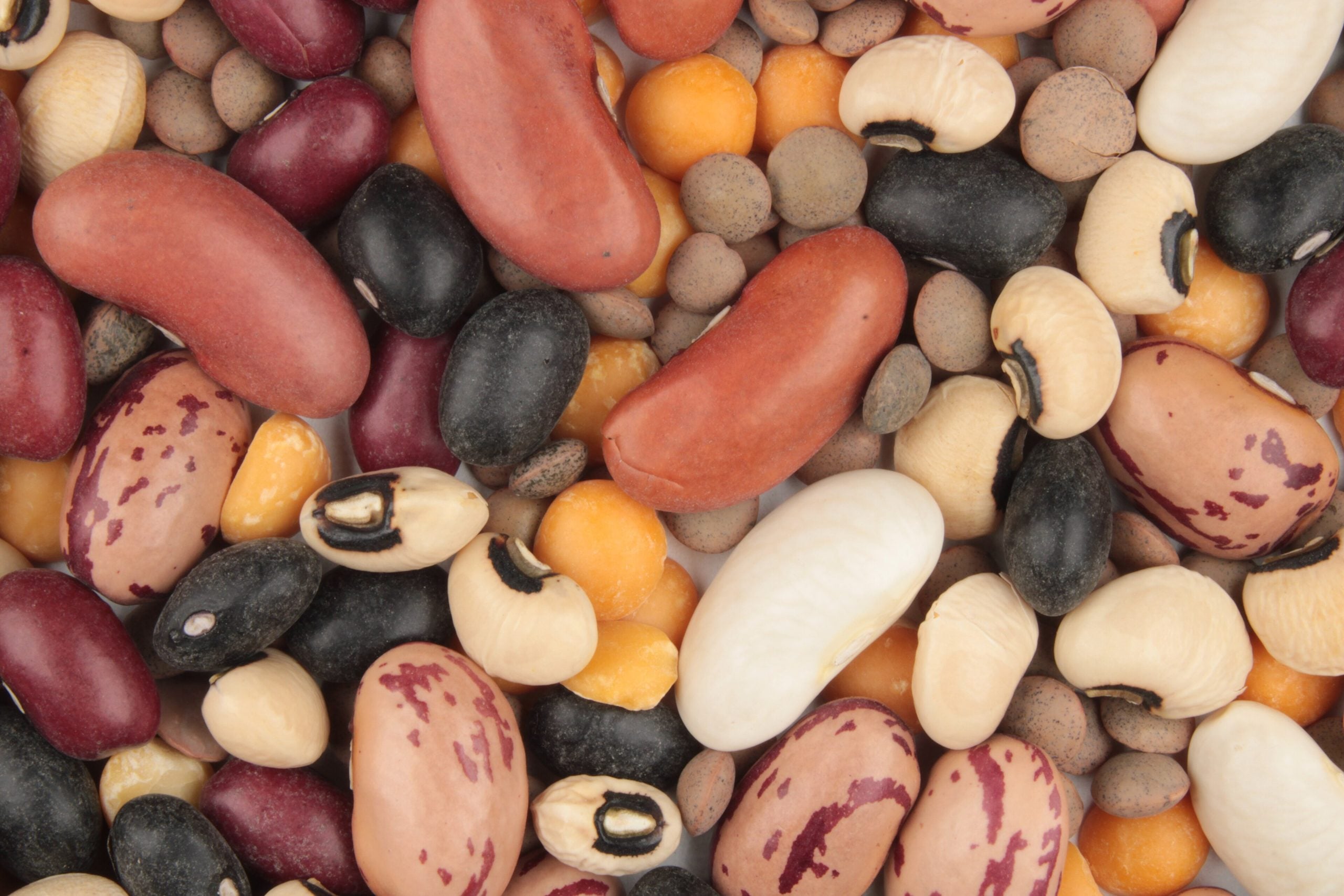
Photo: a mixture of dried beans, peas and lentils. Bean appreciator / Wikimedia Commons, CC0
The adult protein RDA of 0.8 g per kilogram of body weight a day comes from one document: the US Institute of Medicine's Dietary Reference Intakes for Energy, Carbohydrate, Fiber, Fat, Fatty Acids, Cholesterol, Protein, and Amino Acids, dated 2002 and reissued in 2005. The same report set an Estimated Average Requirement (EAR) of 0.66 g/kg a day.
The two figures do different jobs. An EAR is the intake estimated to meet the requirement of half the healthy people in a group. An RDA sits above it, at the level estimated to cover about 97.5 per cent of them. Neither was written as a performance target, and the Institute of Medicine, now the National Academy of Medicine, set no Tolerable Upper Intake Level for protein.
That shapes how the other numbers should be read. Sports bodies work from 1.2 to 2.0 g/kg, researchers in older-adult nutrition from 1.0 to 1.2 g/kg, and the ceiling figures that circulate in popular coverage have no official standing at all.
The 19 nitrogen balance studies behind 0.8
The evidence base for the adult figure is a meta-analysis by Rand, Pellett and Young, published in the American Journal of Clinical Nutrition in January 2003 (77(1):109–127). The authors pooled data for 235 individual subjects, each studied at three or more test protein intakes, gathered from 19 studies.
Those studies used nitrogen balance. Researchers measure the nitrogen going in as protein and the nitrogen coming out in urine, faeces and skin, then look for the intake at which the two break even. The working assumption is that break-even equals adequacy.
Rand and colleagues put the median EAR at 105 mg of nitrogen per kg a day, which they expressed as 0.65 g of good-quality protein per kg a day. The 97.5th percentile of that distribution, the figure they labelled the RDA, came out at 132 mg N/kg/day, or 0.83 g/kg/day.
The Institute of Medicine then set its own values close to those, an EAR of 0.66 and an RDA of 0.80 g/kg/day, rounding 0.83 down. The familiar 0.8 is therefore a rounded percentile of a pooled distribution, stated in terms of good-quality protein, rather than a measured requirement for any individual.
The report was also blunt about the method it had leaned on. Its wording, as quoted from page 643 of the 2005 volume in later National Academies materials, is that "due to the shortcomings of the nitrogen balance method noted earlier, it is recommended that the use of nitrogen balance should no longer be regarded as the ‘gold standard’ for the assessment of the adequacy of protein intake and that alternative means should be sought".
Why athletes are given 1.2 to 2.0
The athletic range answers a different question. The RDA asks what prevents deficiency. Sports nutrition asks what supports training adaptation, repair and the retention of lean mass under load.
The joint position of the American College of Sports Medicine, the Academy of Nutrition and Dietetics and Dietitians of Canada, "Nutrition and Athletic Performance" (Medicine & Science in Sports & Exercise 2016;48(3):543–568), puts athlete intakes at 1.2 to 2.0 g/kg a day.
Older adults are the other group with a separate figure. The PROT-AGE Study Group, writing as Bauer and colleagues in the Journal of the American Medical Directors Association in 2013, recommended that healthy older people take in an average of at least 1.0 to 1.2 g/kg a day to maintain or regain lean mass and function.
Those ranges are reachable on a plant-based diet without unusual planning. By simple arithmetic, a 70 kg athlete aiming at 1.6 g/kg, the midpoint of the ACSM range, would be looking at 112 g a day, which is a matter of building meals around lentils, tofu, tempeh, soya milk and nuts rather than treating high-protein vegan foods as an occasional addition.
The upper end, where no official number exists
Because the Institute of Medicine set no Tolerable Upper Intake Level for protein, there is no official maximum to quote. Any ceiling figure in circulation comes from individual researchers or from commentary, and should be read that way.
The VegOut video "What Too Much Protein Does to Your Body" works from the same 0.8 g/kg baseline, giving roughly 60 g for someone weighing 75 kilos, and says the "healthy range runs from there up to about 90 or 100". A day that "pushes past 150 g", it adds, is "far beyond the ceiling".
The video attributes that ceiling to 2024 work by researchers at the University of Pittsburgh, putting the threshold at "about 22% of your daily calories, or roughly 25 g in a single meal". Those figures are the video's account of that research, not regulatory limits, and the underlying paper was not independently examined for this piece.
The arithmetic the video sets out is easier to check. It counts an all-plant day of oats cooked with soya milk, peanut butter, chia seeds and almonds at about 25 g, a lentil and chickpea stew with wholegrain bread at another 35, and a tempeh and quinoa bowl at around 40, which lands at about 100 g without supplements. Adding a shake to every meal, plus bars and chips between them, is what takes that day past 150 g in the video's example, and vegan protein powder stacked on meals already built around legumes is the fastest route there.