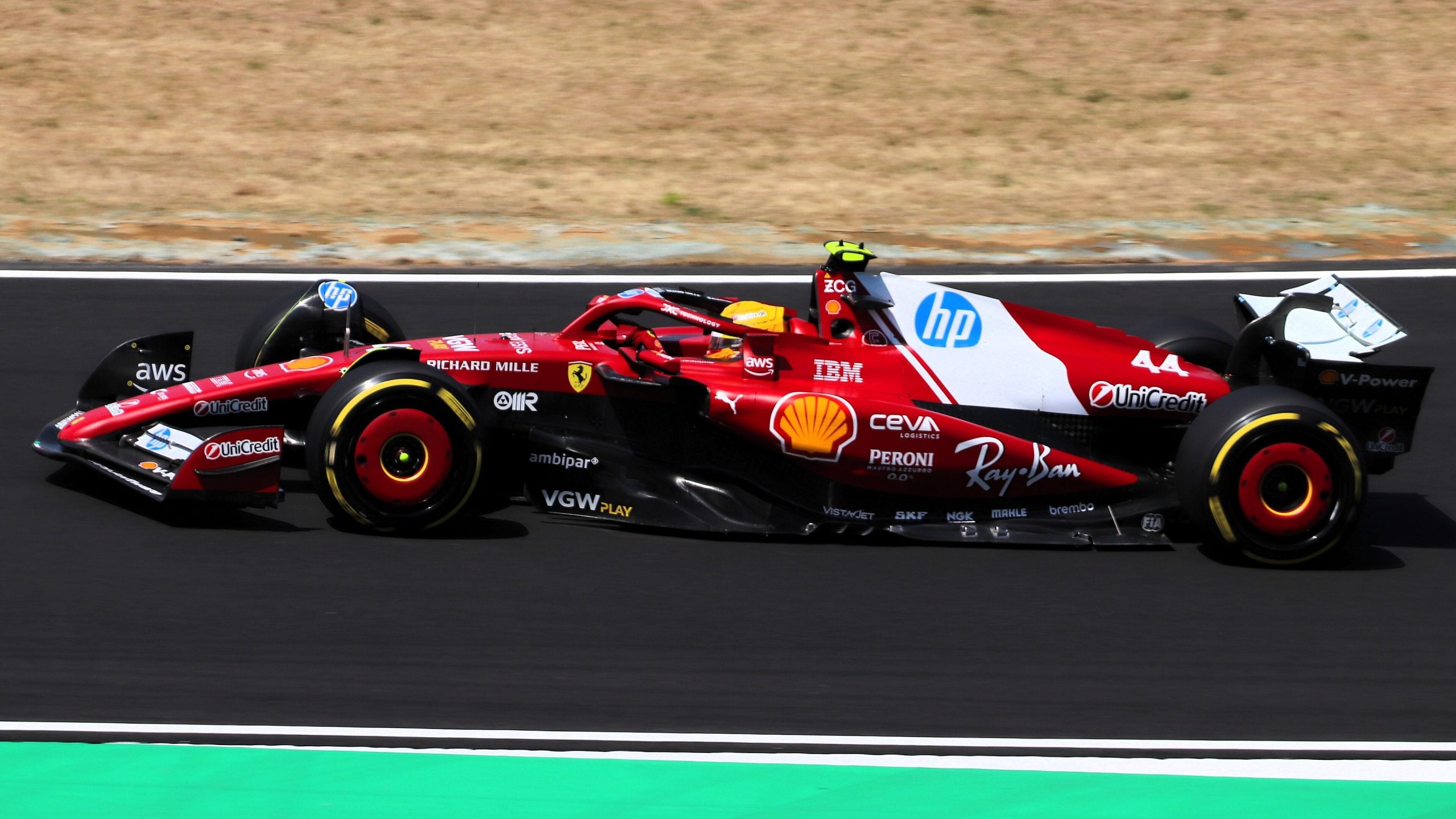
Photo: Lewis Hamilton in the Ferrari during practice for the 2025 Japanese Grand Prix. Liauzh / Wikimedia Commons, CC BY-SA 4.0
Lewis Hamilton is 41, born on 7 January 1985, and is racing for Ferrari in the 2026 Formula 1 season. After the Brazilian Grand Prix on 8 November 2026, where he finished ninth for two points, he is fourth in the drivers' standings on 261 points, behind Kimi Antonelli on 390, Max Verstappen on 279 and George Russell on 262, and 12 points clear of his Ferrari team mate Charles Leclerc.
He has eaten plant-based since 2017. The change came in stages rather than as one announcement, starting with red meat around 2015, and the fullest account of it is his own, given in two interviews with BBC Sport.
The diet changed in stages, not overnight
On 16 September 2017, in Singapore, Hamilton told BBC Sport's Andrew Benson that he was aiming to become vegan. "I stopped eating red meat two years ago," he said. "I have generally been pescatarian for the majority of the year and now I've cut fish." Benson wrote that Hamilton, then driving for Mercedes, had not eaten chicken for much of that year, and that in Singapore, where he was catered for by chefs, he had eaten only plant-based food.
Hamilton was candid about how untested the change was. "So far I don't feel as if I have been missing out," he said. "But I don't know how easy it is going to be when I get home. That is going to be a real test."
Two months later he pushed back on the assumption that it would not last. Asked in a Telegraph interview published on 24 November 2017 about friends suggesting he would drop the vegan diet over the winter, he replied: "No – I'm not half-in, half-out. This is the direction I'm going in now."
By 30 December 2017, speaking to BBC Sport again, he set out the sequence himself. "Came off red meat two and a half years ago, stopped eating chicken at the beginning of this year and was pescatarian," he said. "Then the final thing was seeing this one documentary. I'd seen a couple, but this one was, 'OK, I'm done'." The two timings he gave, two years in September and two and a half years in December, both point back to around 2015 for red meat.
Salads, bread and an avocado breakfast
That December 2017 interview is also the most specific published description of what he was eating. "I live on salads," Hamilton told BBC Sport. "I have a lot more carbs now, which is weird because before I had cut my carbs completely and had a high protein diet but now I'm on salads, a lot of breads, pancakes." On how he felt, he said: "I do have more energy but before I had more than enough energy anyway. I just feel cleaner. I don't feel bogged down, don't have problems with my stomach like I used to have, just feel cleaner."
A VegOut video on his routine puts breakfast as avocado on toast most mornings, sometimes with fruit, sometimes with a plant-based protein smoothie alongside it. That detail comes from the video rather than from a published interview with Hamilton.
The shift he described, from a low-carbohydrate, high-protein pattern to one built on salads, bread and pancakes, is a fuelling change above all. Carbohydrate is the main fuel for high-intensity work, and bread, pancakes and fruit all supply it.
Protein is the question put to any athlete who stops eating animal products, and the published guidance is not vague. The 2016 joint position statement from the American College of Sports Medicine, the Academy of Nutrition and Dietetics and Dietitians of Canada, in Medicine & Science in Sports & Exercise, sets 1.2 to 2.0 grams of protein per kilogram of body weight per day for athletes. That is a general range, not a figure anyone has published for Hamilton. Reaching it without animal products means building meals around pulses, tofu, tempeh, seitan and other high-protein vegan foods, which is why a scoop of vegan protein powder in a smoothie is a common way to close the gap on heavy training days.
Still at Ferrari, with three races left in 2026
The diet travelled with him to Italy. In a Telegraph interview published on 13 March 2025, after his move to Ferrari, Hamilton joked: "Oh God. I've eaten so many pizzas in the last few weeks." He added: "But funnily enough, I've lost weight." Tom Cary, who wrote the piece, said the pizzas were cheese-free and described Hamilton as vegan and a vocal advocate of plant-based living since 2017.
No comparable first-person interview about his food has followed in 2026. What is on the record this season is the racing. Every Grand Prix entry on his 2026 results page, from Australia on 8 March to Brazil on 8 November, is listed under Ferrari, and those finishes add up to the 261 points that place him fourth.
Three rounds remain on the official calendar: Las Vegas on 21 November, Qatar on 29 November and Abu Dhabi on 6 December. Hamilton turns 42 a month after the final race.