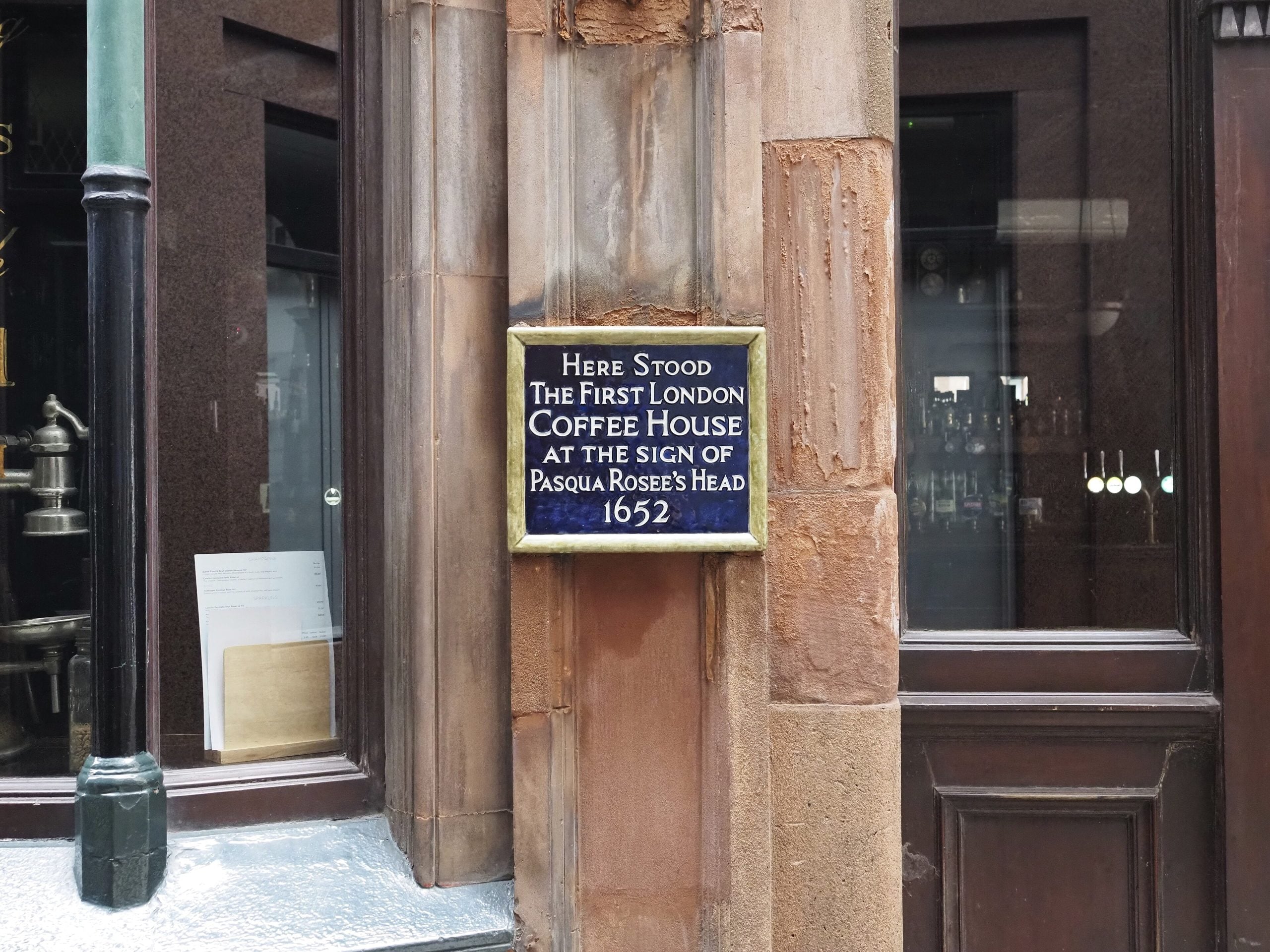
Photo: the Jamaica Wine House in St Michael's Alley, on the site of London's first coffee house, photographed on 12 February 2023. Bex Walton / Wikimedia Commons, CC BY 2.0
A seventeenth-century handbill headed "The Vertue of the COFFEE Drink. First publiquely made and sold in England, by Pasqua Rosee" sold the new drink in the City of London. Its best-known line is about sleep: "It will prevent Drowsiness, and make one fit for busines, if one have occasion to Watch."
The same sheet carried a warning. Readers were told not to drink it after supper "unless you intend to be watchful, for it will hinder sleep for 3 or 4 hours". The place line names the seller and the spot: "Made and Sold in St. Michaels Alley in Cornhill, by Pasqua Rosee, at the Signe of his own Head."
1652 is the traditional date given for that shop, usually called London's first coffee house. More than 350 years later the European Food Safety Authority put numbers on the sleep warning. Its May 2015 scientific opinion on the safety of caffeine says single doses of 100 mg "may affect sleep duration and patterns in some adults, particularly when consumed close to bedtime", while intakes up to 400 mg a day "do not raise safety concerns for healthy adults in the general population, except pregnant women".
What the handbill claimed
The text survives in a damaged copy, transcribed by the Early English Books Online Text Creation Partnership and published by the PRISMS project. Beyond alertness, it sold coffee as medicine: "good against the Head-ach", able to "very much stop any Defluxion of Rheums" and so "prevent and help Consumptions; and the Cough of the Lungs". It was "excellent to prevent and cure the Dropsy, Goat, and Scurvy", recommended for sore eyes if the drinker held their head over the steam, and "very good to prevent Mis-carryings in Child-bearing Women".
None of that is medical information. It is advertising for an unfamiliar import, and the pregnancy claim runs opposite to what later research has found. The sheet described the plant in trade terms: the berry "groweth upon little Trees, only in the Deserts of Arabia", and was "brought from thence". Coffee reached London by the kind of long-distance trade route European companies fought to control, as the Dutch did when they seized the nutmeg trade in the Banda Islands in 1621.
The serving instructions were exact: about half a pint, taken "as hot as possibly can be endured", with no food for an hour before or after.
The 1652 date and the paper trail
The handbill itself carries no date. The Wing imprint reads "[London: 1675?]" and the EEBO edition note gives "1670-1680?", while a 2012 post on Oxford University Press's OUPblog, drawing on the Oxford Dictionary of National Biography, quotes the drowsiness line and dates the sheet "(c.1652)". Those are catalogue judgements about when the sheet was printed rather than anything on the page, and they differ by two decades.
The ODNB records Pasqua Rosee as active between 1651 and 1656, and the OUPblog post describes his coffee house as a shed in St Michael's churchyard, where he served "two or three dishes" of coffee "at a time twice or thrice a day". Markman Ellis, writing in the London Journal in 2004, showed that the 1652 date rests on later antiquarian accounts rather than documents from the 1650s. It is the traditional date, not a documented one.
1652 is also the date on the alley. A plaque there reads "Here stood the first London coffee house at the sign of Pasqua Rosee's Head 1652". The Jamaica Wine House occupies the site today.
What the modern evidence supports
The broadest summary of the health research is an umbrella review published in the BMJ on 22 November 2017 by Poole and colleagues at the University of Southampton and the Medical Research Council/University of Edinburgh Centre for Inflammation Research. It pulled together 201 meta-analyses of observational research covering 67 unique health outcomes and 17 meta-analyses of interventional research covering nine.
Coffee consumption "was more often associated with benefit than harm", the paper says. The largest relative risk reductions came at three to four cups a day compared with none: all-cause mortality 0.83 (95 per cent confidence interval 0.79 to 0.88), cardiovascular mortality 0.81 (0.72 to 0.90) and cardiovascular disease 0.85 (0.80 to 0.90). High versus low consumption was associated with an 18 per cent lower risk of incident cancer.
The harms clustered in pregnancy. High versus low or no consumption was associated with low birth weight (odds ratio 1.31, 1.03 to 1.67), preterm birth in the first trimester (1.22, 1.00 to 1.49) and the second (1.12, 1.02 to 1.22), and pregnancy loss (1.46, 1.06 to 1.99). Coffee drinking was also associated with fracture risk in women but not in men. These are associations drawn from observational data. The authors said randomised controlled trials are needed to establish whether any of them are causal, and that outside pregnancy coffee could be tested as an intervention without significant risk of harm, with women at increased risk of fracture possibly excluded.
EFSA's other figures sit alongside those findings. Single doses up to 200 mg "do not raise safety concerns for the general healthy adult population", and in pregnancy intakes from all sources up to 200 mg a day "do not raise safety concerns for the foetus". The 400 mg daily figure is a ceiling for healthy adults rather than a target, in the way the 0.8 g per kg protein reference intake is a reference point rather than a goal. Where that caffeine comes from varies by country: according to EFSA, in Ireland and the United Kingdom tea was the main source, contributing 59 per cent and 57 per cent of total caffeine intake respectively.