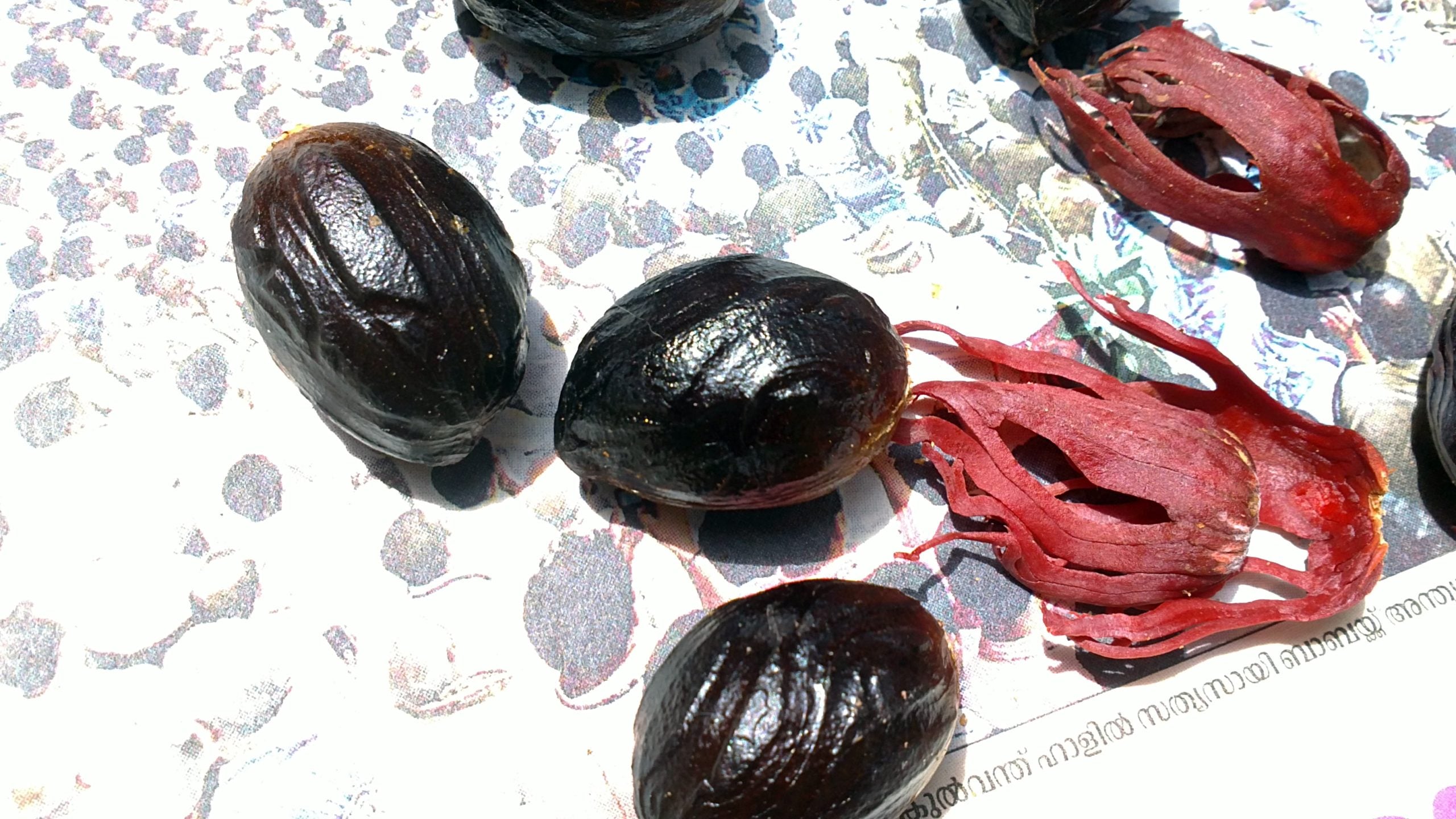
The Banda Islands in the Moluccas, now Maluku province in Indonesia, were "the only place where nutmeg grew at the time" when Jan Pietersz Coen committed a massacre there in 1621, Michiel Baas wrote for the International Institute for Asian Studies in The Newsletter 89, Summer 2021, published around the 400th anniversary. Coen was governor-general of the Dutch East India Company, the VOC.
Four hundred years on, the same seed sits in home spice racks, and the US National Capital Poison Center advises: "Use only recommended amounts in recipes."
This piece was reported and source-checked by the VegOut editorial team on 13 November 2026.
The conquest that made nutmeg a Dutch monopoly
Vincent Loth's history of the islands, "Pioneers and Perkeniers", published in Cakalele in 1995, records that the Dutch first reached the ten small islands of Banda in 1599, "at that time the sole source of nutmeg and mace." The Bandanese, who had resisted Portuguese advances since Antonio d'Abréu arrived in 1511, received them cordially. The VOC then built a fort and a trading post on Neira and pressed for contracts binding the islanders to trade the spices exclusively with it.
Those contracts failed. The Bandanese depended on overseas trade for food and other goods and kept bartering nutmeg and mace with other buyers, Loth writes. Relations broke down, and in 1609 an attack on a Dutch delegation killed 46 men, among them the leading officer Pieter Verhoeven. By 1614 the company's directors in the Netherlands were ready to conquer the islands outright. In 1616, 240 Dutch and 23 Japanese troops took the island of Ay; many defenders were killed and another 400, including women and children, drowned trying to reach nearby Run.
At the end of 1620 Coen sailed with 19 VOC ships carrying 1,655 European and 286 Asian troops, joined in Banda by a local contingent and 36 indigenous vessels. What followed, Loth writes, is "certainly one of the blackest pages in the history of Dutch overseas expansion." On his estimate, only about 1,000 of the estimated 15,000 inhabitants of the islands remained after the conquest. Leaders were executed, families were shipped to Batavia, and others were enslaved, deported or fled. The land went to planters known as perkeniers, who worked it with enslaved labor under VOC contracts.
VegOut set out the same Banda thread in a video published on 9 August 2026, in a chapter on the dark history of nutmeg.
One island stayed outside the system. The English claimed Run, and the matter was settled only at the Peace of Breda in 1667, when they gave up their claims, according to Loth. The New York Courts Historical Society records that Breda ended the Second Anglo-Dutch War, that the Dutch formally ceded New Netherland to the English, and that they retained their monopoly in the spice trade. Each side kept what it held. The Financial Times headline "The spice island they swapped for Manhattan" is shorthand for that settlement rather than a description of a single barter.
What poison centers have recorded since
The spice the VOC fought over is now ordinary kitchen stock, and the warnings attached to it concern large amounts. Poison Control's "Kitchen surprises and cautions" page says: "Nutmeg tastes great in cookies and eggnog, but too much can cause hallucinations. Children who get into the container, and people who deliberately swallow a lot of nutmeg trying to get high, can become miserably sick. Nausea, vomiting, agitation, prolonged drowsiness, and coma are all possible. Keep the nutmeg, and its relative, mace, out of the reach of children." The page gives no gram or teaspoon figure.
Case data fills in the pattern. A review of Illinois Poison Center calls from 2001 to 2011 by Jamie Ehrenpreis and colleagues, published in the Journal of Medical Toxicology in 2014, found 32 reported cases of nutmeg ingestion. Seventeen (53.1 percent) were unintentional, and 10 of those involved children under 13. Four of those ten cases were eye exposures. Fifteen (46.9 percent) were intentional; five of those were recorded with combined drug intoxication, in patients aged 15 to 20. The median age across the cases was 16. One patient with polypharmaceutical exposure required ventilatory support in hospital.
A January 2015 letter in the Netherlands Journal of Medicine, "Unintentional nutmeg autointoxication," describes a 37-year-old woman who reached an emergency department with confusion, incoherent speech and drowsiness after adding about two teaspoons of nutmeg to her asparagus at dinner, "which was more than she intended." The authors write: "Toxic symptoms have been observed with a nutmeg dose of as little as 5 g, which is equivalent to two teaspoons or two-thirds of a tablespoon of grated nutmeg." Symptoms "usually occur three to eight hours after ingestion and can last for up to 48 hours." The clinical course is "usually benign and self-limiting, although two deadly cases attributed to nutmeg overdose have been published." The 5 g figure marks a dose at which toxic symptoms have been seen; the paper sets out no safe amount.
What the guidance means in the kitchen
Both the Illinois review and the Dutch case report describe nutmeg as a spice normally used in small amounts to flavor food, seasonal drinks and baked goods. Poison Control names cookies and eggnog, the kind of seasonal cooking that also fills out a vegan Thanksgiving meal guide and VegOut's notes on being the only vegan at Thanksgiving, where the spice is measured by the recipe rather than poured from the jar.
The advice from the National Capital Poison Center runs to a few practical steps: use only recommended amounts in recipes, lock up ingredients that might be harmful if children swallow too much, and keep nutmeg and mace out of the reach of children. If someone has swallowed more, help is available through the webPOISONCONTROL online tool or by calling 1-800-222-1222. Online or by phone, that guidance is free, confidential and available 24 hours a day.