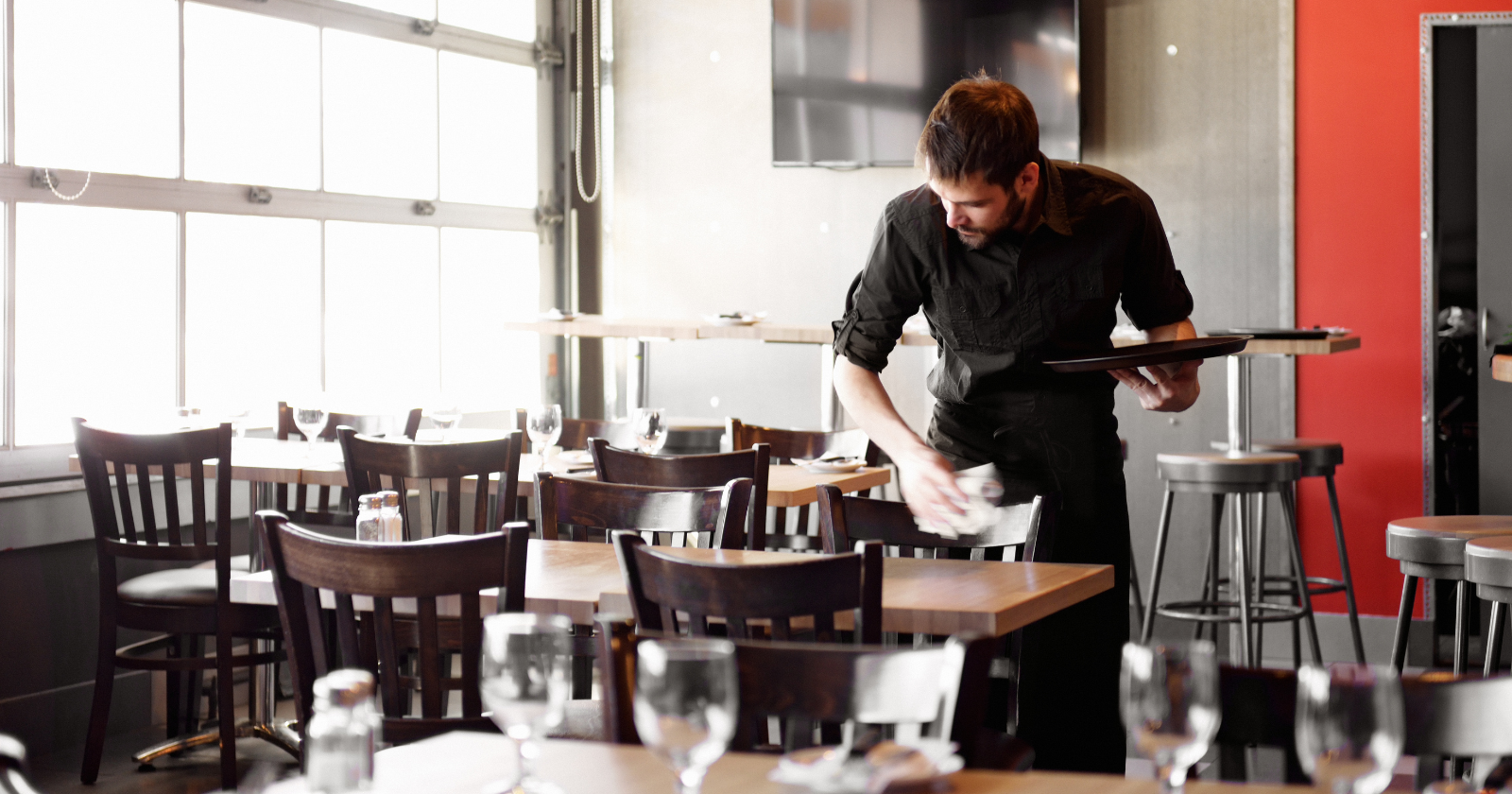
It's a small moment, almost easy to miss. A couple finishes dinner, and before they stand up, one of them quietly stacks the plates, gathers the cutlery in a tidy pile, and folds the napkins on top. Nothing dramatic. No announcement. They just leave the table a little easier for whoever has to clear it.
It's also one of those tiny behaviours that says more about a person than they probably realise.
Some people see it and assume the plate-stacker is showing off, performing for a date, or trying to look polite. Psychology suggests something quieter is usually going on. The stacking isn't for the room. It's for the person behind the swinging kitchen door, the one nobody at the table can see.
The behaviour nobody is rewarding
To understand what plate-stacking actually reveals, you have to notice what it doesn't do. It doesn't impress the waiter, who's usually moved on by the time the table is cleared. It doesn't impress the people at other tables, who aren't watching. It doesn't earn the diner a discount, a thank-you, or any social currency they can spend later.
What it does, almost invisibly, is make life slightly easier for someone who will never know who did it.
This is the part that interests psychologists. Behaviour that costs you something and benefits a stranger you'll never meet is one of the cleanest tests we have for what's actually going on inside a person's moral wiring. It's the difference between performed kindness and the kind that happens when no one's looking.
The empathy-altruism hypothesis
Psychologist Daniel Batson spent decades trying to answer a deceptively simple question. Do people ever help others purely because they care about them, or is every act of kindness secretly self-interested?
His empathy-altruism hypothesis, supported by a long body of experimental work, argues that when people feel genuine empathic concern for someone, they help them, even when no one is watching, even when there's no reward, even when it's easier to walk away. The empathy itself becomes the motivator. The "what's in it for me" calculation never gets run.
Plate-stacking is a textbook case. The diner is imagining, even briefly, the person who's going to have to wipe the table down. They're picturing the small relief of a stack instead of a mess, and that mental image is enough to move their hands. There's no audience for any of it. The behaviour is just the natural overflow of having taken someone else's perspective for a moment.
The cognitive skill underneath
Perspective-taking is the specific skill at work here, and psychology has been studying it carefully for years. It's the capacity to step out of your own experience long enough to imagine someone else's, even when their experience is invisible to you in that moment.
People high in this trait do a lot of small things that go unnoticed. They merge into traffic without cutting people off. They wipe down the gym equipment after using it. They put the shopping trolley back. They leave the airbnb a little tidier than they found it. None of these behaviours pay them back in any direct way. They're just what falls out of a mind that automatically thinks about the next person.
The plate-stacker, in other words, isn't doing anything special. They're just running their normal cognitive defaults. The defaults happen to include the busser.
Why some people don't do it
It's worth being honest about the other side, because the contrast is what makes the trait visible.
UC Berkeley psychologist Dacher Keltner's research on power, summarised in his book The Power Paradox, found something uncomfortable about how status and entitlement change behaviour. People who feel even slightly powerful in a given situation tend to take less account of others, particularly people they perceive as lower status. They interrupt more. They take more than their share. They notice service workers less.
This isn't a moral failing so much as a predictable shift in attention. When you feel like the system is set up to serve you, the people doing the serving become background. You stop seeing them. And once you've stopped seeing them, you stop running the perspective-taking that would make you stack the plates.
The diners who tidy up haven't necessarily decided to be virtuous. They've just never let those people slip into the background in the first place.
The character signal
Behaviour you do when no one's watching has always been one of the most reliable readouts of who a person actually is. Psychologist Mark Leary, who developed the widely used Brief Fear of Negative Evaluation Scale, has shown that many people only behave well when they think they're being judged. The plate-stacker is doing the opposite. They're behaving well in the absence of any judgment at all.
That's the part that's hard to fake. You can perform politeness when the waiter is at the table. You can't perform politeness toward a person you can't see.
The deeper layer
Buddhist psychology has been pointing at this kind of small, invisible kindness for centuries. The contemplative traditions noticed early on that the integrity of a person's life isn't found in the grand gestures. It's found in the thousand tiny moments where they choose to consider someone else without any expectation of credit. Over a lifetime, those moments are what a person actually becomes.
The plate-stackers are not virtuous performers. They're not trying to be seen as kind. Most of them would be slightly embarrassed if you pointed it out.
They've just, somewhere along the way, internalised the simple idea that the people who clean up after them are people too, with tired feet, long shifts, and small mercies that accumulate over a night.
Stacking the plates is one of those mercies.
It doesn't change the world. But it changes the room slightly, in the direction of more care, and that's almost always what the quietly decent people in our lives have been doing all along.