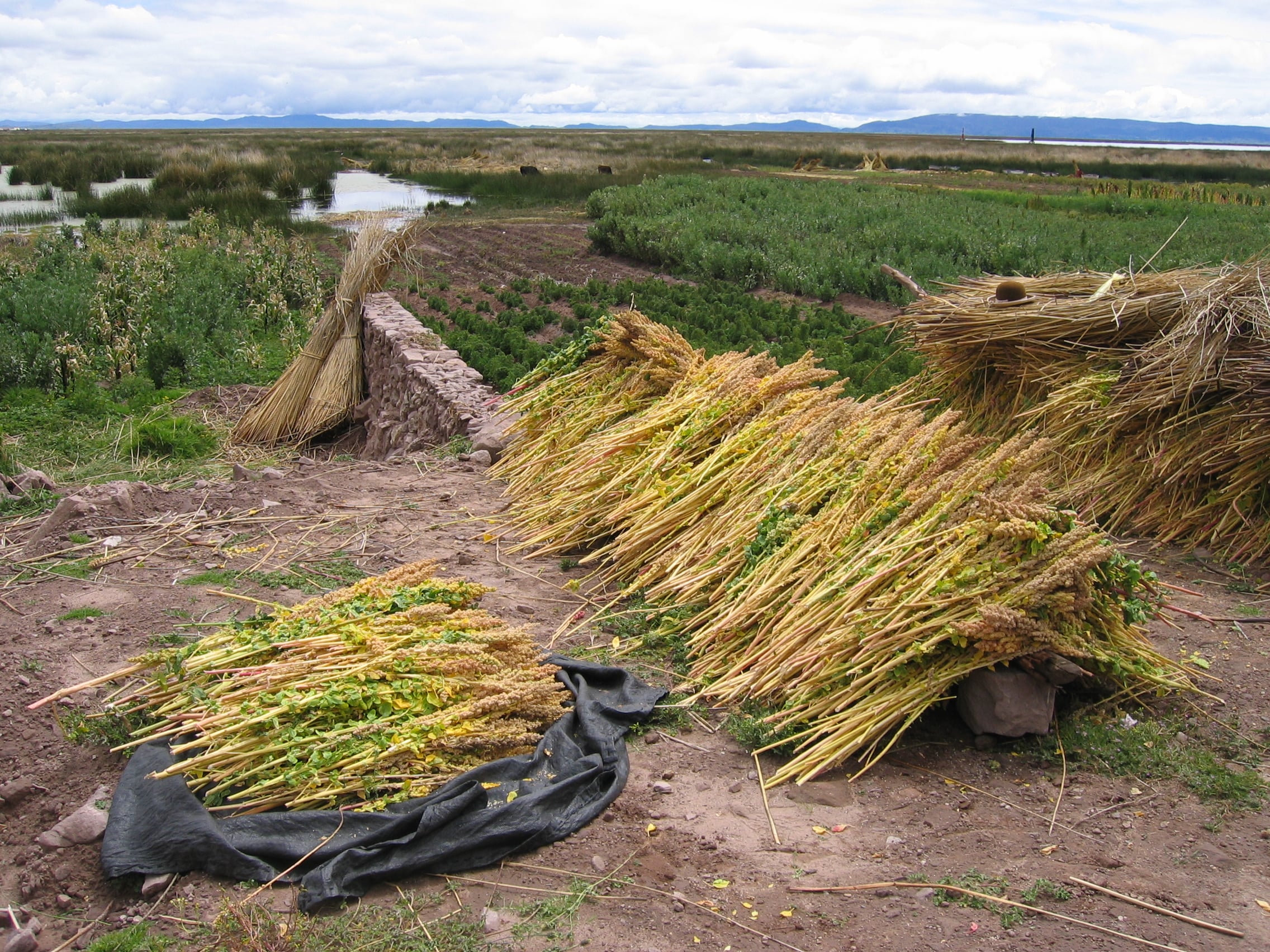
Photo: quinoa drying near Puno, Peru. Michael Hermann / Wikimedia Commons, CC BY-SA 3.0
A 25% rise in the price of quinoa — close to the jump in the purchase price between 2013 and 2014, when international demand spiked — came with a 2.5% to 5% gain in welfare for quinoa-producing households in Peru, in the district-level core specification of a study by economists Marc F. Bellemare, Johanna Fajardo-Gonzalez and Seth R. Gitter. Their paper, “Foods and fads: The welfare impacts of rising quinoa prices in Peru,” ran in World Development (volume 112, 2018, pages 163–179); the figures cited here appear in the authors’ revision dated 8 February 2018.
The opposite claim, that Western appetite for the grain hurt the people who grow it, has had staying power, and it supplies the hook for the VegOut video below, “Quinoa: The Wellness Industry’s Biggest Lie.” The guilt is better known than the arithmetic behind it.
Where the guilt story started
Quinoa, grown for millennia in the Andean regions of Bolivia, Colombia, Ecuador and Peru, went in less than a decade from a commodity largely unknown outside South America to an upper-class staple in rich countries. US imports rose more than tenfold, from about 5 million pounds a year in 2004 to almost 65 million pounds a year in 2013, and the price tripled; the paper credits those figures to DePillis (2013) and Blythman (2013). A footnote puts the United States as the largest export market for Peruvian quinoa, taking 50% of it, citing Andina (2016).
A January 2013 article in the Guardian, cited by the authors as Blythman (2013), set the terms of the argument: “[T]here is an unpalatable truth to face for those of us with a bag of quinoa in the larder. The appetite of countries such as ours for this grain has pushed up prices to such an extent that poorer people in Peru and Bolivia, for whom it was once a nourishing staple food, can no longer afford to eat it.”
Days later, an article in Toronto’s Globe and Mail, cited as Saunders (2013), made the opposite case. The people of the Andean plateau “are indeed among the poorest in the Americas. But their economy is almost entirely agrarian. They are sellers—farmers or farm workers seeking the highest price and wage. The quinoa price rise is the greatest thing that has happened to them.”
Bellemare, Fajardo-Gonzalez and Gitter dismiss both: “As one might expect from media accounts, neither claim was based in serious empirical analysis.” Arguments over who gains when a regional crop turns into a global commodity are far older than the superfood aisle, as VegOut’s account of the 1621 Dutch nutmeg monopoly in the Banda Islands shows, but the 2013 quinoa exchange ran on assertion. The same instinct, to test a popular food story against the data, also runs through VegOut’s reporting on cooking rice in excess water to cut arsenic and on the emissions figures behind Thanksgiving main courses.
What 11 years of household data showed
Bellemare, then an associate professor of applied economics at the University of Minnesota and the paper’s corresponding author, worked with Fajardo-Gonzalez, then an assistant professor of economics at Universidad EAFIT in Colombia, and Gitter, an associate professor of economics at Towson University. They used 11 years of a large-scale, nationally representative household survey to build pseudo-panels at three levels of Peruvian geography — district, province and department, smallest to largest — and set the value of real household consumption, their proxy for welfare, against the international price of quinoa.
One descriptive figure frames the rest. Quinoa accounts for less than 1% of the average household’s budget share among the roughly 30% of households that consume it at all.
For consumers, the paper reports that a 25% increase in the price of quinoa, “a change that is commensurate to the change in the purchase price of quinoa between 2013 and 2014, when international demand spiked,” was associated with total household consumption among quinoa-consuming households rising by about 1.25% on average. The authors read the district and province results as evidence of positive general equilibrium effects on the average household in those units.
For producers, the core specification at district level puts “the quinoa price elasticity of household welfare” between 0.01 and 0.02. Applied to the 25% price rise, that gives the 2.5% to 5% gain. The number, the authors write, “is in line with the increase in quinoa revenues from 1.5% to 4% of total household consumption” recorded in their own table. The introduction gives a narrower version of the same district-level result: a 3.5% to 4% increase in consumption for quinoa-producing households.
The limits sit in the paper. At province and department level, the producer results are not statistically significant, and the point estimate turns negative in two specifications controlling for year fixed effects, one provincial and one departmental. The abstract describes the largest regions as showing small declines of less than 1% of total household consumption. On the consumer side, the authors put the negative departmental effects at a 1% decrease in total consumption at most, and that when prices double.
Why the size of the geographic unit changes the answer
The pattern across the three levels has a simple count behind it. Among departments that produce any quinoa, an average of 6% of households were producers. The figure is 16% for provinces and 29% for districts. Larger units fold in provinces and districts that grow no quinoa, which thins out any effect the price has on the households that sell the crop.
The authors’ own summary covers the full range: “at worst (i.e., at the departmental level), welfare decreased in an imperceptible way for those households that are producers of quinoa in response to rising quinoa prices; at best (i.e., at the district and provincial levels), it increased very slightly for those same households.” Either way, they write, “our results suggest that the quinoa price spike did not have the dramatic negative consequences that the ‘hot takes’ of some media commentators have assumed.”
Two boundaries hold. The study is about Peru: the introduction names Bolivia, Colombia and Ecuador as places quinoa has long been grown, but the welfare estimates rest on Peruvian survey data and say nothing about households elsewhere in the Andes. And the result is not isolated. The only other economic study of rising quinoa prices the authors identify, by Stevens (2015), found that cultural preference for quinoa in certain areas of Peru has not led to a worsening of nutritional outcomes.
The abstract states the conclusion plainly. Commentators suggested that rising international demand, “which tripled prices, might have substantially harmed Peruvian quinoa consumers.” The authors’ response: “Our analysis suggests these fears are unwarranted.” Their findings “that the international trade of quinoa has not been harmful to household welfare in Peru thus run counter to some of the myths surrounding quinoa.”
This piece was reported and source-checked by the VegOut editorial team on 15 November 2026.