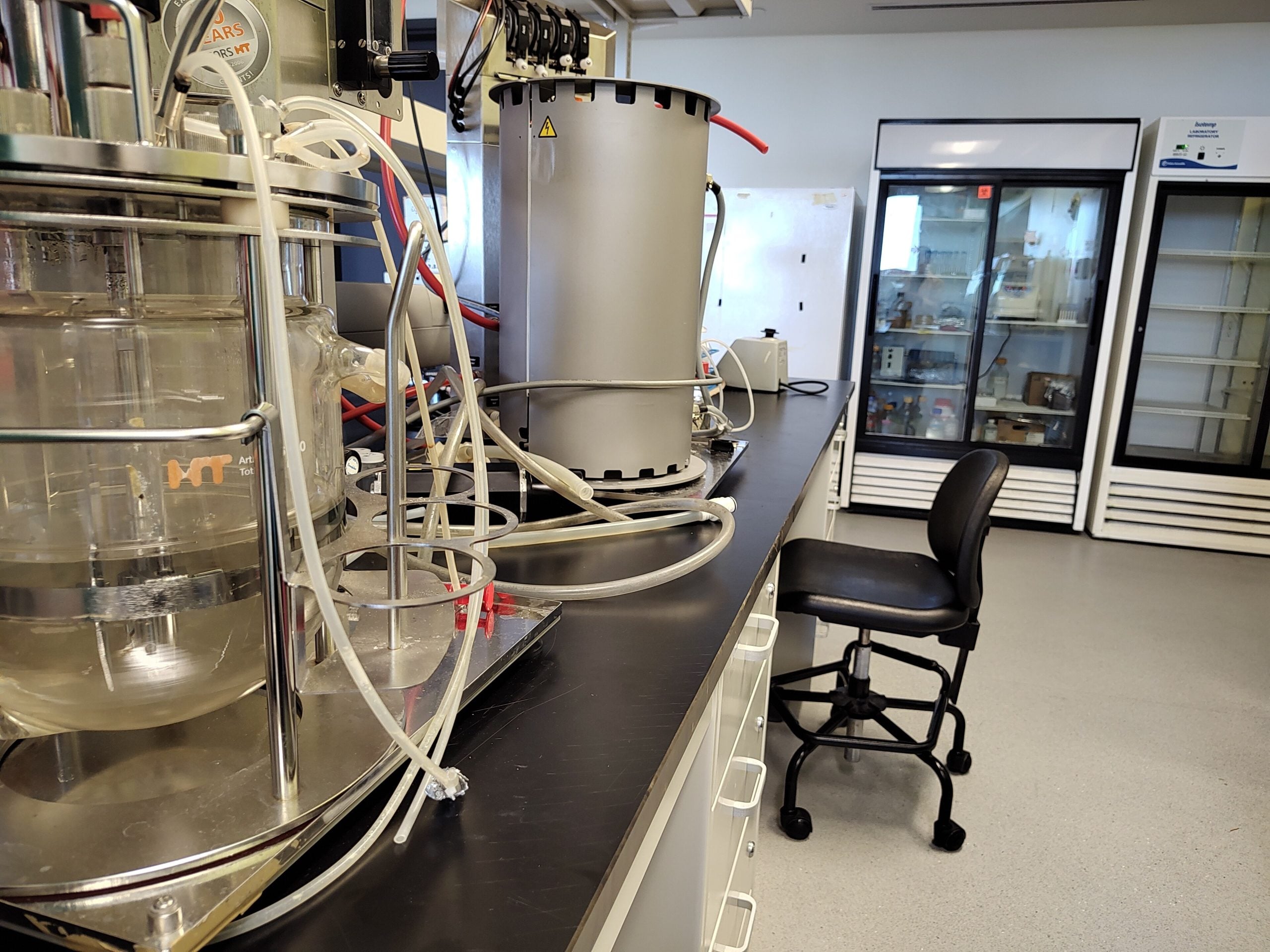
Photo: a laboratory bioreactor (generic; not Perfect Day). Luis Fernando Flores LAB / Wikimedia Commons, CC BY-SA 4.0
Whey protein made without a cow starts in a fermentation tank, where a microbe does the work a mammary gland normally does. For Perfect Day, that microbe is Trichoderma reesei, a fungus carrying a gene for beta-lactoglobulin, a whey protein found in cow's milk. The company's filing describes the finished ingredient as a white to cream colored powder in which beta-lactoglobulin makes up more than 90 percent of total protein.
Precision fermentation is the general name for the approach: an engineered microbe is grown in a tank, it makes one specific protein, and that protein is separated out and dried. Perfect Day's ingredient went through the Food and Drug Administration's voluntary notification program for substances generally recognized as safe, filed as GRAS Notice No. GRN 000863. The agency's response, dated 25 March 2020, turned on one phrase: "we have no questions at this time." The live FDA media URL for that letter returned 404 on 15 November 2026; the wording here was checked against the 25 December 2020 archived copy of the same file.
How a fungus is set up to make a cow protein
The production organism is a strain called QM6a-PD1, built from the T. reesei strain QM6a. Perfect Day made it, the notice says, by targeted integration of an expression cassette "carrying a gene codon-optimized for expression in T. reesei that encodes beta-lactoglobulin identical to [beta]-lactoglobulin from domestic cow (Bos taurus)." In plainer terms, the fungus is handed the instructions for a cow protein, written in a dialect its own cellular machinery can read. Mass spectrometry confirmed that the amino acid sequence matched.
Manufacturing runs as submerged fermentation of a pure culture under controlled conditions. The fungus secretes the protein into the fermentation media rather than holding it inside its cells, which simplifies what comes next. Biomass is separated by centrifugation, the pH is adjusted to concentrate the protein, an optional filtration step can follow, and the liquid is concentrated by ultrafiltration and diafiltration before being spray-dried into powder.
The video above covers the same fermentation route. What the regulatory file adds is the chemistry at the end of it. Perfect Day's conclusion, as summarized by the agency, is that "protein characterization data show that the sequence of [beta]-lactoglobulin produced by fermentation is identical to commercially available bovine produced beta-lactoglobulin."
What the FDA letter says, and what it does not
The GRAS notification program is not an approval queue. A company reaches its own conclusion that an ingredient is safe for a stated use, assembles the evidence, and tells the agency. The FDA reviews the submission and replies by letter, either with questions or without them. The wording of that reply is the point: a "no questions" response is narrower than an approval, and it covers only the use the company described.
Perfect Day's notice reached the agency on 20 May 2019 and was filed on 28 June 2019, followed by amendments on 3 July, 14 August, 10 September and 30 December 2019, and on 28 January 2020. The intended use set out in it is as a source of protein in food at levels up to 35 percent. The company stated that the ingredient is not intended for infant formula or for products regulated by the US Department of Agriculture.
The reply, signed by Susan Carlson, director of the Division of Food Ingredients in the Office of Food Additive Safety at the Center for Food Safety and Applied Nutrition, reads: "Based on the information that Perfect Day provided, as well as other information available to FDA, we have no questions at this time regarding Perfect Day's conclusion that [beta]-lactoglobulin is GRAS under its intended conditions of use. This letter is not an affirmation that [beta]-lactoglobulin is GRAS under 21 CFR 170.35."
The second sentence sets the limit. The letter is not an approval, and not a formal affirmation of GRAS status under the regulation it cites. It records that the agency read the dossier and raised no objection to the company's own safety conclusion for the use described. Perfect Day's published FAQ puts the outcome in its own words, saying the protein "has been confirmed as Generally Recognized as Safe (GRAS), and has received a 'no-objections' letter from the United States Food and Drug Administration (FDA)."
Milk allergen labeling and what followed
Because the molecule is a milk protein, allergen rules follow it out of the tank. The notice states that "beta-lactoglobulin produced by fermentation requires labeling under the FD&C Act because it contains protein derived from milk," and Perfect Day told the agency the ingredient will produce a milk protein allergy when consumed by individuals with milk allergies. People who avoid dairy because of an allergy are not the audience for it, whatever the production route.
On ingredient panels, the company says products made with it "are required to list our animal-free protein on their ingredient labels as 'non-animal whey protein'" — wording that is one reason the category keeps prompting the question of what vegan whey protein actually is. The protein sequence matches the dairy version; the route to it does not pass through a cow.
Perfect Day's FAQ places the first commercial use before the FDA letter, saying: "We launched the first animal-free ice cream made with Perfect Day in 2019." Partner brands have since used the protein in foods and drinks. Which of those sit on a shelf in any given month is a matter for each brand, and the GRAS notice speaks only to the ingredient and the conditions of use described in it: a protein source at up to 35 percent, outside infant formula and outside USDA-regulated foods. For plant proteins more broadly, VegOut also keeps a list of high-protein vegan foods.
This piece was reported and source-checked by the VegOut editorial team on 15 November 2026.