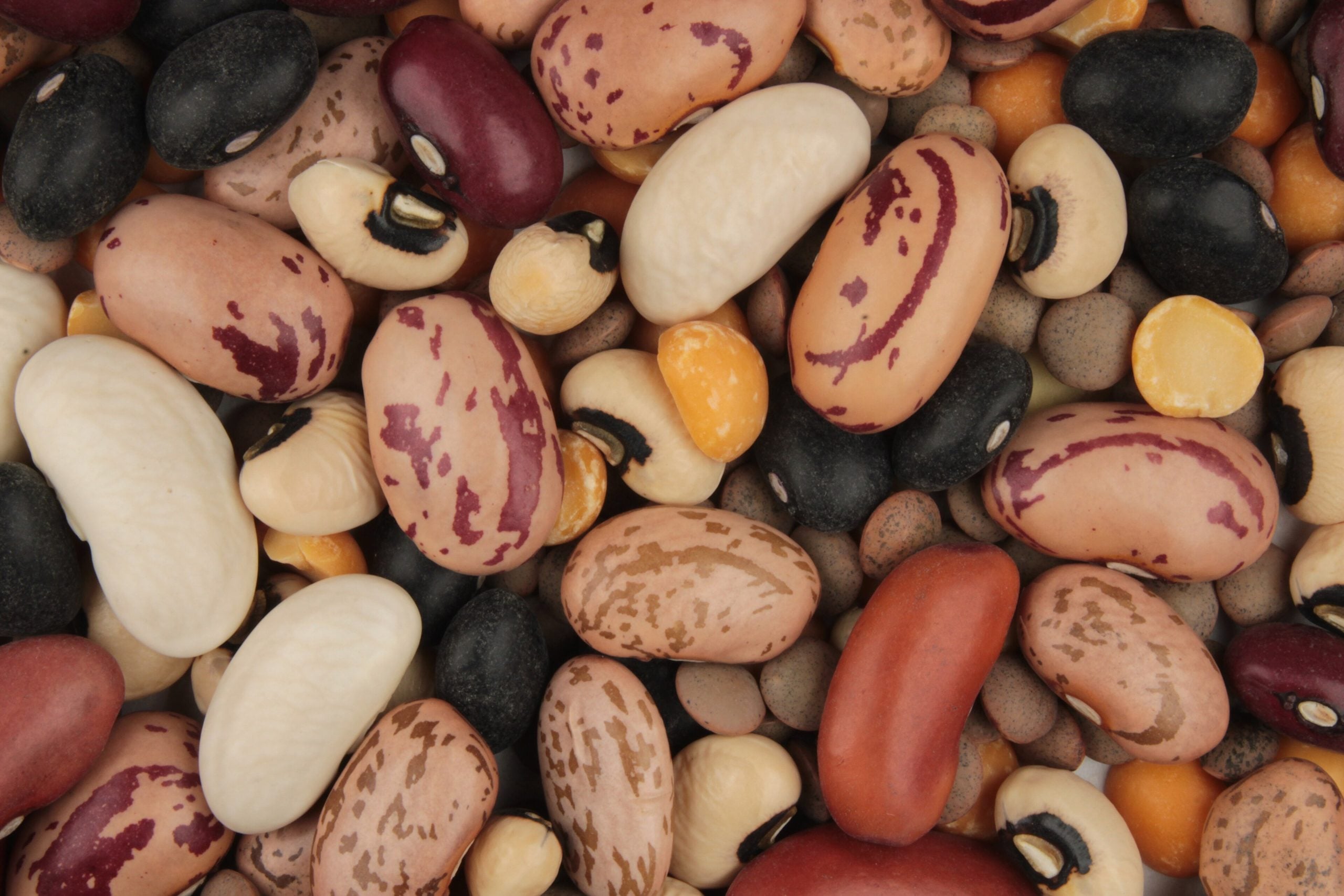
Photo: mixed beans, peas and lentils, as fibre-rich foods. Bean appreciator / Wikimedia Commons, CC0
Denis Burkitt's paper "Epidemiology of cancer of the colon and rectum" appeared in the journal Cancer in July 1971 and drew on his observations in Uganda. The figure that now anchors advice on dietary fibre arrived almost half a century later, in a series of systematic reviews and meta-analyses published in The Lancet in 2019: risk reduction across a range of critical outcomes was greatest at 25 to 29 grams a day.
The hypothesis was never Burkitt's alone. Andrew Reynolds and his co-authors open the 2019 paper this way: "It is more than half a century since Burkitt, Trowell and Painter, based largely on epidemiological observations in Africa, suggested that processing of cereal based foods (grains) with removal of what came to be called dietary fibre, rather than excessive intakes of sugar, were key determinants of both cardiometabolic and large bowel diseases."
What the 1971 paper supports, and what came after
Burkitt's article is the citation people reach for when they describe the fibre hypothesis. The published record supports the plain details: the title, the journal, the July 1971 issue and the observations in Uganda behind it. The VegOut video above takes up that section of the story. The quantities below come from the papers themselves.
The argument has been examined since. A 2019 review in The Lancet Gastroenterology & Hepatology, "Burkitt's hypothesis revisited", returned to it by name. The work that produced a number was commissioned by the World Health Organization to inform updated recommendations on carbohydrate intake. Its stated aims included establishing "an evidence base for quantitative recommendations for intakes of dietary fibre" — a target, rather than general encouragement to eat more plants.
Where 25 to 29 grams comes from
Andrew Reynolds, Jim Mann, John Cummings, Nicola Winter, Evelyn Mete and Lisa Te Morenga pooled 135 million person-years of data from prospective studies and 58 clinical trials with a total of 4,635 adult participants. Their summary is specific: "Risk reduction associated with a range of critical outcomes was greatest when daily intake of dietary fibre was between 25-29 grams. Dose response curves suggested that higher intakes may confer even greater benefit".
The comparison behind that range is a banded one. Measured against the lowest fibre consumers, people eating 25 to 29 grams a day showed an improvement in six of the seven critical outcomes the team tracked. At 20 to 24 grams the improvement covered four of seven; at 15 to 19 grams, three of seven. In the observational data, higher total fibre intakes were associated with a 15 to 31 per cent reduction in the risk of the specified critical outcomes. For all-cause mortality and coronary heart disease incidence, the authors translate that into 13 fewer deaths (95% CI 8 to 18) and six fewer cases of coronary heart disease (95% CI 4 to 7) per 1,000 participants over the duration of the studies. Quality of evidence for the cohort meta-analyses was graded moderate, apart from the stroke data.
In the peer-reviewed manuscript held by the University of Dundee, the authors write that individual adult intakes of total dietary fibre "should be no less than 25 to 29 grams per day with additional benefits likely to accrue with higher intakes." The range is a floor with a slope above it rather than a ceiling. Dose-response relationships for total fibre and total mortality, coronary heart disease, type 2 diabetes and colorectal cancer were, in the authors' words, "many of which are linear with no sign of a plateau within the available data".
The gap between the number and the plate
The practical problem is distance. Reynolds and colleagues write that population intakes in the 25-to-29-gram range are reported in some countries, but that the majority consume less than 20 grams a day. Moving from one band to the other is a question of what the bulk of the day's food is made of, not of a single ingredient.
The reviews give one clue about where the fibre in those cohorts came from. Broadly similar trends appeared in the prospective studies that examined cereal fibre, which the authors describe as typically the largest contributor to total dietary fibre. Results for wholegrain foods reflected those for fibre overall, and the team suggests the protective effect of whole grains may be due to their fibre content. Data on legume, fruit and vegetable sources, and on "soluble", "insoluble" or extracted subcategories, were limited, so total fibre and whole grains carry the weight of the evidence while finer distinctions between sources remain thinly studied.
On the food side, the authors point to the direction most national guidance already takes: nutrition guidelines issued by many governments and professional organisations encourage increased consumption of vegetables, fruit and whole grains, and the paper's closing recommendation is to raise fibre intake and replace refined grains with whole grains. For plant-based eaters that means intact grains, pulses, vegetables and fruit as the base of the day. Those same pulses and grains turn up on VegOut's list of high-protein vegan foods, which makes the two shopping lists largely one list.
None of this describes a treatment. The 2019 reviews report reductions in risk across populations, with the certainty of evidence for dietary fibre graded moderate, and the authors stop at a quantitative intake figure. What connects the 1971 paper to that figure is method: a hypothesis built from epidemiological observation in Uganda and elsewhere in Africa, then tested decades later against pooled cohorts and trials whose combined results, the authors write, "indicate that the relationships may be causal". VegOut has also covered another nutrition-science history of that kind in its account of how nixtamalisation and niacin research addressed pellagra in the United States.
This piece was reported and source-checked by the VegOut editorial team on 15 November 2026.