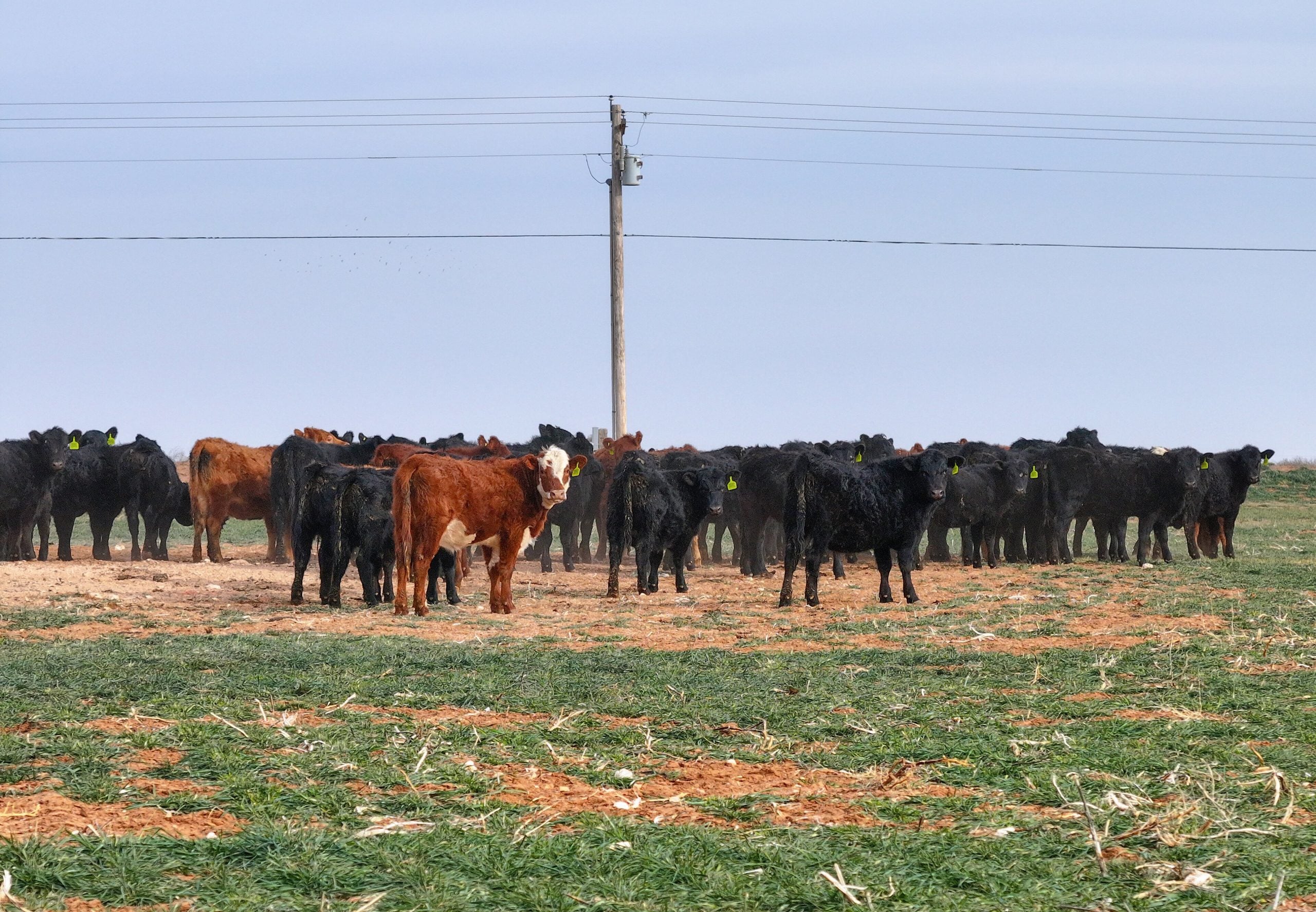
Photo: cattle grazing on pasture in eastern New Mexico, photographed on 28 January 2025. Quintin Soloviev / Wikimedia Commons, CC0
Beef carries a global average water footprint of 15,400 litres per kilogram, and 94 per cent of that total is green water, meaning rainwater taken up and evaporated by the grass, fodder and feed crops cattle eat. The figure comes from the Water Footprint Network, which describes the beef footprint as "predominantly green water (94%)".
The rounded 15,400 comes from a more exact number. The study behind it, by Mesfin Mekonnen and Arjen Hoekstra and published in Ecosystems in 2012, puts the weighted global average for beef at 15,415 cubic metres per tonne, which is the same as 15,415 litres per kilogram. That splits into 14,414 litres green, 550 blue and 451 grey, or 94 per cent, 4 per cent and 3 per cent after rounding.
For readers who think in gallons, the arithmetic is simple: 15,400 divided by 3.785411784 gives about 4,068 US gallons per kilogram, and the exact 15,415 litres gives about 4,072 gallons. That total is the number behind the short below, "The Real Cost of One Burger, In Water".
Green, blue and grey count different things
The three colours are not interchangeable, and mixing them up is what makes the 15,400 figure easy to misread. Green water is rainwater held in the soil and taken up by plants as they grow, then lost to the air as they transpire. Mekonnen and Hoekstra put it in one line: "The green water footprint refers to the rainwater consumed." For beef, almost all of it is rain used by the grass, fodder and crop residues that make up most of cattle feed.
Blue water is surface water and groundwater: irrigation drawn from rivers, lakes and aquifers, plus the water animals drink and the water used to clean and service farm buildings. Grey water is not water used at all but a pollution measure, defined as the volume of freshwater required to assimilate the pollutant load from production.
Blue water is the category most household water advice deals with, from the metered supply to the mains water at a kitchen tap, including the method of cooking rice in excess water to cut arsenic. The beef number is a different kind of accounting. The 15,400 litres are not litres of tap or drinking water: drinking and service water together account for 1 per cent of the total.
Feed accounts for 99 per cent of the total
The Water Footprint Network attributes 99 per cent of beef's total water footprint to animal feed. Drinking and service water make up that remaining 1 per cent of the total, but 30 per cent of the blue water footprint, because the blue share of the whole is small to begin with: 550 litres of the 15,415.
The balance follows from what cattle eat. Concentrates, the processed cereal and oilseed part of a ration, make up only 5 per cent of beef cattle feed as a global average, Mekonnen and Hoekstra found, and the rest is roughage: grass, fodder crops and crop residues. For broiler chickens the concentrate fraction is 73 per cent. Concentrates carry a larger water footprint than roughages, the Water Footprint Network says.
So a beef animal's number is large mostly because a cow eats a great deal of plant matter over a long life, and most of that plant matter grows on rain. Of the water footprint of a beef cow, 83 per cent is attributed to the beef itself, the Network says, with smaller fractions going to offal, leather and semen.
Beef sits well above other meats in the same dataset. The global averages given alongside it are 10,400 litres per kilogram for sheep meat, 6,000 for pig, 5,500 for goat and 4,300 for chicken.
The production system changes the mix, not just the size
One piece of beef can be very different from another. The Water Footprint Network says the precise footprint depends on whether the beef comes from a grazing, mixed or industrial system, on the composition of the feed, and on where that feed was grown. Industrial systems convert feed more efficiently, so their beef generally has a lower total footprint. They also feed a larger share of concentrates, so, in the Network's words, "industrial beef has generally larger blue and grey water footprints than beef from mixed or grazing systems".
Freshwater problems, the Network says, mostly relate to blue water scarcity and water pollution, and to a lesser extent to competition over green water. On that basis it concludes that "grazing systems are preferable over industrial production systems from a water resources point of view". The judgement is specifically about water resources rather than a general verdict on grazing.
The same dataset allows comparisons by nutrient rather than by weight. Per calorie, the average water footprint of beef is twenty times that of cereals and starchy roots. Per gram of protein it is six times that of pulses, the comparison worth holding next to the adult protein reference intake of 0.8 g per kilogram of body weight, since protein is the nutrient most often cited in defence of meat.
The production figure sets the scale. Mekonnen and Hoekstra put the global water footprint of beef production at about 800 billion cubic metres a year over 1996 to 2005, one third of the total water footprint of all farm animal production.