Guests expecting to be the only vegan at the Thanksgiving table should tell the host early and offer to bring a dish or two, Mary Brewer, MSN, MBA, RDS, RN, VLCE, wrote in a post for Main Street Vegan published on 12 November 2024. Brewer has worked as a registered dietitian for 42 years and a registered nurse for 16, and has been vegan for more than four decades.
Thanksgiving in the United States falls on 26 November 2026. Published guidance from Brewer, from PETA and from Cadry Nelson of Cadry's Kitchen converges on the same two steps before the day: a conversation with the host about the menu, and a dish picked for sharing rather than for difficulty.
Tell the host, then ask what they are making
Brewer's section is headed "Let the Host Know You Are Vegan and Offer to Bring a Dish or Two." On what that dish should be, she wrote: "This ensures you have something to eat and showcases vegan foods. Make sure these are dishes you've successfully made in the past. Now is not the time to try a dish that takes four hours prep time and calls for 40 different spices. Remember to bring a few copies of the recipe, as people will surely have questions."
She also wrote: "Ask the hosts what they're making so you don't step on their toes." Her remaining points cover the hours after the food is on the table: do not panic, focus on the social element, be prepared for the usual questions, keep answers informative but light, and do not be pulled into arguments.
PETA's Friendsgiving guide makes the coordination point from the host's side. It tells hosts to decide first whether the meal is a sit-down dinner, a buffet or a potluck, to set up a shared sign-up sheet so guests can avoid duplicate dishes, and to ask guests about food allergies. Guests, it says, should check with the host about that sign-up sheet to avoid duplicating dishes.
What to carry through the door
PETA tells guests to bring something easy to share and naturally vegan, listing hummus and vegetable platters, roasted sweet potatoes, cornbread and a fruit crumble, and to label the contribution with its ingredients so that everyone, especially guests with allergies, can eat with confidence.
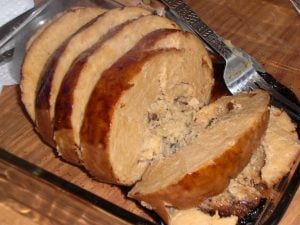
For a centerpiece, the guide names Gardein's Plant-Based Turk'y Roast, Field Roast's Celebration Roast and Tofurky's Plant-Based Roast; VegOut keeps a separate guide to vegan roasts. The rest of PETA's suggested menu runs to chickenless pot pie, stuffing, garlicky mashed potatoes, green bean casserole, mac n' 'cheese', cornbread and pumpkin pie. For allergies, it names Ian's Gluten-Free Homestyle Stuffing and Wholly Wholesome Gluten-Free Organic Pie Shells as both vegan and wheat-free, and suggests oat, rice or flax milk in place of soy milk, with olive oil or a soy-free vegan butter in dishes such as mashed potatoes.
Nelson, in a post titled "12 tips for surviving your first vegan Thanksgiving", wrote that a guest can bring a main course, such as a vegetable pot pie or a vegan turkey roast, or skip the entree and build a plate from sides. She advised against cooking for the whole room: "It feels much better to go home with an empty bowl than it does to spend a lot of time and money cooking, only to find yourself eating your dishes again and again and again in the days following Thanksgiving." She also made the case for a shorter menu, writing, "It's okay to just have three different things on a plate," and named her own three as mashed potatoes and gravy; a pot pie, seitan dish or turkeyless roast; and roasted cauliflower or Brussels sprouts.
On dessert, Nelson wrote that a bought pie does the job: a pre-made vegan pie or a pre-cut slice from a local co-op or natural grocery store. She added that stores such as Walmart or Target carry "accidentally vegan" pies, among them many of Marie Callender's fruit pies, with the ingredients checked and the pumpkin version skipped because it is not vegan.
Sharing a table with the non-vegan version
Nelson devotes one tip to avoiding a direct comparison. One year she took mushroom gravy to a non-vegan potluck where a meat-filled gravy sat beside it. "Let's just say that it's disheartening to make gravy for 20, only to drive back home with gravy for 19," she wrote. The next year she agreed with the host that she would make all the gravy for the day, in two kinds, both vegan; by the end of the night every drop was gone.
Dishes that pass without comment, she wrote, include mashed potatoes, stuffing, cranberry sauce, a simple salad and roasted vegetables. In her experience, guests are also less hesitant about store-bought items brought in their original containers or takeout packaging, which, she added, take no time at all to prepare.
Swaps by other cooks can cut the workload. Nelson wrote that her mother replaces the animal-based butter and milk in her mashed potatoes with vegan butter and plain cashew milk, and that her sister-in-law leaves the dairy-based cheese off a fall salad with apples and candied pecans, or serves it separately. Guests may not feel comfortable raising such requests with a host they do not know well, she wrote, but family or close friends may not mind at all.
Jokes at the vegan guest's expense appear in her account too, along with the line that "people run out of jokes as the years go on," and the advice that a guest who is pushed too far should step away, to the dishes, a game with the children or a round of water. VegOut has previously covered the situations familiar to the only vegan or vegetarian in a family.
Both Nelson and PETA point to a second gathering as a way around the problem of one plate at one table: a Friendsgiving in the days before the holiday, on whatever date suits the group. Nelson also suggests visiting an animal sanctuary, adopting a turkey from Farm Sanctuary, or sponsoring an animal at Iowa Farm Sanctuary. For hosts running a potluck, PETA's logistics are to assign categories rather than specific dishes, ask guests to bring serving utensils, ask anyone whose food needs warming to arrive 15 to 30 minutes early, keep a few backup dishes ready, and set up a self-serve drink station.