What people splurge on when no budget exists says more about human nature than money—and vacations are where it gets the weirdest.
Vacations are supposed to be a time to relax, recharge, and experience something new.
But if you’ve ever crossed paths with wealthy travelers while abroad, you’ve probably noticed that they approach vacations very differently. What feels natural to them can look downright strange to everyone else.
Here are eight things the rich do on vacation that leave middle-class travelers scratching their heads.
1. They bring staff with them
Imagine heading to Italy with your family and bumping into someone who flew in with their personal chef and nanny. It happens more often than you think.
For the wealthy, vacation doesn’t mean “fending for yourself.” It means bringing the comforts of home wherever you go. Having staff ensures their routines don’t break down—meals are tailored, schedules stay organized, and kids are cared for.
I once saw this firsthand in Bali. While I was figuring out street food stalls and juggling luggage between taxis, another family arrived with three assistants in tow. One unpacked their clothes, another coordinated dinner with the chef, and a third kept the kids occupied with games. The parents simply sipped cocktails.
Middle-class travelers, on the other hand, are more likely to celebrate vacation by eating at local restaurants, improvising meals, or trading babysitting shifts. To them, part of the adventure is doing things differently.
2. They spend more time working than relaxing
Ever noticed someone on the beach surrounded by laptops, assistants, and phone calls? That’s not a travel cliché—it’s real.
Many wealthy people blur the line between work and vacation. The mindset is: why stop earning just because you’re in Bali? They’ll take conference calls from yachts, edit contracts before breakfast, and check in with their teams while everyone else is lining up for scuba lessons.
This looks bizarre from the outside, but it makes sense when you remember that for many wealthy individuals, their work is their passion. As Mihaly Csikszentmihalyi explained in his research on “flow,” high achievers often find joy in work itself. Switching off feels less satisfying than weaving work into a new setting.
When I traveled through Morocco, I shared a riad with a businessman who spent most of his day in meetings. I asked why he didn’t just take a break, and he laughed: “This is my break. I’d be more stressed doing nothing.” That’s a perspective most middle-class travelers find baffling.
3. They prioritize privacy over sightseeing
Most of us book vacations to see and do as much as possible. We want to tick off landmarks, squeeze in excursions, and fill our camera rolls.
Wealthy travelers? They’ll often pay to avoid the crowds entirely. Renting a private island, blocking off a section of a resort, or booking exclusive tours is more common than joining the tourist line.
In Greece a few years ago, I remember a small beach being closed off because a wealthy family had rented it for the day. Locals shrugged, but other tourists were furious. To the family, though, it was normal—they valued seclusion over sights.
And it’s not just about being antisocial. Privacy brings safety, control, and peace. When your daily life involves constant exposure or pressure, anonymity on vacation can feel more restorative than any postcard view.
4. They spend fortunes on convenience
Ever paid $50 for an airport shuttle and felt guilty? Rich travelers won’t hesitate to spend thousands for time-saving perks.
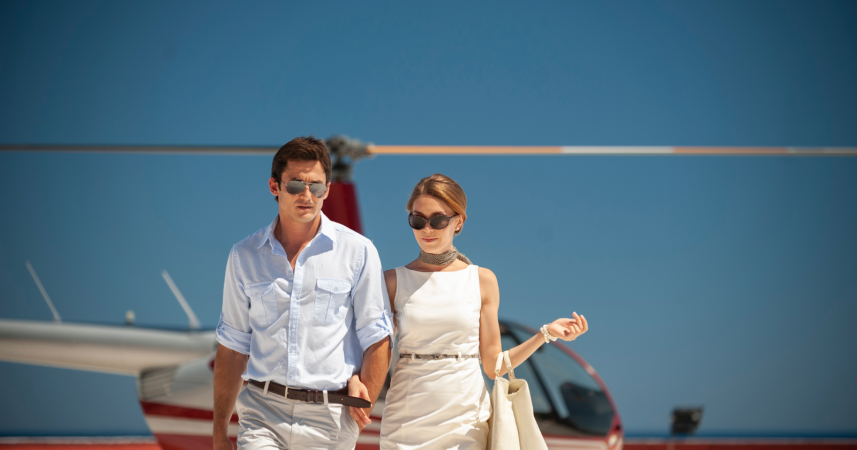
Private jets, helicopter transfers, personal drivers—the point isn’t luxury for its own sake, it’s efficiency. They want to maximize every hour of the trip without waiting in lines or dealing with delays.
I saw this play out in Patagonia. While most of us spent ten hours on winding buses to get between towns, a wealthy group hopped in a chartered plane and arrived in under an hour. They didn’t just save time—they avoided stress and discomfort.
As travel author Alain de Botton once noted, “The great luxury of travel is not so much the exotic location but the freedom from inconvenience.” For wealthy travelers, buying convenience is second nature. For everyone else, it looks over-the-top.
5. They repeat the same destination every year
Most of us try to see as many places as possible. Rich people? They’re surprisingly loyal to a single spot.
Families with money often return to the same villa, island, or resort every summer. They’ll even leave belongings there year-round. It’s about creating tradition, familiarity, and comfort.
From the outside, it seems odd—why not explore? But when you can afford to travel anytime, the thrill of novelty isn’t as strong. Vacations become about stability instead of adventure.
Psychologists say this ties into something called “decision fatigue.” When you have endless choices, sticking to one reliable option can feel more freeing than chasing variety. For middle-class travelers, that repetition can look like a waste of opportunity.
6. They vacation with other rich families
Here’s another quirk: the wealthy often vacation in groups with people of similar means.
I once stayed at a resort in Mexico where two families flew in separately but acted like they were one big household. Their kids had known each other since preschool, and their vacations were basically networking disguised as leisure.
For the middle class, vacation is usually about family bonding. For the rich, it doubles as a chance to strengthen alliances, build business ties, or maintain social circles.
Sociologist Shamus Khan, in Privilege: The Making of an Adolescent Elite at St. Paul’s School, argues that elite groups tend to form “closed worlds”—networks of people who share similar backgrounds, wealth, and opportunities. These networks help perpetuate influence and advantage.
7. They rent experiences instead of things
Want to know the difference between buying souvenirs and renting a Formula 1 racetrack for the afternoon? It’s the gap between middle-class and wealthy vacation spending.
Rich people often pay for experiences most of us don’t even realize are options. Things like private museum tours after hours, swimming with marine biologists, or commissioning a one-day art class from a famous painter.
This isn’t just about showing off. Studies in consumer psychology—like the work of Thomas Gilovich at Cornell—show that experiential purchases (vacations, concerts, unique activities) tend to bring more lasting happiness than material purchases.
I met a woman in Tokyo who had booked a private sushi-making session with one of the city’s top chefs. She wasn’t interested in souvenirs—her goal was to come home with a story no one else could match. For her, the memory was the ultimate luxury.
8. They treat wellness like the main event
While most people squeeze in a spa day, wealthy travelers often build entire vacations around wellness.
Think detox retreats, silent meditation resorts, or week-long fitness boot camps with celebrity trainers. It’s not just pampering—it’s optimization. For them, vacation is a time to “upgrade” mind and body.
In Thailand, I once met a couple who had flown in for a three-week Ayurvedic program. They weren’t interested in temples or nightlife. Their trip was structured around healing, routines, and therapies. For middle-class travelers nearby, it looked like a strange way to “relax.”
Wellness tourism is actually one of the fastest-growing parts of the travel industry. The Global Wellness Institute reports that global wellness tourism spending grew from about US$651 billion in 2022 to US$868 billion in 2023, and is expected to hit around US$1 trillion in 2024.
Final thoughts
What seems “weird” about rich people on vacation often boils down to priorities. They value privacy over crowds, efficiency over thrift, and tradition over novelty.
And while it can look bizarre from the outside, it’s not about being eccentric—it’s about having the freedom to design vacations without the usual limits.
So the real question is: if you had that kind of freedom, would you find yourself doing the same things? Or would you stick to the middle-class version of travel—messy, crowded, but maybe more fun?
What’s Your Plant-Powered Archetype?
Ever wonder what your everyday habits say about your deeper purpose—and how they ripple out to impact the planet?
This 90-second quiz reveals the plant-powered role you’re here to play, and the tiny shift that makes it even more powerful.
12 fun questions. Instant results. Surprisingly accurate.