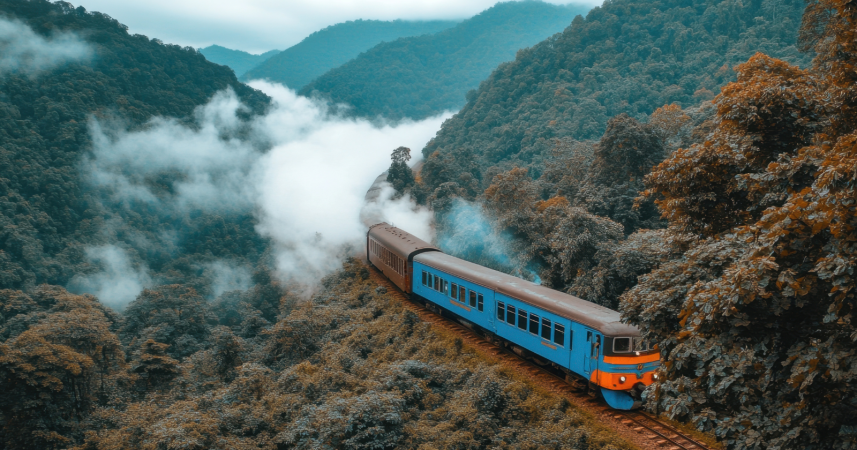
There’s a quote I love from Mark Twain: “Travel is fatal to prejudice, bigotry, and narrow-mindedness.” Trains do that in a specific way—slowly, side-by-side, with time to rethink your assumptions.
There’s a reason our parents and their friends light up when they talk about trains.
They’re slower than planes, but richer than most flights could ever be.
You get time, texture, and the kind of big-window perspective that rewires how you think about place.
I used to shrug off rail as nostalgia.
Then I rode a few of these routes, camera in my lap, vegan snacks in my bag, and a stack of behavioral-science notes in my head about how context shapes memory.
Trains change your context in the best way—no constant phone service, no car to steer, just long stretches of scenery and strangers who often end up feeling like temporary neighbors.
As the travel writer Paul Theroux put it, “I have seldom heard a train go by and not wished I was on it.”
Boomers have been right about this all along.
Let’s ride.
1) The Canadian
Toronto to Vancouver, days of prairie light and nights of sleeping to the hush of steel on steel.
This is the long-form album version of travel.
It’s not about rushing; it’s about learning how big a country can feel when you cross it at human speed.
I brought a simple meal strategy—mix of packed staples (hummus, crackers, fruit, roasted chickpeas) plus whatever plant-based options the dining car could muster.
Between meals, you wander the dome car, talk to retirees tracing old honeymoon routes, and listen to the landscape pivot from lakes to wheat to mountains.
Two things happen to your brain on a trip like this.
First, you get what psychologists call “attention restoration”—scenery that doesn’t demand anything from you but still engages your eyes.
Second, you build a clean narrative in memory: city → farmland → Rockies → Pacific.
Stories stick when they have arcs.
This journey has one of the greats.
2) The Ghan
Adelaide to Darwin, right up the spine of Australia.
The Ghan isn’t subtle; it’s operatic.
Red earth, far horizons, a line through a continent that reminds you how much space most of us never see.
I’ve mentioned this before in a post about decision fatigue: big landscapes shrink your petty worries.
Somewhere north of Alice Springs, I realized how small my inbox really is.
You eat, you chat, you read, you watch the outback slide by in long strokes of rust and gold.
If you’re plant-based, this is where a little pre-trip note to the kitchen pays off—most crews can sort a vegan main if you give them a heads-up.
The boomers who love The Ghan aren’t just nostalgic.
They’re onto something.
When you cross the middle of a country by rail, you feel the geography in your bones.
And once you’ve felt it, your choices back home tend to get simpler.
3) West Highland Line
Glasgow to Mallaig in Scotland, with the Glenfinnan Viaduct and moorland that looks like a watercolor that never quite dries.
This one is short enough to be a day trip but cinematic enough to haunt you for years.
I stood between cars for a lot of it, camera slung, catching the light that breaks open after rain.
You pass lochs that look staged by a set designer and little stations where a single person gets off with a dog and a bag of groceries.
The social psychology of trains shows up here too.
People talk.
Not in a commuter hurry, but in that “we’re both looking at the same hills” way that builds quick trust.
If you ever wanted to test the idea that shared attention creates connection, ride this line on a day with changeable weather and watch strangers narrate the sky to each other.
Pro tip for food: stock a backpack at a Glasgow market before boarding—oatcakes, berries, a tub of bean salad—and you’re set.
Lunch with a view of Ben Nevis hits different.
4) Glacier Express
Zermatt to St. Moritz in Switzerland, all glass and glamour and slow, deliberate speed across 291 bridges.
The name sounds fast.
The reality is better: unhurried luxury that gives the Alps time to show off.
If you want a case study in “peak-end rule” (we judge experiences by their peak moments and their endings), this route is basically a lab.
Peaks: the Oberalp Pass, the Rhine Gorge, the way small villages suddenly appear like toy sets.
Endings: rolling into St. Moritz with that crisp, high-altitude light that makes you think clearer.
I didn’t expect the food to be a highlight here, but it was.
You can request vegan meals in advance, and Switzerland’s pretty dialed on that front.
There’s something quietly radical about a proper plant-based lunch served as mountains flicker by like postcards.
If you’ve got even a passing interest in photography, sit near a window you can keep clean of reflections and pack a lens cloth.
This is the route that turns casual shooters into composition nerds.
5) California Zephyr

Chicago to the Bay.
I’m California-based, so yes, I’m biased, but the Zephyr is the sleeper classic.
You climb the Rockies, drift through desert, cut across the Sierra, and end near water.
It’s a crash course in American topography and a great reminder that the U.S. is too big to understand in one lifetime.
I did this one with a tiny self-assigned “analog block.”
No streaming, no inbox.
Just a notebook and a pen.
The observation car becomes a moving salon: a retired couple chasing national parks, a college kid heading west for a first job, a chef reading a paperback with a cracked spine.
From a vegan logistics standpoint, the café car is your baseline (chips, fruit cups, black coffee), but the real game is packing smart: wraps, nut butter packets, veggies that hold up (snap peas, carrots), and a solid treat for the long, late miles.
I can’t explain why a square of dark chocolate tastes better somewhere in Nevada.
It just does.
What I love most about the Zephyr is how it recalibrates your sense of distance.
Driving compresses time with tasks; flying erases it.
Trains stretch it.
You start making room for the long version of things again.
6) Darjeeling Himalayan Railway
The “toy train” from New Jalpaiguri up to Darjeeling.
Narrow gauge, sharp curves, tea hills that turn the air into something you want to drink.
This is not luxury; this is charm.
And sometimes charm is exactly what you need.
A personal note: I rode just the upper section on a monsoon-threat day, and I’ve never been more grateful for a dry window seat.
Kids waved from doorways; women in bright shawls stood in misty tea gardens.
It felt like the world was letting me eavesdrop on its weekday.
If you’re into the psychology of rituals, watch how tea functions here.
It slows conversation, marks time, and gives you a shared prop.
Order a steaming cup the moment you arrive in town and the whole day eases back two notches.
Foodwise, the street snacks around Darjeeling are wildly veg-friendly—momos with veggie fillings, spiced potatoes, fried chili bites.
If you’re strict about ingredients, ask and double-check, but you’ll be happy.
The reason boomers keep this one on their list: it’s a living piece of history that still serves a community, not just tourists.
You feel that authenticity in your bones.
7) Bergen Line and Flåm Railway
Oslo to Bergen across the roof of Norway, plus the Flåm branch that drops you to a fjord in a 20-kilometer love letter to gravity.
If you’ve ever wondered what “clean design” looks like in landscape form, this is it: icy plateaus, tidy villages, water that mirrors cloud.
I took this one in shoulder season, when the light gets that Scandi silver sheen.
Between Oslo’s urban hum and Bergen’s maritime personality, the middle is all mindset reset.
You start the day in city brain and end with fjord breath.
From a plant-based angle, Norway’s surprisingly easy now.
Pack sandwiches, yes, but the stations and cafés are catching up—look for plant milks, vegetable soups, and rye breads that could double as paperweights.
You’ll be fueled.
Novelty plus awe equals sticky memories.
Awe makes you feel smaller in a good way and nudges you to be more generous and present.
This route delivers awe in measured doses—enough to change your day, maybe your month.
The boomers were right
There’s a quote I love from Mark Twain: “Travel is fatal to prejudice, bigotry, and narrow-mindedness.”
Trains do that in a specific way—slowly, side-by-side, with time to rethink your assumptions.
If you’ve dismissed these routes as old-school, consider this your nudge.
Pick one.
Book a seat.
Let the map unspool at window speed.
You’ll come home different in small, durable ways—more patient, more observant, more generous.
That’s the entire point, isn’t it?
If You Were a Healing Herb, Which Would You Be?
Each herb holds a unique kind of magic — soothing, awakening, grounding, or clarifying.
This 9-question quiz reveals the healing plant that mirrors your energy right now and what it says about your natural rhythm.
✨ Instant results. Deeply insightful.