The invisible economy of favors that runs every hotel lobby.

Add VegOut to your Google News feed. 
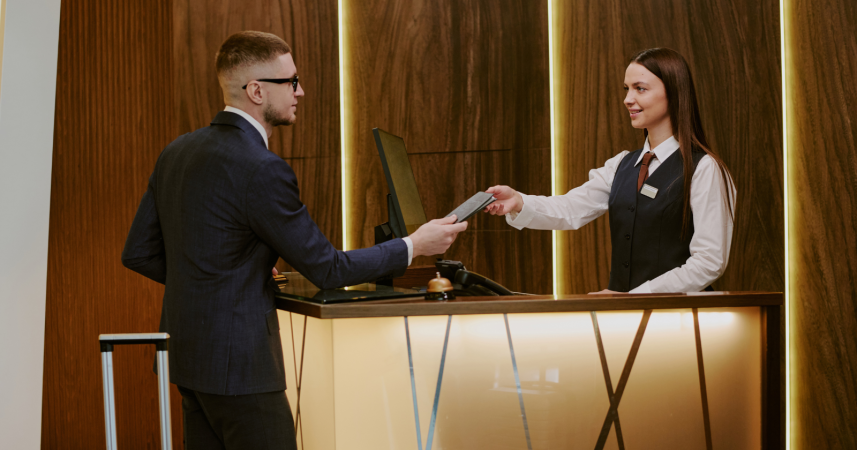
Behind every hotel front desk is a person with more power than you realize. They can't change hotel policy, but they can interpret it creatively. They can't manufacture rooms that don't exist, but they can find ones that aren't supposed to. The difference between a weekend in a broom closet and a suite with a view often comes down to a thirty-second interaction that follows rules nobody talks about.
These aren't tricks or hacks—they're the natural laws of an ecosystem where underpaid humans control temporary luxury. Master them, and doors open. Ignore them, and you'll wonder why everyone else seems luckier than you.
1. The first ten seconds are everything
Your upgrade fate is usually sealed before you've shown your ID. How you approach the desk, whether you're on your phone, if you make eye contact—these microsignals tell the agent everything about how this interaction will go.
Front-desk agents develop instant pattern recognition for guest types. The person who approaches with genuine warmth gets a different mental file than the one already complaining about the airport. That initial energy sets the entire tone. You're auditioning for upgrade consideration from the moment you enter their peripheral vision.
2. Mentioning your loyalty status kills your chances
"I'm a Platinum Elite Diamond member" translates to "I'm entitled to special treatment." The desk agent knows your status—it's on their screen in bold letters. Announcing it suggests you think the normal rules of human interaction don't apply to you.
The agents who can help you most are motivated by discretion, not obligation. When you wave status like a flag, you transform a potential favor into a demanded service. The best upgrades go to people who let their status speak silently while their personality does the talking.
3. Arriving at 3 p.m. on Friday guarantees nothing good
Check-in time isn't random—it's strategically crucial. Peak arrival times mean depleted inventory, stressed staff, and a lobby full of increasingly frustrated people. The agent has already given away their upgrades to the nice couple at noon who brought them coffee.
Early morning and late evening arrivals find different mathematics. The morning agent has full inventory and optimism. The night agent has unexpected cancellations and fewer witnesses. The 3 p.m. agent has neither rooms nor patience.
4. Your problem becomes their problem—or it doesn't
"The website said..." starts an argument. "I'm hoping you can help me with something" starts a collaboration. Frame your needs as puzzles they can solve, not failures they must fix.
Agents psychologically divide guests into problems versus people. Problems get policy; people get creativity. When you position them as the hero who can save your anniversary weekend, they'll move mountains. Position them as the villain who must answer for corporate's sins, and you'll get exactly what you paid for.
5. Cash still talks, but it whispers
The folded twenty is mostly mythology now, but targeted appreciation isn't. A coffee card for the morning shift, authentic gratitude for staying late—these create reciprocal psychology that policies can't override.
Modern appreciation reads as genuine rather than transactional. The guest who brings Starbucks for the whole desk gets remembered. The one waving bills gets security called. It's about creating human connection, not conducting bribery.
6. Your backstory matters more than your reservation
Celebrating something specific beats "just vacation." Anniversaries, birthdays, first trips together—these create narrative weight that agents can use to justify upgrades in their system notes.
Hotels track gesture opportunities religiously. Giving agents a story to support means they can code the upgrade as "guest satisfaction" rather than "I felt like it." The vaguer your purpose, the fewer tools they have to help you.
7. Desperation smells from across the lobby
The more you need that upgrade, the less likely you'll get it. Agents can sense desperation like sharks sense blood, and it triggers their defensive instincts rather than their generous ones.
Outcome independence is magnetically attractive in service interactions. The guest who seems genuinely fine with any room often gets the best room. The one who's clearly planning to complain their way up gets exactly what's guaranteed, nothing more.
8. Loyalty builds over stays, not years
The guest who stays monthly gets different treatment than the one who stayed once in 2019. Recent, frequent interaction creates relational investment that agents protect.
They remember who tips housekeeping, who doesn't complain about construction noise, who treats them like humans at 2 a.m. Your history isn't just in the computer—it's in their memory. And memory has override codes that policy doesn't.
9. The afternoon shift remembers everything
Morning shift handles arrivals. Night shift handles problems. But afternoon shift—they're the institutional memory. They know which rooms have the good views, which ones have weird smells, who got upgraded last time and why.
Building relationships with afternoon agents pays compound interest. They're less harried than morning, less exhausted than night. They have time to notice you're a person, not just a reservation number. And they talk to every other shift.
Final thoughts
The secret about hotel upgrades isn't that they're random or that they're rigged—it's that they're human. Behind every decision is someone making eleven dollars an hour who has the power to make your weekend better or worse. They're not withholding upgrades out of spite. They're distributing limited resources based on complex calculations that include availability, policy, and whether you treated them like furniture or a person.
The paradox is that the people who get the most upgrades aren't trying to get upgrades. They're trying to have pleasant interactions with other humans who happen to work at hotels. They understand that front-desk agents are artists working in the medium of room assignments, and appreciation for their craft goes further than demands for their compliance.
Next time you're standing at that desk, remember: you're not just checking in. You're participating in an ancient dance of favor and reciprocity that predates Marriott points and probably civilization itself. Dance well, and doors open—literally. Dance poorly, and enjoy your view of the parking lot. The rules are unspoken, but now you know them. Use them wisely, or better yet, use them kindly.
If You Were a Healing Herb, Which Would You Be?
Each herb holds a unique kind of magic — soothing, awakening, grounding, or clarifying.
This 9-question quiz reveals the healing plant that mirrors your energy right now and what it says about your natural rhythm.
✨ Instant results. Deeply insightful.

Avery White
Formerly a financial analyst, Avery translates complex research into clear, informative narratives. Her evidence-based approach provides readers with reliable insights, presented with clarity and warmth. Outside of work, Avery enjoys trail running, gardening, and volunteering at local farmers’ markets.
More Articles by Avery