
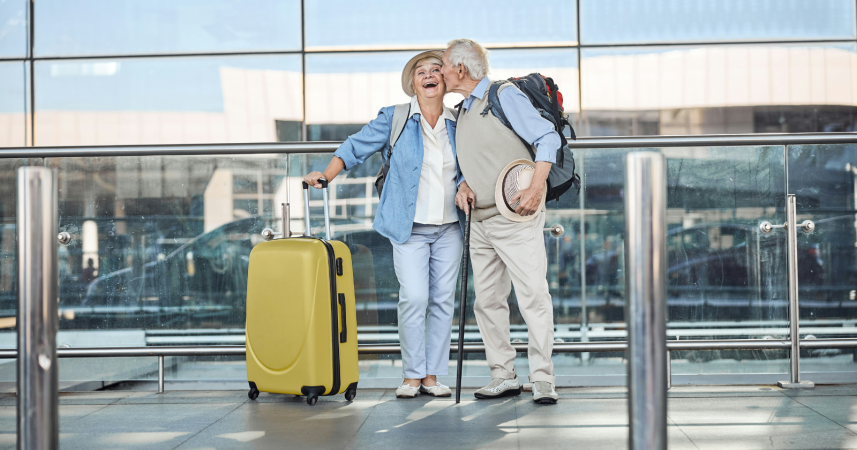
When someone says, “Let’s get there three hours early,” what they mean is, “Help me feel calm in the chaos.”

Add VegOut to your Google News feed. 
I travel a lot—sometimes for work, sometimes to chase a trail race in a new city, and often to visit family.
Over the years, I’ve noticed a pattern when I’m traveling with my favorite boomer relatives. Certain phrases pop up like clockwork the second we hit the curbside drop-off. It’s equal parts charming and revealing.
This isn’t a roast. It’s a field guide. Think of it as a gentle, practical look at generational habits—why these phrases come up, what they’re trying to do for us, and how we can keep the trip smooth (and actually fun) when they do.
Because beneath every airport quirk is a need: for certainty, connection, control, or comfort. If we can hear the need, the phrase becomes a cue—not a conflict.
Let’s roll our carry-ons to the gate together.
1. “Let’s get there three hours early—you never know.”
My dad says this before I’ve even zipped my suitcase. I used to resist it. Now I interpret it as code for “I want to reduce stress.” Airports once felt civilized to him—fewer lines, fewer rules—so the modern gauntlet can spike anxiety. Extra time is his insurance policy.
If you’re the quicker traveler, ask yourself: what’s the smallest concession that brings the temperature down for everyone?
I meet him halfway: we aim for two hours early on domestic flights, with a clear plan. He gets his margin; I get my sanity. Then I channel that early arrival into something pleasant—coffee, a walk to the quiet end of the terminal, or a quick stretch.
The reframe: early isn’t only about fear; it’s about control. Give a little control up front and you’ll gain a lot of cooperation later (when, say, you suggest switching to the app for boarding passes).
2. “Can I talk to a person?”
Kiosks, QR codes, chatbots—great until they glitch. Boomers grew up with human problem-solvers, not error messages. When they say this, they’re often saying, “I don’t trust a machine to care about my problem.”
I get it. I worked as a financial analyst for years, and I still remember the first time an automation script tanked a report 15 minutes before a board meeting. The person who saved me wasn’t the software—it was a colleague who knew the system and could think.
Here’s my move: I offer a “both/and.” I’ll try the kiosk while they queue for the agent.
First solution wins. If my kiosk sprint works, we step out of line without fuss. If their human wins, I cheer like they just scored an upgrade.
The point isn’t who’s right; it’s getting through with everyone feeling respected. As Deborah Tannen reminds us, so much conflict is about metamessages—we’re not just hearing the words; we’re hearing what the words imply about power, care, and competence.
3. “Print the boarding passes—just in case.”
I used to roll my eyes. Then I watched an entire jet bridge stall while half the plane hunted for a pixelated barcode with 3% battery. Paper has a timeless feature: it never dies.
Boomers tend to favor redundancy. It’s not stubbornness; it’s risk management shaped by pre-cloud life. When they ask for paper, I treat it like packing an extra headlamp on a trail run—not always necessary, rarely regrettable.
Compromise idea: keep the digital pass for primary use, print a single hard copy for the group, and stash it in an easily accessible pocket. Zero drama, maximal flexibility. It also frees you to experiment with the app’s perks (seat changes, upgrade alerts) without making anyone feel exposed.
4. “Back in my day, you could bring a real shampoo.”
Ah, the 3-1-1 lament. It’s nostalgia with a dash of protest. The underlying message is grief for a lost ease—and maybe a quiet worry about being caught out by a rule they can’t remember.
Instead of correcting, I narrate the present gently: “We’re good with travel-sized liquids in one clear bag. If something’s bigger, we can toss it in checked or leave it.” Then I model the behavior—pre-bagged liquids on top of the carry-on, laptop ready. That quick demonstration does more than any lecture.
I’ve also learned to give options: “Want me to pack a tiny shampoo for you?” It’s an easy win that prevents the security-bin scramble and preserves dignity.
5. “Is that the final boarding call?”
This pops up regardless of what the loudspeaker actually said.
Translation: “I fear missing out, and I’m worried I’m not interpreting the signals correctly.” Airports are loud, accents vary, and aging ears do their best. Anxiety fills any gap in information.
What helps is simple, visible certainty. I always screenshot the gate info and pull up the progress bar in the airline app. Then I say, “We’re in Group 3; they’re boarding 1 now. We’re five minutes out.” That tiny bit of structure calms the nervous system.
As Brené Brown puts it, “Clear is kind.” When I give clear, timely updates, I’m not just sharing data—I’m reducing cognitive load.
Bonus: I make myself the trusted narrator of the trip, which pays off later when things get weird (and they always get a little weird).
6. “Why is everyone in such a rush? The plane leaves when it leaves.”
I hear a values statement in this one. To many boomers, courtesy and order mean waiting your turn, not stampeding the jet bridge like it’s a Black Friday doorbuster. When they say this, they’re asserting a social norm that used to be more broadly shared: slow down, be decent.
Rather than debating modern boarding sociology, I acknowledge the value behind it: “You’re right—pushing helps no one.” Then I layer in the practical reality: “Boarding early helps us find overhead space so we’re not gate-checking.” It’s a both/and—etiquette plus strategy.
And I put my money where my mouth is. If we’re not in a rush, I let other people merge. If someone’s struggling, I offer to lift a bag. Modeling the courtesy they miss softens their frustration and quietly proves we can hold onto what’s good while adapting to what is.
7. “I don’t want to put my card on the app.”
There’s cybersecurity caution here—and it isn’t unfounded. Many boomers learned about online risk through sensational headlines and personal horror stories. When they balk at saving a card, they’re trying to protect themselves (and sometimes you).
This is where I play bridge. I explain the specific protections of the app we’re using, enable two-factor authentication, and offer a one-time wallet use: “We can use my card for the in-app upgrade and settle up later.”
Or I suggest alternatives: airport kiosks, gift cards, or booking on a home computer instead of a public network.
As organizational psychologist Adam Grant likes to say, “Argue like you’re right; listen like you’re wrong.” I come in with facts and patience. And if they still prefer not to store a card, that’s okay. The goal is a good trip, not perfect tech compliance.
What these phrases are really asking for
Strip away the airport noise and each phrase maps to a psychological need:
-
Predictability (“Let’s get there early.”)
-
Human connection (“Can I talk to a person?”)
-
Redundancy and safety (“Print it—just in case.”)
-
Clarity in changing rules (“Back in my day…”)
-
Certainty in the moment (“Is that the final boarding call?”)
-
Courtesy and order (“Why is everyone in such a rush?”)
-
Security and control (“I don’t want to store my card.”)
When I hear the phrase, I answer the need. That’s the leverage point.
A quick, no-drama playbook for flying cross-generationally
-
Set roles before you leave the house. I’m the gate info person; my dad is the luggage sherpa. Clear lanes reduce the mid-terminal tango.
-
Translate the airport. I narrate what I’m doing (“I’m adding the boarding pass to the wallet; it updates automatically if the gate changes”) so the tech feels less mysterious.
-
Offer visible certainty. Screenshots, alarms, and written mini-itineraries work wonders.
-
Use “and” more than “but.” “You’re right that paper is reliable, and the app makes seat changes fast.”
-
Give future you a gift. A snack stash, a spare phone battery, and prepped IDs are the universal calmers.
-
Make room for stories. The “back in my day” moment is a chance to ask what travel used to feel like. That memory often uncovers a value you can honor in some small way.
-
Rehearse compassion. If a phrase repeats, it’s a sign, not an attack. Meet it with a tool, not a sigh.
Why this matters beyond the terminal
Airports are just concentrated life: rules shifting under our feet, crowded spaces, high stakes, and little control. How we handle those boomer phrases—how we translate, make space, and share control—becomes practice for the rest of our relationships.
And yes, it goes both ways. If you’re the boomer reading this, there are Millennial/Gen Z classics that make me twitch. (“We can Uber to the airport 50 minutes before departure—it’ll be fine.” Reader, it was not fine.) What if we made a pact to hear the need under each other’s habits and respond to that, instead of the surface-level irritation?
One more tool I love
When the terminal is chaos and everyone’s stressy, I borrow a line that settles the dust: “Here’s what’s happening, and here’s what we’re going to do next.” It keeps me focused on the controllables—clarity, action, and tone.
As Deborah Tannen notes in her work, mismatched conversational styles easily masquerade as character flaws. They’re usually not. They’re just styles. And styles can coordinate.
And when the information itself is fuzzy, I lean on a line I first underlined years ago: “Clear is kind.” That reminder from Brené Brown steers me back to specifics: times, gates, groups, next steps.
If a conversation gets heated—say, over whether to store a card in an app—Adam Grant’s rule helps me keep my balance: argue like I’m right, listen like I’m wrong. It’s not about winning; it’s about landing—together.
I’ll be honest: I still forget, sometimes, that these phrases come from love—love of order, safety, and the tiny pleasures that made travel feel special when tickets were paper and meals came on real plates. When I remember that, I travel better. I leave earlier when it helps. I print the pass when it helps. I hold the line for courtesy even when the jet bridge turns into a rugby scrum.
And in exchange, I ask for trust when I say the app has us. I ask for five more minutes to walk, to think, to sip a coffee before we board. We take care of each other’s needs, and somehow the long day feels shorter.
So if you hear these seven phrases on your next trip, smile. Translate. Offer the smallest, kindest fix you can. That’s the real carry-on that keeps a family moving.
Safe travels—and save me a seat near the window.
What’s Your Plant-Powered Archetype?
Ever wonder what your everyday habits say about your deeper purpose—and how they ripple out to impact the planet?
This 90-second quiz reveals the plant-powered role you’re here to play, and the tiny shift that makes it even more powerful.
12 fun questions. Instant results. Surprisingly accurate.












