When your stuff has a place, your mind can go explore.
There are two kinds of travelers.
The “drop the bag and go find tacos” people.
And the “give me five minutes to set up my little base camp” people.
If you’re in the second group, you’re not fussy—you’re strategic.
Here’s what I’ve noticed (and learned the hard way) about folks who unpack the second they arrive.
1. They crave orientation
New city. New room. New routine.
Unpackers orient themselves fast.
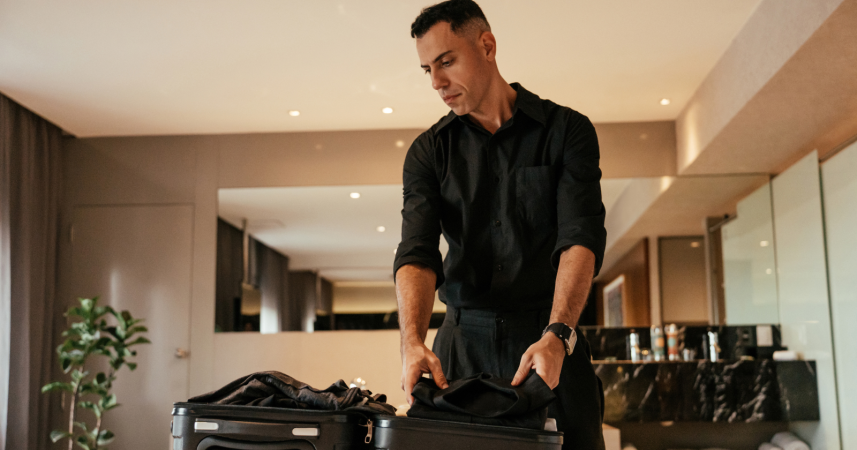
They hang clothes, stash toiletries, and choose a “home” for keys and the key card. They like knowing where stuff is when their brain is tired and the time zone is weird.
I’ll do a quick sweep—mini-fridge, outlets, safe, closet—then set my bag under the desk.
Ten minutes later, I know the lay of the land and my mind stops scanning for what might be missing.
2. They reduce decision fatigue
Travel multiplies small choices.
Where’s my charger? Which shirt is clean? Did I pack toothpaste or was that last trip?
Unpacking is a preemptive strike on decision fatigue.
By front-loading the setup, you avoid 30 little “Where is…?” moments over three days.
Future you loves this.
Outfits are visible, toiletries are in one place, and your morning routine runs on rails instead of vibes.
3. They respect rituals
Some people meditate; some people run.
Unpackers build a tiny arrival ritual: clothes out, toiletries lined up, book on the nightstand.
Rituals mark transitions. They tell your brain, “We’re here now.”
I learned this on a solo trip through Osaka.
Night one, I tossed my bag in a corner and crashed. Night two, I unpacked first—the whole week went smoother.
Same city, same tasks, but the ritual made it feel like home base.
4. They prioritize hygiene
Hotel rooms are cleaner than internet horror stories suggest—but they’re still shared spaces.
Unpackers keep clothes off the floor, shoes in one spot, and toothbrushes away from the sink splash zone.
As organizing icon Marie Kondo puts it, “The objective of cleaning is not just to clean, but to feel happiness living within that environment.”
Different context, same energy: set up your space so it supports how you want to feel
5. They plan for spontaneity
This sounds backwards, but it’s real.
When your room is dialed in, you’re freer to be impulsive outside of it.
Unpackers can say yes to the last-minute dinner or sunrise hike because their base camp is set.
They’re not mentally budgeting time to sort piles later.
They’re out the door—knowing a calm landing pad is waiting when they get back.
6. They travel light—and use what they bring
People who unpack quickly tend to pack intentionally.
If you’re going to lay it all out, you notice the extra “just in case” items and stop bringing them next time.
I’ve mentioned this before but your bag is a mirror.
When you set your things out, you see your habits.
The shirt you never wear? The third pair of “maybe” shoes? That bulky jacket you haul to warm places?
Unpacking is feedback.
Over a few trips, the clutter disappears and your carry-on starts to look like a well-edited playlist.
7. They invest in rest
Sleep is the force multiplier on the road.
Unpackers set the stage for it.
They pull the blackout curtains all the way, place earplugs on the nightstand, set the thermostat, and charge their phone across the room.
Maybe they even put their sleep mask under the pillow like a tiny, practical Easter egg.
Five minutes of setup means you’re not hunting for cables at midnight or waking up to a 2% battery.
Morning-you is less chaotic, which quietly makes the entire trip better.
8. They practice micro-organization
This isn’t full-blown alphabetized spice-rack energy.
It’s tiny systems that save time.
Packing cubes become drawer dividers.
Dirty laundry gets its own tote.
Cables live in a zip pouch that always sits by the kettle (hello, tea and charging).
On a work trip to Austin, I tried the opposite: I lived out of the suitcase.
By day two, my T-shirts had formed a sedimentary rock layer.
By day three, I was late to a meeting because I was mining for a charger.
Micro-organization isn’t about being “neat.” It’s about making friction so low you glide.
9. They close loops
Open loops—those half-finished tasks humming in the background—quietly drain you.
Unpackers close the first loops fast: bag emptied, cords placed, receipts clipped, toiletries parked.
Author Gretchen Rubin has a line I love: “Outer order contributes to inner calm.”
It’s simple, and it tracks with travel. When the room looks ready, your brain feels ready.
There’s also a tiny identity shift in all of this.
When you unpack, you’re telling yourself, “I live here for the next few days.”
Not in a forever way—just enough to be present, meet people, try the local vegan spot, and actually enjoy being where your feet are.
Quick setup checklist (what I actually do)
-
Hang tomorrow’s outfit and set shoes underneath.
-
Put the toiletry bag by the sink and open it.
-
Drop tech pouch on the desk; plug in the phone and battery pack.
-
Choose a “drop zone” for keys, wallet, and card.
-
Park dirty laundry bag in the closet from minute one.
-
Place a water bottle and book on the nightstand.
-
Pull curtains tight and set the thermostat before leaving the room.
None of this takes long.
But it changes how the trip feels.
The bottom line
People who unpack immediately aren’t fussy—they’re freeing up energy for what they came to do.
A little order up front buys you calm, better sleep, fewer lost items, and more room for serendipity.
Travel should be about the place you’re in, not the pile you’re managing.
Unpack once. Then go live the trip.