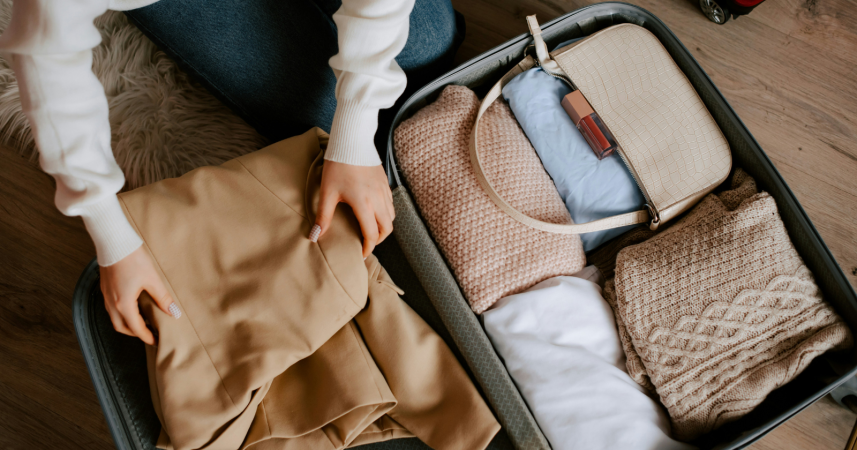
Your bag doesn’t need to carry every “what if.” Just the version of you that knows how to adapt.
I used to treat travel like an evacuation: pack for every scenario, assume nothing will be available where I’m going, and toss in “just in case” items until the zipper cried for help.
Then one bleary morning, I heaved my suitcase onto a scale and realized it weighed more than my trail-running pack, laptop, and a small cat combined. That was my wake-up call. The trip itself wasn’t heavy—my decisions were.
Since then, I’ve learned that packing light is less about deprivation and more about clarity. It’s a mindset shift that spills into everything else we do. Antoine de Saint-Exupéry captured it perfectly: “Perfection is achieved not when there is nothing more to add, but when there is nothing left to take away.” I think about that line every time I reach for one more “maybe.”
Ready to make your life—and your suitcase—lighter? If these seven things are on your list, it’s a neon sign you’re carrying too much.
1. “Just-in-case” outfits for imaginary scenarios
Let me guess: there’s a cocktail dress “in case there’s a fancy dinner,” hiking pants “in case we find a trail,” and a blazer “in case a meeting pops up.”
I’ve packed that suitcase of multiple personalities, and it never ends well.
Here’s the truth: “just in case” really means “I’m not sure what I want.” Uncertainty invites excess. Instead, define your trip in one sentence before you pack: “Three days in Lisbon—museums, long walks, casual dinners.” Now you know your uniform.
Build a small capsule (tops, bottoms, shoes) that mix and match into every outfit you’ll actually wear.
My rule of thumb: if an item doesn’t pair with at least three other things in the bag, it doesn’t make the cut. And if an event truly pops up unexpectedly? You can adapt—borrow, rent, or buy a single item locally rather than hauling an entire backup wardrobe across continents.
2. More than three pairs of shoes
Shoes are sneaky. They’re bulky, heavy, and oddly persuasive. I used to justify bringing five pairs because “footwear makes the outfit.” Maybe it does—but it can also make your bag feel like a brick.
Pick a trio that covers your range. For most trips, that’s: one walk-all-day pair, one smart casual pair (often the same if you choose well), and one light specialty shoe (sandals or trainers).
If you’re going somewhere wet, choose materials that handle rain rather than adding a whole extra pair “for bad weather.”
Pro tip from the school of sore feet: test your walking shoe on a real errand day before travel. If you can’t spend six hours on city sidewalks in them at home, they won’t magically behave in Rome.
3. Full-size toiletries (and duplicates)
Why do we pack a 300-ml bottle of shampoo for a four-day trip? Habit. And a dash of fear that the hotel amenities will smell like a pine tree married a bar of soap.
Decant what you love into travel bottles or pick solid versions (shampoo bar, conditioner bar, deodorant) to skip the liquid shuffle entirely. Most places you’ll visit sell toothpaste and sunscreen. And if you’re heading somewhere remote, plan quantities like a scientist: number of uses × days, then add a 10% buffer. Not 100%.
One more thing: duplicates. You don’t need two moisturizers, three chapsticks, and separate day/night serums unless you’re traveling for many weeks. Your future shoulders will thank you.
4. A stack of “someday” books
As a lifelong learner, I used to treat travel like a reading retreat. I’d tell myself, “This is when I’ll finally finish those three dense nonfiction books.” Spoiler: I did not. I napped on the plane, people-watched in cafés, and by day three my neck hurt from carrying the library I didn’t touch.
There’s also psychology at play. Too many options can freeze us. Barry Schwartz calls it the paradox of choice, where more choices make us less satisfied and more indecisive. A bag crammed with books can make you read none of them.
Bring one book you can’t wait to open and one lightweight backup (or go digital). I download a few titles and a podcast series, then give myself permission to read—or not. The point of your trip is the place, not a self-assigned syllabus.
5. Bulky gadgets you won’t actually use
I love gear. As a former financial analyst, I can spreadsheet a tech decision into next week. But the market is built to make you feel underprepared. Suddenly your bag contains a camera body and two lenses, a tablet, a laptop, a Kindle, a drone (!), and more cables than a server room.
Before you pack any device, ask: “What job does this do that my phone can’t?” If the answer isn’t clear, it stays home. For most travelers, a phone plus one “creator” device is plenty. If you’re not actively editing video or shooting long-exposure landscapes, that DSLR is probably along for a joyride.
And chargers: universal plug, one small power bank, one cable set that covers all. I wrap mine in a flat zip pouch so it doesn’t turn into a wire nest at the bottom of my bag.
6. A first-aid kit that could stock a clinic
I’m all for being prepared. I trail run, garden, and volunteer at farmers’ markets—Band-Aids are a lifestyle. But I used to pack a kit so comprehensive it required its own seat on the plane. The truth? Most city destinations have pharmacies on every corner.
Think triage, not apocalypse. Essentials only: pain reliever, blister care, a few bandages, your personal meds, and one antihistamine. Add a couple of single-use antiseptic wipes and call it done. If you have a specific condition, of course, plan accordingly. But the rest is “what-if” weight that rarely pays off.
Bonus: learn the local word for pharmacy and save it offline. You’ll feel prepared without hauling half a medicine cabinet.
7. Backup bags for your backup bags
Tote for the plane, backpack for day trips, clutch for dinners, foldable duffel “just in case,” and a packing cube that doubles as a sling. I have owned (and nested) them all. The result is a matryoshka of fabric inside your suitcase and a mental load of decisions: which bag today?
Pick one day bag that handles your core activities—hands-free and weather-ready—and one tiny compressible tote for overflow like groceries or a beach towel. If you think you’ll shop, plan a shipping budget rather than a shoulder-digit-severing duffel. Souvenirs feel less urgent when you don’t have the space to haul them.
The bigger why: packing is a mirror
Here’s the sneaky part. Overpacking isn’t just a travel habit—it’s a mindset. We pack “just in case” when we don’t trust our ability to improvise. We pack options when we haven’t decided who we want to be on this trip. We pack duplicates when we’re afraid of discomfort.
The lighter we pack, the more we practice trust—trust that we can handle small surprises, find what we need, and let go of the rest. Yvon Chouinard put it well: “The more you know, the less you need.” Knowledge and resourcefulness weigh nothing and go everywhere with you.
When I finally committed to a carry-on only experiment, I noticed odd side effects. I spent less time deciding what to wear and more time watching sunrises. I felt calmer moving through airports. I didn’t end trips with a pile of unworn clothes and “why did I bring this?” guilt.
And crucially, I stopped assigning vacations the job of making me a different person. I let the trip be the trip.
A simple formula that never fails
If you like a framework (hi, fellow spreadsheet lovers), try this:
-
Clothes: the “3×3” capsule—three tops, three bottoms, all mix-and-match, plus one layer and one weather-specific item (rain jacket or swimsuit). Add underlayers and sleepwear appropriate to the climate.
-
Shoes: two, maybe three. Wear the bulkiest on the plane.
-
Toiletries: decanted essentials + sunscreen. Nothing full-size.
-
Tech: phone, earbuds, one creator device (optional), compact charger kit.
-
Health: tiny triage kit + prescriptions.
-
Bags: one day bag + one foldable tote.
Write it once, reuse it forever. If your destination or season changes, swap the weather-specific pieces, not the whole system.
How to say no to the extra… nicely
Sometimes overpacking isn’t about what we want—it’s about social pressure. A well-meaning friend suggests a nicer outfit “in case” or insists you’ll need a second coat. When that happens, I borrow a line from design: constraints are creative. As noted by Saint-Exupéry above, taking away can be the path to better.
I’ll say, “I travel light, so I choose one ‘dress-up’ piece that works hard.” Or, “If I need an extra, I’ll rent locally.” Most people nod, and a few ask for my list.
What if I regret leaving something behind?
You will… once or twice. I’ve stood in a drizzle wishing for the umbrella I left on my entryway bench. Then I bought a cheap one from a street vendor and moved on with my life. The regret lasted fifteen minutes; the freedom lasted the whole trip.
Remember, you’re not auditioning for the role of Perfect Packer. You’re practicing being someone who values clarity, mobility, and presence over contingency planning. As you practice, your confidence grows—and your bag shrinks.
Final thought (and a quick challenge)
Packing light is not a personality trait; it’s a skill. Skills get better with reps. For your next trip, try this: pack your usual bag, then make yourself remove five items.
Wear your bulkiest shoes and layer your heaviest piece on the plane. Notice what you miss (if anything), what you don’t, and how your days feel when you’re not managing stuff.
You might find that the weight you’ve been carrying isn’t only on your shoulders—it’s in your decisions. Lighten that, and watch everything else feel easier.
And if, mid-pack, you need a mantra, use one of mine: “If I can’t name when I’ll wear it, it stays.” Or tape this to your suitcase lid: “Perfection is achieved not when there is nothing more to add, but when there is nothing left to take away.” One more time for the folks in the back.
Happy travels—and an even happier back.
VegOut Magazine’s November Edition Is Out!
In our latest Magazine “Curiosity, Compassion & the Future of Living” you’ll get FREE access to:
-
- – 5 in-depth articles
- – Insights across Lifestyle, Wellness, Sustainability & Beauty
- – Our Editor’s Monthly Picks
- – 4 exclusive Vegan Recipes