Your best hotel upgrade might be your mindset: ask for solutions, not exceptions.
Let’s be honest: the first five minutes at a hotel can set the tone for your whole stay.
I’ve had check-ins that felt like gliding into a mini-vacation… and I’ve had others where I’m fumbling for IDs, juggling bags, and wondering why I didn’t just go home.
Over the years (and after too many flights with too little sleep), I’ve picked up a handful of small habits that make check-in smoother, kinder, and—dare I say—elegant.
None of this is about being flashy. It’s about reading the room, thinking ahead, and treating people like the pros they are. Ready to level up your arrival?
1. Have your “ready set” items in one quick-grab pouch
Before I even walk through the sliding doors, I put three things in one zip pouch: a government ID, the credit card I booked with, and my confirmation number (screenshot, not just the app).
If I’m using a corporate rate, I add the employer letter if required.
Why a pouch? Because it keeps me from performing the “luggage tango” while digging through a tote. I can maintain easy eye contact with the agent instead of staring into my bag. It’s a subtle cue: I’m organized, I respect your time, and we’ll be done in two minutes.
Front desk teams appreciate guests who arrive prepared—so will the line behind you.
Pro touch: I keep a pen in that pouch. Sometimes you still need to sign a registration card or jot a taxi time. It’s low-tech, high-grace.
2. Use the lobby pause: observe, breathe, and match the tone
I call it the lobby pause. I stop just inside the entrance, take one calm breath, and scan for: the check-in line flow, elite/priority signage, and any queue ropes I should respect.
Then I match my energy to the vibe. If it’s a busy convention hotel at 5 p.m., I keep my questions tight. If it’s a boutique property with a candle burning at 10 p.m., I slow down and say hello like I mean it.
That tiny reset keeps me from arriving like human turbulence. It also makes it easier for the agent to help me quickly because I’m not hopping between “Where’s the bar?” and “Can you upgrade me?” in one breath.
3. Lead with names and gratitude (and make it specific)
I always start with a simple, warm introduction: “Hi, I’m Avery White, checking in for one night.” If the agent is wearing a name tag, I use it—“Thanks, Maya”—because names humanize the exchange.
And I offer gratitude that’s specific, not generic: “I know this line is long; thanks for moving us through.” People relax when they feel seen.
As the Ritz-Carlton Gold Standards famously put it, “We are Ladies and Gentlemen serving Ladies and Gentlemen.” I’m not staying at the Ritz most nights, but that spirit—mutual respect—travels well. One sincere sentence can upgrade the mood, even if it can’t upgrade the room.
4. State your preferences succinctly (and only the ones that matter)
You know how we sometimes become “that guest” at the desk—recounting our entire travel day, our favorite pillow loft, and the saga of a delayed Uber? I’ve done it too.
What helps me look like a pro is the “two preference rule.” I decide the two things that actually matter to me for this stay and state them calmly, once, right up front:
“I’d love a quiet room away from the elevator, and if possible, a late checkout around 1 p.m.”
Short. Clear. Prioritized. It gives the agent a solvable puzzle instead of a scavenger hunt. If they can’t do both, they’ll typically secure one and note the other. If nothing is available, I don’t argue—I ask for a waitlist or a follow-up time to check again.
Clear requests plus flexibility feel—and look—professional.
5. Keep confirmations handy—and show, don’t tell
If there’s a special rate, amenity, or upgrade in your confirmation, have it ready as a screenshot.
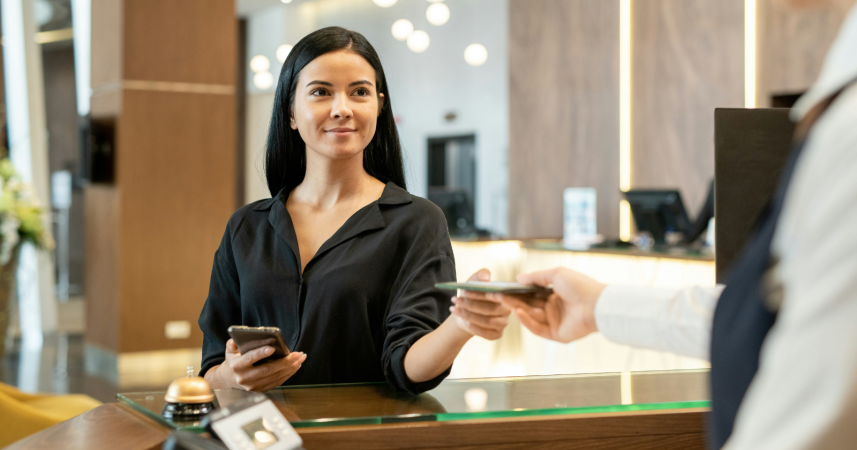
Instead of saying, “I’m pretty sure breakfast was included,” I’ll say, “I believe breakfast is included on this booking—here’s the line in my confirmation to help.” I slide my phone forward and let them read.
This isn’t about being pushy; it’s about making it easy for the team to honor what was promised. Screenshots matter because apps can lag or change mid-stay.
Showing the exact text avoids the he-said-she-said. The agent gets what they need to adjust the folio; I get what I booked; the line moves. Win-win-win.
6. Pack “check-in hands”: one suitcase, one shoulder, one hand free
There’s a physical choreography to arriving that nobody teaches us.
Here’s mine: roller bag in my dominant hand, smaller bag on the opposite shoulder, and one hand totally free for doors, IDs, and kindnesses (like helping someone upright a stroller). It keeps me from building a leaning tower of luggage on the front desk, and I don’t block the line while I reassemble myself.
Is it glamorous? No. Does it look competent? Absolutely.
And it prevents the dreaded passport-in-teeth move.
7. Confirm the essentials out loud (it takes 20 seconds)
Even seasoned travelers get burned by assumptions. I take 20 seconds and confirm the five essentials before I leave the desk:
-
Total room rate and taxes per night
-
Hold amount on the card and when it releases
-
Breakfast hours (or lounge access rules)
-
Wi-Fi details (is it included? tiered?)
-
Late checkout policy and how to request it the morning of
As hospitality educator Kate Edwards often reminds teams, clarity reduces friction. I apply the same logic as a guest: a quick recap catches surprises while we’re both right there, and it saves me from calling down later when the line is even longer.
8. Ask for solutions, not exceptions
Here’s a little mindset trick I stole from my years as a financial analyst: optimize within the system. Instead of “Can you waive that?” I’ll ask, “What’s the best way to minimize that fee?” Instead of “Can you upgrade me?” I try: “If there’s any flexibility on room assignment, I’d really appreciate something quiet/high floor.”
It invites the agent to problem-solve instead of defend a policy. And it signals I’m a partner, not a pusher. More often than not, I walk away with a smarter option—maybe a different room type that meets the need, or a note on my profile that helps next time.
“Help me understand what’s possible” is my favorite sentence at a front desk. It’s respectful and disarming.
9. Keep a tiny “fix-it kit” in your carry-on
This one has saved me so many awkward lobby moments.
My kit has: a slim power bank, a short charging cable, two bandages (for those surprise blisters), a stain wipe, two peppermint teabags, and a granola bar. Why bring it to check-in? Because the lobby is where problems announce themselves—dead phone, paper cut from a luggage tag, coffee on your shirt.
Fix problems quietly and you look instantly competent. Also, you won’t need to ask the front desk for tiny favors during the rush. When I do need help, I’m not the person who has asked for five small things already—credibility preserved.
10. Exit graciously with “the two thanks” (and a mental note)
I end check-in with two thanks: one to the person who helped me (“Thanks, Maya—really appreciate you finding a quiet room”), and one to the team (“Hope your shift goes smoothly”).
It’s brief, sincere, and it bookmarks the interaction on a positive note.
Then, I make a mental note: what worked, what didn’t, and what I’ll do differently next time. If something outstanding happened, I send a quick email to the hotel afterward mentioning the staff member by name.
As etiquette expert Lizzie Post often emphasizes, gratitude is a practice. Practiced travelers stand out—in the best way.
Bonus: the “tough arrival” script for when things go sideways
Sometimes the system is down, your room isn’t ready, or a mistake was made on the reservation. Here’s the script I lean on:
-
Start with empathy: “I know this is a tough check-in rush.”
-
Name the problem cleanly: “I’m seeing a different rate/room than what’s in my confirmation.”
-
Ask for process, not magic: “What’s the best way to reconcile what I booked? I have the screenshot here.”
-
Create a bridge: “If the original room type isn’t available, I’m happy with anything quiet and away from the elevator.”
-
Close the loop: “Is there anything you need from me right now to make this easier on your end?”
It works because it respects their reality and keeps you focused on outcomes. As customer-service researcher Frances Frei has noted, trust grows when we demonstrate authenticity, logic, and empathy at the same time. Little wonder the calm, outcome-focused guest usually gets the best available solution.
A few small truths I remind myself of in the lobby
-
My energy is contagious. If I arrive flustered, I multiply the chaos. If I arrive composed, I reduce it.
-
Specific beats vague. “Quiet room away from elevator” gets results; “nice room please?” does not.
-
Everything is easier when I assume good intent. Most front desk pros are juggling 20 variables I can’t see. Meeting them halfway is the fastest path to keys-in-hand.
And one more thing: none of this requires status, fancy luggage, or a titanium card. It’s everyday professionalism applied to travel—the same common sense I bring to a project review or a farmers’ market volunteer shift. The more I practice, the more automatic it becomes.
So the next time you roll into a hotel, try one or two of these habits. Watch how check-in feels different. Watch how people respond.
And watch how you start your stay not as a stressed traveler, but as the kind of guest everyone’s happy to see coming through the doors.
Safe travels—and smooth arrivals.
If You Were a Healing Herb, Which Would You Be?
Each herb holds a unique kind of magic — soothing, awakening, grounding, or clarifying.
This 9-question quiz reveals the healing plant that mirrors your energy right now and what it says about your natural rhythm.
✨ Instant results. Deeply insightful.