
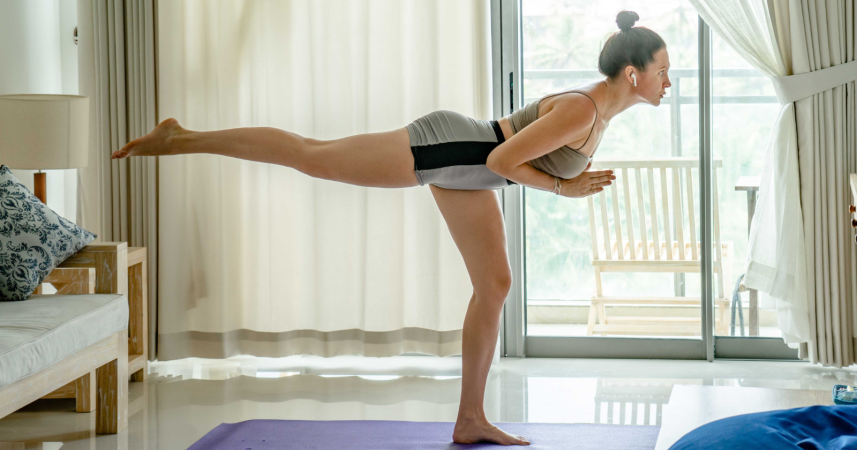
A simple daily ritual that clears your head, loosens your body, and sets the tone for everything that follows.

Add VegOut to your Google News feed. 
If your mornings are anything like mine used to be—snooze, scroll, sprint—you probably feel behind before you’ve even started.
Here’s the reset that changed my days: a short, kind-to-your-body yoga flow you can do almost anywhere.
Mini living room. Office with a chair. Hotel carpet that’s seen better days. No fancy gear, no perfection required.
“Exercise is the most transformative thing that you can do for your brain today,” neuroscientist Dr. Wendy Suzuki reminds us—and I’ve felt that in real time when I roll out of bed and move, even briefly.
I’m not interested in guilt or grind. I want a morning that feels grounded, focused, and doable on the busiest weeks. If that’s you too, let’s begin.
1. Start with your “why,” not your hamstrings
What would feel like a win by 8 a.m.? Less stiffness? A calmer mind before your inbox opens? More energy for the kids, your commute, or that 10 a.m. presentation?
When I worked as a financial analyst, I learned that small, consistent actions compound.
Fifteen minutes is enough to change the tone of your day. Not because it’s heroic, but because you can actually stick with it.
Pick your “why,” and the movement will have a place to land.
2. Your 15-minute anywhere sequence (no mat required)
Here’s a simple flow I return to again and again. Set a soft timer or follow your breath.
If you’ve got tight spots, linger. If something hurts, skip it.
This is a gentle “good morning,” not a performance.
1 minute — Arrive
Stand or sit tall. Close your eyes if that’s comfortable. Inhale through your nose for 4 counts, exhale for 6. Let your shoulders drop. unclench your jaw. Notice three things you can feel (feet on floor, air on skin, heartbeat). That’s you, arriving.
2 minutes — Cat–Cow (spine wake-up)
On the floor: hands under shoulders, knees under hips. Inhale, arch your back (Cow). Exhale, round (Cat). Move slowly, like you’re oiling each vertebra.
Chair option: hands on thighs, same movement seated.
2 minutes — Forward fold to half lift (hamstrings + back)
Stand with soft knees. Exhale fold, let your head hang. Inhale, hands to shins or thighs, flatten your back (half lift). Exhale fold again. Repeat with generous knees.
Wall option: hinge to half lift with palms on the wall.
3 minutes — Mini sun salutations (warmth + circulation)
From standing: inhale arms up, exhale fold. Inhale half lift, exhale step to a short plank or wall plank, hold two breaths. Exhale to a gentle downward dog or hang in a forward fold. Inhale rise back to standing. Repeat 2–3 rounds at your pace.
Desk option: place hands on desk for the plank; it still counts.
2 minutes — Low lunge with twist (hips + upper back)
Step right foot forward, left knee down (or keep it lifted). Inhale lengthen; exhale gentle twist to the right, hand to thigh. Breathe. Switch sides.
Chair option: sit tall, right ankle over left knee for a figure-four, then add a gentle twist toward the lifted knee. Switch.
2 minutes — Down dog to plank waves (core + shoulders)
From down dog (or wall dog), inhale forward to a short plank; exhale back. Small range is fine. Add 3–5 knee taps to the floor or to your wall/desk plank.
Wrist-sensitive? Skip plank; hold wall dog and pedal your heels.
2 minutes — Standing balance (focus + ankles)
Tree pose: foot to ankle or calf (avoid the knee). Hands at heart. Stare at something still and breathe. Switch sides. Wobbling is welcome; that’s your body learning.
1 minute — Quiet close
Sit or lie down where you are. One hand on your chest, one on your belly. Inhale through your nose, exhale like you’re fogging a mirror but with your mouth closed. Two or three rounds. Notice how you feel—less tight, more here.
That’s it. Fifteen honest minutes. Mobile, modular, and merciful.
3. Breathe like you mean it
Ever notice how your breath gets shallow when you’re stressed? Try this as a default through the whole flow: in through the nose, out through the nose, exhale a touch longer than your inhale.
It nudges your nervous system toward “rest and digest.” No need to count obsessively. Think of it like downshifting a gear.
On tougher mornings, I pair movement with a simple phrase. Inhale, “I’m here.” Exhale, “I’m okay.”
It’s not magic. It’s presence.
4. Make it truly anywhere
No floor today? Do the entire sequence standing at a wall or using a chair. Chair cat–cow, chair folds, wall plank, chair figure-four, wall “down dog,” standing tree. Done.
Tight clothes or shoes? Keep the ranges small. Micro-bends beat no movement.
Crowded space? Shrink each pose to its essence. A 6-inch fold still stretches your back. A pinky-toe-on-the-floor tree pose still trains balance.
Time pinched? Take the same order and do 30 seconds each. Two minutes is better than zero. The point is consistency, not heroics.
5. Let your body lead (and why this matters)
Yoga’s best gift isn’t bendiness; it’s relationship. Relationship with sensation, limits, and attention.
I know I’ve mentioned this book before, but reading Rudá Iandê’s Laughing in the Face of Chaos nudged me to trust what my body reports instead of bulldozing through it.
One line stays with me: “The body is not something to be feared or denied, but rather a sacred tool for spiritual growth and transformation.”
That’s how I treat this short flow—less workout, more conversation.
If that resonates, the book might meet you where you are. His insights helped me stop chasing a “perfect practice” and start listening to the one I actually have.
6. A mindset that makes sticking with it effortless
Curious question: what would make tomorrow’s session almost automatic?
A few ideas that have worked for readers (and for me): anchor it to something you already do—coffee brew time, dog walk, starting your laptop.
Movement becomes the “cost of entry” to the next thing. Lay out a towel, water, or stretchy pants where you’ll trip over them.
And keep the contract small: fifteen minutes. Finish, collect your win, and get on with your day.
And because we’re toggling between science and lived experience here, I love this reminder from socio-economist Randall Bell: “Those who exercised, even for 15 minutes a day, dominated statistically in every single measure of success”.
You don’t need a 90-minute studio class to move the needle.
7. Common snags (and kinder solutions)
“I’m not flexible.” Perfect. The flow is designed for stiffness. Bend your knees. Use the wall. Flexibility follows consistency, not the other way around.
“I skip it when I travel.” Hotel wall + desk chair + towel = full practice.
“I get bored.” Change one variable: add music, take it outdoors, or swap in a pose you love (or avoid—gently).
“I forget.” Calendar it. Alarms aren’t a lack of willpower; they’re good operations.
8. What changes when you move first thing
I won’t promise miracles. But I notice this: on mornings I move, my brain feels less foggy and my mood less brittle.
It’s like opening a window in a stuffy room. And because the flow is short, I don’t negotiate with myself all morning. I do it, and I’m done.
That simplicity is worth more than perfect alignment ever will be.
Your turn: pick tomorrow’s plan. Choose your “why.” Pick the version—floor, wall, chair.
Set your timer for 15. Breathe longer out than in. Finish and go live your actual life.
Quick recap you can screenshot:
- Arrive — 1 min
- Cat–Cow — 2 min
- Fold ↔ Half lift — 2 min
- Mini salutations — 3 min
- Low lunge + twist — 2 min
- Down dog ↔ Plank waves — 2 min
- Tree + switch — 2 min
- Quiet close — 1 min
Small, honest practice. Big, noticeable mornings.
If You Were a Healing Herb, Which Would You Be?
Each herb holds a unique kind of magic — soothing, awakening, grounding, or clarifying.
This 9-question quiz reveals the healing plant that mirrors your energy right now and what it says about your natural rhythm.
✨ Instant results. Deeply insightful.

Avery White
Formerly a financial analyst, Avery translates complex research into clear, informative narratives. Her evidence-based approach provides readers with reliable insights, presented with clarity and warmth. Outside of work, Avery enjoys trail running, gardening, and volunteering at local farmers’ markets.
More Articles by Avery










