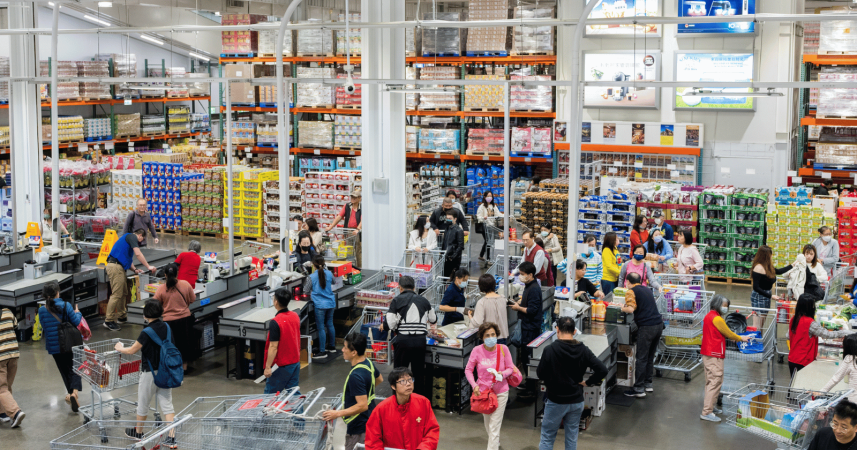
I spent twenty minutes photographing price tags in the olive oil aisle before an employee gently explained I was doing warehouse shopping completely wrong.

Add VegOut to your Google News feed. 
I still remember my first Costco trip like it was yesterday. I pushed that oversized cart through those industrial warehouse doors, immediately overwhelmed by the sheer scale of everything. The pallets stacked to the ceiling, the restaurant-sized containers of olive oil, the fact that you apparently needed to buy 36 rolls of paper towels at once.
I stood there clutching my brand-new membership card, trying to look like I belonged while secretly panicking about whether I'd just made a terrible financial decision.
That was five years ago, right after I'd left my corporate job and was trying to stretch every dollar while building my writing career. I'd heard Costco could save money, but I had no idea what I was doing. Looking back, I'm sure the employees spotted me as a newbie within seconds.
Here's the thing though: there are certain behaviors that quietly signal to Costco staff that someone's not just new, but navigating that tricky space of being budget-conscious while trying to make smart purchasing decisions. And I've been there, done that, and learned from every awkward mistake.
1) Grabbing a regular cart instead of a flatbed
Walk into any Costco and you'll see two types of carts: the standard shopping carts and those massive flatbed dollies. New members, especially those watching their spending carefully, almost always reach for the regular cart. It feels more manageable, more like a normal shopping trip.
But here's what I learned the hard way: those regular carts fill up fast at Costco. Really fast. You're not buying single items here. You're buying cases, bulk packages, and economy-sized everything.
I remember trying to balance a 35-pack of toilet paper on top of an already-full cart while a 12-pack of paper towels threatened to topple onto a passing shopper. An employee gently suggested I might want to grab a flatbed next time. She didn't say it, but I knew what she was thinking: first-timer.
The flatbed isn't about buying more than you need. It's about accommodating the reality of how Costco works. Even a modest shopping trip can require serious cart real estate.
2) Photographing or writing down prices obsessively
I get it. When you're trying to make every dollar count, you want to be absolutely certain you're getting a good deal. So you pull out your phone and start photographing price tags, or you're there with a notepad doing mental math about unit costs versus your regular grocery store.
Employees notice this behavior immediately, and it's not because there's anything wrong with it. It's just that experienced Costco shoppers have already done this homework. They know which items are genuine savings and which ones aren't worth the bulk purchase.
During my financial analyst days, I was obsessed with optimizing every purchase. That first Costco trip, I spent 20 minutes in the olive oil aisle alone, calculating per-ounce costs on my phone. An employee walked past me three times. On the third pass, he smiled and said, "The Kirkland brand is always your best bet."
He was right, of course. But more than that, he'd pegged me as someone still figuring out the Costco ecosystem.
3) Avoiding the Kirkland brand entirely
Speaking of Kirkland, here's a dead giveaway: new members who are budget-conscious often skip right past the store brand, assuming the name brands must be better quality.
This makes sense if you're coming from traditional grocery stores where store brands sometimes cut corners. But Kirkland Signature is different. It's consistently high-quality, often manufactured by the same companies that make the name brands, and significantly cheaper.
When I first joined, I bought name-brand organic quinoa for $18 when the Kirkland organic quinoa, literally right next to it, was $11 for the same quantity. I didn't know any better. I thought I was being smart by sticking with what I recognized.
An employee stocking shelves nearby caught my eye and gestured to the Kirkland bag. "Same supplier," she said quietly. "Just different packaging."
That single interaction probably saved me hundreds of dollars over the following year. Now I default to Kirkland unless there's a compelling reason not to.
4) Shopping during peak weekend hours
If you walk into Costco on a Saturday afternoon, you're immediately swimming upstream through a sea of humanity. Carts everywhere, samples stations mobbed, checkout lines stretching back into the aisles.
Employees can often tell who's new by who shows up during these absolute chaos hours. Experienced members know the rhythm. They come weekday mornings or evenings. They avoid Sundays like the plague.
But when you're juggling a tight schedule and trying to make a special trip count, you come when you can. Which often means weekends. Which means fighting crowds and feeling overwhelmed by the sheer intensity of it all.
I learned this through trial and error. After three stressful weekend trips where I left feeling drained rather than accomplished, I started coming Tuesday evenings after my run. The difference was remarkable.
Suddenly Costco felt manageable, even pleasant. I could think clearly, compare products without getting jostled, and actually enjoy the experience.
An employee I'd chatted with a few times mentioned she always knew the new members because they looked slightly shell-shocked on Saturday afternoons. I'd been one of them.
5) Filling the cart with perishables they can't possibly use
The bulk produce section is seductive. Those prices per pound look incredible compared to regular grocery stores. Three pounds of organic spinach for less than you'd pay for one small container elsewhere? Five pounds of strawberries? A bag of avocados that could feed a small army?
New members, especially those trying to eat well on a budget, load up on fresh produce without thinking through the logistics. I certainly did.
That first trip, I bought enough fresh vegetables to stock a restaurant kitchen. I had visions of elaborate vegan meals, meal prep perfection, my refrigerator organized and abundant. What actually happened: half of it went bad before I could use it. I ended up wasting money instead of saving it.
Employees see this constantly. They watch first-timers load cart after cart with perishables, knowing full well that much of it won't get consumed in time. They're too polite to say anything, but they recognize the pattern.
Now I buy strategically. I'll get the bulk spinach but immediately portion and freeze half of it. I'll buy those strawberries but plan specific recipes. I've learned to think about consumption rate, not just unit price.
6) Skipping the free samples but feeling guilty about it
The sample stations are a Costco institution. On weekends, they're everywhere, offering tiny cups of everything from juice to frozen dumplings to artisan cheese.
Here's what I noticed about myself and other budget-conscious first-timers: we'd awkwardly avoid the sample stations, worried that taking free food felt somehow shameful or that we'd be judged for not buying the product afterward.
I'd walk past sample stations with my eyes straight ahead, pretending I hadn't noticed them. I felt like accepting samples when I was carefully watching my budget somehow advertised my financial situation. Like I was taking advantage.
But employees don't see it that way at all. The samples are there for everyone. They're marketing, yes, but they're also genuinely meant to let you try products before committing to bulk sizes. That's especially valuable when you're being careful with money.
It took me months to realize that regular Costco shoppers cruise past sample stations without a second thought. They grab what interests them, skip what doesn't, and feel zero guilt either way. Nobody's judging. Nobody cares.
Once I let go of that self-consciousness, I discovered products I genuinely loved and bought specifically because I'd tried them first. It actually helped me make better purchasing decisions.
7) Leaving without checking the receipt at the exit
Every Costco has that person at the exit checking receipts. New members sometimes try to breeze past with a quick wave, not realizing this is actually a required step, not an optional security theater.
But beyond that, budget-conscious first-timers often don't realize the exit receipt checker is actually doing you a favor. They're not just verifying you paid. They're catching scanning errors, making sure you weren't charged twice for something, ensuring you got all the items you paid for.
I once had an employee at the exit catch that I'd been charged for two cases of sparkling water when I only had one in my cart. She flagged it immediately, sent me back to customer service, and I got $15 back. I hadn't even noticed.
That interaction shifted my perspective entirely. These employees aren't obstacles or inconveniences. They're part of a system that actually works in your favor, especially when you're watching every dollar.
Final thoughts
Looking back at my early Costco days, I realize I was so worried about appearing like I didn't belong there, like I was somehow failing at middle-class adulting by being budget-conscious at a warehouse store.
But here's what I've learned, both from my own experience and from conversations with employees over the years: nobody cares. Nobody's judging. Everyone was a first-timer once.
The employees who quietly notice these behaviors aren't looking down on anyone. If anything, they're rooting for you to figure out the system, to make it work for your budget and your life. Many of them have been exactly where you are.
Costco can absolutely save money, but only if you learn how to shop there strategically. It took me a solid year to really get the hang of it. Now it's second nature. But those early trips, awkward as they were, taught me something more valuable than shopping efficiency.
They taught me that being budget-conscious isn't something to hide or feel ashamed about. It's smart. It's responsible. And it's something worth learning to do well.