
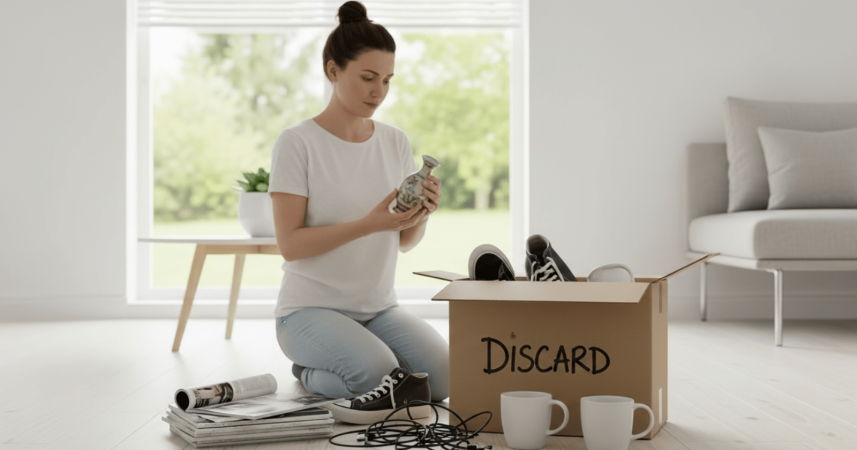
Sometimes it’s not the mess that weighs us down, but the quiet little things we keep buying that steal our sense of calm.

Add VegOut to your Google News feed. 
For years, I thought my home felt chaotic because I just wasn’t organized enough. Turns out, it wasn’t my lack of tidying—it was the stuff itself.
Certain items, no matter how “useful” or trendy, instantly make a space feel busy and overwhelming. Once I stopped buying them, my home not only looked cleaner but also felt calmer.
If you’re craving simplicity, here are seven things I’ve cut out—and why you might want to as well.
1. Decorative knick-knacks
Do you know those little trinkets you pick up at gift shops, vacations, or clearance sales? They look cute at first, but then they multiply. Before you know it, every shelf and tabletop is covered in tiny figurines, novelty candles, or random souvenirs.
I used to think they added personality. But what they really did was collect dust and distract from the things I actually love. Now, instead of filling every surface, I keep one or two meaningful pieces in view. The rest? Gone.
Psychologists note that visual clutter actually increases stress by overwhelming the brain with stimuli. As Dr. Sherrie Bourg Carter has written in Psychology Today, “Clutter bombards our minds with excessive stimuli, making it harder to relax.”
I’ve found this to be true—my home feels more like a sanctuary when it isn’t shouting at me from every corner.
One trick that helped me was taking a photo of each surface in my home. Somehow, seeing it in a picture made it easier to recognize what looked messy. If the shot looked busy, I knew it was time to pare down.
2. Extra throw pillows
Here’s a confession: I used to be the person with 10 pillows on the bed and at least six more on the couch. They looked cozy in home magazines, so why not?
Well, here’s why not: every night, I had to pile them on the floor before bed, then put them all back in the morning. The sofa was no better—guests had to move a mountain of pillows just to sit down.
At some point, I realized they weren’t adding comfort; they were adding work. And work disguised as “cozy décor” is not my idea of home.
Now I keep it simple with two on the couch and just what I actually sleep with on the bed. The space looks less fussy, and I spend a lot less time rearranging things no one was using anyway.
It’s funny how letting go of something so small can shift your mindset. I no longer feel like I need to keep up with every home décor trend. Instead, I’ve embraced the idea that less really can be more.
3. Cheap storage bins
It sounds counterintuitive, right? Storage bins are supposed to help with organization. But here’s the problem: I used them to hide clutter, not solve it.
Plastic bins, baskets, and tubs gave me the illusion of tidiness while I was really just shoving things out of sight. Over time, they piled up in closets, under the bed, even in the garage. I didn’t have fewer things—I just had layers of plastic disguising the mess.
This is something experts in minimalism often point out: buying more storage isn’t the same as decluttering. Organizing consultant Marie Kondo has noted, “Putting things away creates the illusion that the clutter problem has been solved.”
Now, I use intentional storage—like built-in shelves or a single sturdy box for seasonal items. If I don’t have a proper place for something, that’s my signal I probably don’t need it.
It’s been freeing to realize that space isn’t something I should be trying to “fill.” Space itself can be beautiful—and peaceful.
4. Seasonal décor for every holiday
Once upon a time, I had a bin for Easter, another for Halloween, another for Valentine’s Day… you get the picture. Pulling them out each season was fun at first, but it also meant constant rotation, storage headaches, and an endless feeling that my house was never “finished.”
The truth is, seasonal décor became another way I was chasing “enoughness.” If my house wasn’t decorated for the latest holiday, I felt behind. That’s not exactly the joy I was hoping for.
I’ve since scaled way back. I decorate for the winter holidays because that feels special to me, but everything else? A fresh bouquet or a small centerpiece does the trick.
This shift isn’t about being boring—it’s about choosing what really matters. As author Joshua Becker of Becoming Minimalist has said, “The first step in crafting the life you want is to get rid of everything you don’t.” For me, that includes plastic pumpkins and inflatable cupids.
5. Duplicate kitchen gadgets
I had two cheese graters, three spatulas, and more mismatched mugs than I could count. Somewhere along the line, I convinced myself that having multiples was practical. In reality, it just cluttered up my drawers and made cooking frustrating.
Cooking used to feel stressful, and I blamed my lack of patience. But really, I was wrestling with clutter every time I tried to find something. Once I donated the extras, my kitchen started to feel like a space for creativity instead of chaos.
Now, I keep one of each essential tool and donate the rest. Funny thing—I’ve never once missed that second garlic press.
If you’ve ever rifled through a packed utensil drawer and felt your blood pressure rise, you know how freeing it is to pare down. A clear counter and easy-to-find tools make the kitchen a place I actually want to spend time in.
And there’s a bonus: it cuts back on decision fatigue. Decision fatigue is the mental drain that comes from making too many small choices. Research from the Cleveland Clinic shows that having too many small, trivial decisions throughout the day increases mental exhaustion, making it harder to focus or make good choices later.
6. Bulk beauty products
Sales can be sneaky. I used to stock up on shampoos, lotions, and body sprays because “I’ll use them eventually.” Except, half the time, I didn’t. They just sat in my bathroom, taking up space and expiring before I got to them.
There’s something oddly stressful about staring at rows of half-used bottles. It makes the room feel more like a cluttered store shelf than a place of calm.
These days, I buy one product at a time and actually finish it before replacing it. My bathroom counter looks cleaner, my cabinets are no longer overflowing, and I save money by not chasing sales I don’t need.
This shift also ties into something deeper: delayed gratification. Instead of giving in to every sale or impulse, I’ve learned to pause and ask, “Do I really need this right now?” Often, the answer is no. And that’s powerful in more ways than one.
7. Paper clutter disguised as “essentials”
Mail piles, old receipts, expired coupons—I used to keep them all in drawers and baskets because “I might need them.” But let’s be honest: how often do we really dig through old paper stacks?
The National Association of Productivity & Organizing Professionals points out that 80% of the paper we keep is never looked at again. That hit me hard.
Now I deal with mail the day it comes in, scan anything important, and recycle the rest. My desk finally feels like a place to work, not a dumping ground for loose paper.
There’s also a psychological benefit to this. According to organizational psychologist Dr. Libby Sander, physical clutter in your environment competes for your attention, leading to decreased performance and increased stress. It’s not just about the piles—it’s about the mental weight they carry.
By clearing paper clutter, I’ve noticed my focus sharpen. Work sessions that once felt draining now feel smoother, simply because I’m not surrounded by stacks whispering, “Deal with me.”
Final thoughts
Letting go of these seven categories didn’t just free up space in my home—it freed up mental energy. My rooms feel lighter, calmer, and easier to enjoy.
The truth is, clutter doesn’t just take up physical space—it takes up headspace. When I stopped buying the things that constantly added to the pile, I started appreciating the things I already had.
And here’s something I didn’t expect: living with less has made me more intentional in other areas too. I spend less time shopping, more time outdoors, and I no longer feel pressured to keep up with every trend.
So here’s a question for you: Which items in your home do you keep buying out of habit, even though they add nothing but stress? Maybe it’s time to let them go.
If You Were a Healing Herb, Which Would You Be?
Each herb holds a unique kind of magic — soothing, awakening, grounding, or clarifying.
This 9-question quiz reveals the healing plant that mirrors your energy right now and what it says about your natural rhythm.
✨ Instant results. Deeply insightful.

Avery White
Formerly a financial analyst, Avery translates complex research into clear, informative narratives. Her evidence-based approach provides readers with reliable insights, presented with clarity and warmth. Outside of work, Avery enjoys trail running, gardening, and volunteering at local farmers’ markets.
More Articles by Avery










