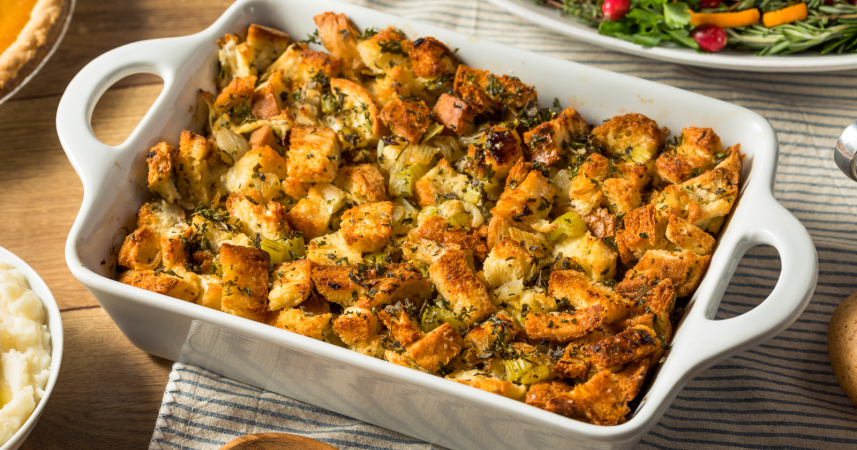
What happens when a holiday classic gets a plant-based twist? Let’s just say nobody at the potluck saw this coming.

Add VegOut to your Google News feed. 
Stuffing is one of those dishes that shows up at every holiday table—but it’s also one of the most misunderstood.
Traditionally heavy with butter, broth, and sausage, it can leave people feeling sluggish and excluded if they’re vegetarian, vegan, or just looking for something lighter.
Yet it’s also the dish everyone expects, a comfort food that signals togetherness.
So when I signed up for a fall potluck, I decided to reimagine stuffing through a plant-based lens—without losing the comfort factor.
The result? Not only did my tray get polished off, but five different people asked me for the recipe before the night was over.
How to make it: my step-by-step stuffing strategy
Start with the bread
Go for a crusty, whole-grain loaf that’s a day or two old. Cube and toast it lightly in the oven to dry it out—that way it soaks up flavor without turning soggy.
Pro tip: Local bakery loaves often come with less packaging, which means less waste and a fresher flavor.
Build flavor with the veggie base
Skip the sausage. Sauté onion, celery, garlic, and carrots in olive oil until fragrant. Add mushrooms for a deep, savory backbone, and a splash of tamari or soy sauce to boost umami.
Layer in fresh herbs
This is where stuffing shines. Use plenty of sage, thyme, and parsley. Fresh herbs, especially from a farmers’ market, pack in both flavor and sustainability points—often grown with fewer chemicals and less packaging.
Use a flavorful binder
Instead of chicken stock, stir in vegetable broth. A flax “egg” (1 tbsp ground flax + 3 tbsp water) or splash of oat cream keeps everything together while staying 100% plant-based.
Bake for texture
Cover and bake until heated through, then uncover for another 15–20 minutes until golden and crispy on top. The mix of soft middle and crunchy edges is what makes people come back for seconds.
Ready to try it yourself?
Here’s the version that won my potluck over—plus a few tweaks you can make depending on what’s in your pantry.
Ingredients
- 1 loaf whole-grain bread, cubed & toasted (about 10–12 cups; day-old works best)
- 2 tbsp olive oil (or avocado oil for a slightly richer flavor)
- 1 onion, diced
- 2 carrots, diced
- 3 celery stalks, diced
- 8 oz mushrooms, chopped (cremini or shiitake add extra depth)
- 3 cloves garlic, minced
- 2 tsp soy sauce or tamari
- 1 tbsp fresh sage, chopped
- 1 tbsp fresh thyme, chopped
- ½ cup parsley, chopped
- 2–3 cups vegetable broth (use more for a softer stuffing, less for a crisper one)
- 1 flax “egg” (1 tbsp ground flax + 3 tbsp water, stirred and rested until thick)
Instructions
- Toast the bread: Cut the loaf into cubes and spread them on a baking sheet. Toast in a 300°F oven for 10–15 minutes, until dry but not browned.
- Cook the veggies: Heat oil in a skillet over medium heat. Add onion, carrots, and celery. Cook until softened, about 8 minutes. Stir in garlic and mushrooms and sauté until mushrooms release their juices. Add soy sauce, herbs, and parsley.
- Mix it together: In a large bowl, combine toasted bread with the vegetable mixture. Add the flax “egg” and just enough broth to moisten evenly. You want the cubes soft but not collapsing—think “damp sponge,” not “wet towel.”
- Bake: Spread mixture into a greased baking dish. Cover with foil and bake at 375°F for 20 minutes. Remove foil and bake another 15–20 minutes until golden on top.
- Serve: Garnish with extra parsley or a drizzle of olive oil before serving.
Variations and swaps
- Add chopped apples or dried cranberries for sweetness.
- Stir in toasted pecans or walnuts for crunch.
- Use rosemary or marjoram if sage and thyme aren’t handy.
- For a richer version, mix in diced roasted butternut squash.
- If gluten-free, swap the bread for your favorite GF loaf—it works just as well if toasted.
The bigger why behind a plant-based stuffing
Once you’ve got the recipe down, here’s why it matters.
Food production contributes strongly to U.S. diet-related emissions, with average diet-related greenhouse gas emissions estimated at 3.8 kg CO₂-equivalent per person per day.
Multiply that by millions of holiday tables, and one plant-based side swap starts to look pretty powerful.
I learned this lesson the hard way at a family Thanksgiving a few years ago. My cousin, who had just gone vegan, sat quietly passing the bread while the rest of us piled on the “traditional” stuffing made with sausage and chicken stock.
At the time, I didn’t think twice—it was the recipe we’d always used. But when I glanced at her empty plate, it hit me: food can either pull people together or quietly leave them out.
That moment stuck with me, and it’s part of why I wanted to create a version that everyone could enjoy without hesitation.
Food waste is another piece of the puzzle. Each Thanksgiving, Americans waste an estimated 316 million pounds of food—the equivalent of nearly 800,000 metric tons of CO₂ emissions.
A dish like this one helps curb that. It disappears fast, and if you do have leftovers, it reheats well or folds into next-day soups and scrambles. Nothing lingers in the back of the fridge until January.
And let’s not ignore the obvious: it tastes good. This isn’t about sneaking kale into dessert or forcing something “healthy” onto the menu.
It’s hearty, herby, and golden-baked—the exact flavors people crave in stuffing. Which proves the point: sustainability doesn’t have to feel like sacrifice. It can taste like seconds at a potluck.
The upshot
Stuffing proves how simple ingredients, baked together, can become something greater than the sum of their parts.
A vegan version does the same for tradition—it shows that comfort and sustainability can share the same dish.
Bring it to your next gathering and you’ll do more than feed people.
You’ll widen the table, spark conversation, and maybe even set a new tradition.
Just don’t expect to take home leftovers.