Homemade pasta isn't nearly as intimidating as it sounds, requiring no fancy equipment or culinary school training, just patience, a clean countertop, and willingness to get your hands messy.
There's something almost meditative about making pasta from scratch.
Maybe it's the rhythmic kneading, or the simple satisfaction of turning basic pantry staples into something genuinely special. I stumbled into pasta-making a few years back when a friend gifted me a hand-crank pasta machine. What started as a curious weekend experiment turned into one of my favorite kitchen rituals.
Here's the thing: homemade pasta isn't nearly as intimidating as it sounds. You don't need fancy equipment or culinary school training. Just a bit of patience, a clean countertop, and the willingness to get your hands a little messy.
Let's walk through this together.
Ingredients
For about 4 servings, you'll need:
For the dough:
2 cups (250g) all-purpose flour, plus extra for dusting
3 large eggs, at room temperature
1 tablespoon olive oil
1/2 teaspoon salt
1-2 tablespoons water (only if needed)
That's it. Seriously.
The beauty of fresh pasta is in its simplicity. No preservatives, no additives. Just flour, eggs, and a touch of oil.
Method
Step 1: Create your flour well
Pour the flour onto a clean work surface and shape it into a mound. Use your fingers to create a well in the center, like a little volcano. This is where the magic starts.
Crack the eggs directly into the well, then add the olive oil and salt. Using a fork, gently beat the eggs, gradually incorporating the flour from the inner walls of the well. Work slowly here. There's no rush.
Step 2: Bring it together
Once the mixture becomes too thick to stir with a fork, it's time to get your hands involved. Start bringing the dough together, using your hands to incorporate the remaining flour. If the dough feels too dry and crumbly, add water one tablespoon at a time. If it's too sticky, dust with a bit more flour.
You're looking for a dough that's smooth and slightly tacky, but not sticking to your fingers.
Step 3: Knead
This is where that meditative quality kicks in.
Knead the dough for about 8-10 minutes. Push it away from you with the heel of your hand, fold it back over itself, give it a quarter turn, and repeat. You'll feel the texture change as you work it. The dough will become silky and elastic.
As noted by pasta expert Evan Funke, "The dough will tell you what it needs." Pay attention to how it feels. When you press your finger into it, it should bounce back slowly.
Step 4: Rest the dough
Wrap your dough ball tightly in plastic wrap and let it rest at room temperature for at least 30 minutes. This step isn't optional. The rest period allows the gluten to relax, making the dough much easier to roll out later.
I usually use this time to prep my sauce or tidy up the flour explosion on my counter.
Step 5: Roll it out
Cut the dough into four equal pieces. Work with one piece at a time, keeping the others wrapped so they don't dry out.
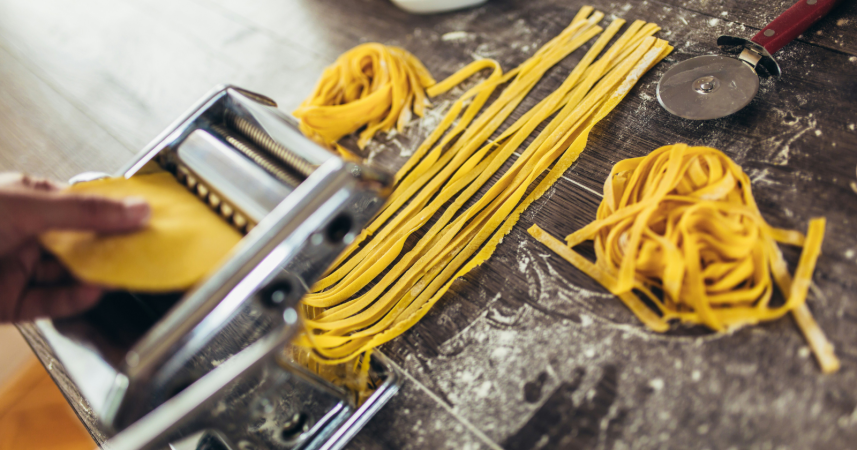
If you have a pasta machine: Flatten the dough piece slightly with your hand, then run it through the widest setting. Fold it in thirds like a letter, then run it through again. Repeat this process 3-4 times. This lamination technique creates those lovely layers. Then, gradually work through each setting, making the dough thinner with each pass. For most pasta shapes, you'll want to stop at the second-to-last setting.
If you're rolling by hand: Lightly flour your work surface and use a rolling pin. Roll from the center outward, rotating the dough frequently. Keep rolling until you can almost see your hand through it. Your arm will get a workout, but there's something satisfying about doing it the old-fashioned way.
Step 6: Cut your pasta
Once rolled, you can cut your sheets into whatever shape you like. For fettuccine, lightly dust the sheet with flour, loosely roll it up, and slice into ribbons about 1/4 inch wide. For pappardelle, go wider at about 3/4 inch. Immediately unroll the cut pasta and arrange it in loose nests on a floured surface.
If you're making filled pasta like ravioli, work quickly before the sheets dry out.
Step 7: Cook it fresh
Bring a large pot of generously salted water to a rolling boil. Fresh pasta cooks much faster than dried, usually in just 2-3 minutes. You'll know it's done when it floats to the surface and tastes tender with just a slight chew.
Reserve a cup of that starchy pasta water before draining. It's liquid gold for finishing your sauce.
Tips for success
Temperature matters
Room temperature eggs blend more easily into the flour. Cold eggs straight from the fridge can make the dough harder to work with.
Don't skip the rest
I learned this the hard way. The first time I made pasta, I was impatient and tried rolling the dough immediately. It kept springing back and was a nightmare to work with. That 30-minute rest makes all the difference.
Flour your surfaces generously
Pasta dough can be sticky. Keep extra flour nearby and don't be shy about using it on your work surface, rolling pin, and the dough itself.
Work quickly once it's rolled
Fresh pasta dough dries out faster than you'd think. Once you've rolled your sheets, cut and shape them promptly.
Substitutions and variations
Flour options
While all-purpose flour works beautifully, you can substitute up to half with semolina flour for a slightly firmer, more traditional texture. Some recipes call for "00" flour, which is finely milled Italian flour. It creates incredibly silky pasta, but honestly, all-purpose does just fine.
Egg-free version
You can make pasta with just flour and water, though it won't have quite the same richness. Use about 1/2 cup of water for every 2 cups of flour, adjusting as needed.
Adding flavor
Want to get creative? Add finely chopped herbs, a spoonful of tomato paste, or even squid ink to your dough during the initial mixing stage. I once made spinach pasta by blending cooked spinach and reducing the eggs slightly. It turned a gorgeous green and tasted incredible with brown butter and sage.
Final thoughts
Making pasta from scratch might seem like an unnecessary effort in our world of convenience. After all, you can buy perfectly good dried pasta at any grocery store.
But here's what I've discovered: it's not really about the end product. Sure, fresh pasta tastes amazing. The texture is incomparable, and there's a certain pride in serving something you made entirely by hand.
But the real gift is in the process itself. Those quiet minutes of kneading dough, the satisfaction of watching thin sheets emerge from the pasta machine, the simple pleasure of creating something with your own two hands.
In my years of volunteering at farmers' markets, I've watched people light up when they taste something made with care and intention. That's what homemade pasta is. It's an act of care. For yourself, for the people you're feeding, for the simple joy of making something real.
So clear off your counter, crack some eggs, and give it a try. Your first attempt might not be perfect, and that's completely fine. Mine certainly wasn't.
But I promise you this: there's something deeply satisfying about twirling that first forkful of pasta you made yourself.
If You Were a Healing Herb, Which Would You Be?
Each herb holds a unique kind of magic — soothing, awakening, grounding, or clarifying.
This 9-question quiz reveals the healing plant that mirrors your energy right now and what it says about your natural rhythm.
✨ Instant results. Deeply insightful.