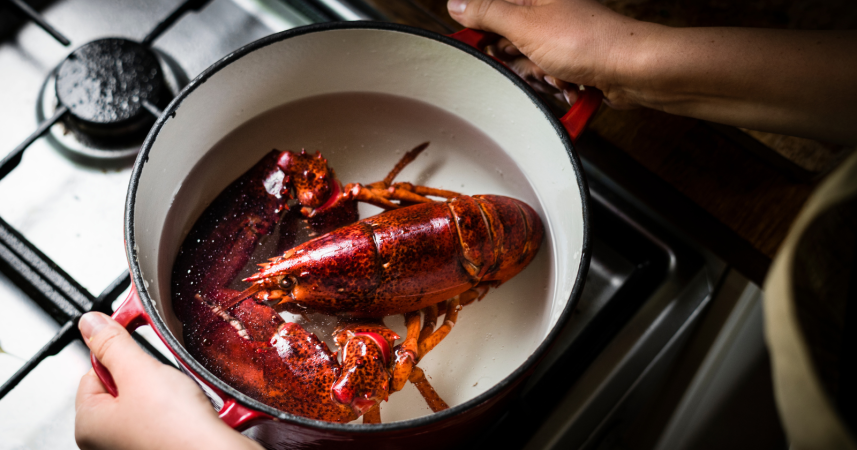
Lobsters, it turns out, don't just twitch in boiling water—they suffer. And British law now recognizes that.

Add VegOut to your Google News feed. 
The United Kingdom has officially ruled that boiling lobsters alive violates existing animal welfare law, marking a turning point in how crustaceans are treated in restaurants and home kitchens across England.
The government's recent clarification means that the common practice of dropping live lobsters into boiling water now faces legal scrutiny, with enforcement by local authorities and relevant inspectors.
This development follows years of advocacy from animal welfare organizations, particularly the Animal Law Foundation, which maintained that the practice had been unlawful since 2022. That year, the Animal Welfare (Sentience) Act formally recognized decapod crustaceans, including lobsters and crabs, as sentient beings capable of experiencing pain.
However, the government initially suggested this recognition wouldn't require changes to industry practices. The foundation challenged this interpretation, arguing that existing regulations prohibiting avoidable pain, distress, or suffering in animals at the time of killing should apply once sentience was legally acknowledged.
The science behind sentience
The legal shift stems from mounting scientific evidence that crustaceans experience genuine pain rather than simple reflex responses. A comprehensive 2021 review commissioned by the UK government examined over 300 scientific studies and concluded that decapod crustaceans display strong evidence of sentience.
The researchers used eight criteria to assess pain capacity, including the presence of specialized pain receptors, integrative brain regions, and behavioral responses that go beyond mere reflexes.
The evidence painted a compelling picture. When exposed to harmful stimuli, crustaceans demonstrate behaviors consistent with pain perception: they learn to avoid locations where they've been injured, value pain relief when hurt, and show anxiety-like responses complete with measurable physiological stress markers.
One particularly striking study found that crayfish exposed to electric shocks developed enhanced fearfulness, preferring dark hiding spaces over exposed areas. When researchers administered anti-anxiety medication, this behavior reversed, suggesting these animals possess mental states similar to anxiety in mammals.
Researchers also discovered that lobsters and crabs respond to opioid painkillers in ways similar to vertebrates. When injured crustaceans are given morphine, they show reduced pain responses, and these effects can be blocked by opioid antagonists, indicating they possess functional pain-processing systems comparable to those in mammals.
The physiological response during boiling is particularly severe: lobsters struggle violently for approximately two minutes after being placed in boiling water, showing clear signs of distress before movement ceases.
Public opinion and practical implementation
British public sentiment strongly supports the change. Recent polling found nearly 80 percent of Britons consider it unacceptable to boil crustaceans alive if they experience pain during the process. The government will publish guidance on acceptable humane killing methods, which include inserting a knife into the central nervous system to quickly destroy the brain or using electrical stunning devices like the Crustastun before boiling.
The seafood industry has expressed concerns about implementation costs and logistics. The Shellfish Association of Great Britain warned that businesses unwilling to invest approximately £3,500 in electrical stunning equipment might shift to importing frozen seafood instead. Some industry representatives argue the regulations place additional financial burden on an already high-cost sector facing rising wages and operational expenses. Critics suggest restaurants may struggle to adopt new protocols, questioning whether establishments will genuinely invest in stunning equipment or find workarounds.
Animal welfare advocates, however, celebrate the ruling as long overdue. Edie Bowles, founder of the Animal Law Foundation, described it as a vital protection that addresses extreme suffering while correcting a disconnect between written law and actual practice. The UK joins Switzerland, Norway, and New Zealand in banning live boiling, with these countries having already implemented similar protections for crustaceans.
Broader implications for animal welfare
This ruling represents part of a larger animal welfare strategy announced by the UK government in December 2024. The comprehensive package includes potential bans on trail hunting, battery cages for laying hens, and farrowing crates for pigs. The strategy also prohibits shrink-wrapping live crustaceans, another practice welfare advocates consider cruel.
The recognition of crustacean sentience raises profound questions about how humans treat the estimated 420 million crabs, lobsters, shrimp, and langoustines caught annually in UK waters. While the immediate focus remains on killing methods, the broader acknowledgment of these animals as feeling beings could influence future policies affecting their capture, transport, and handling throughout the supply chain.
Some resistance to the changes has emerged. Political figures have criticized the reforms as government overreach, arguing they represent excessive regulation of traditional practices. The debate highlights ongoing tension between animal welfare priorities and concerns about regulatory burden on businesses and individual freedoms.
The UK's decision to enforce humane slaughter requirements for crustaceans reflects evolving scientific understanding and changing social values regarding animal treatment. As research continues to reveal the complex inner lives of species once considered too simple to suffer, legal frameworks are gradually catching up. Whether this shift will fundamentally transform the seafood industry or prove difficult to implement in practice remains to be seen, but it signals a clear commitment to extending welfare protections based on evidence rather than tradition.
For restaurants, fishmongers, and home cooks, the message is straightforward: lobsters experience pain, and the law now requires their humane treatment reflects that reality. The days of casually dropping live crustaceans into boiling water without consideration for their suffering are officially over in England.
If You Were a Healing Herb, Which Would You Be?
Each herb holds a unique kind of magic — soothing, awakening, grounding, or clarifying.
This 9-question quiz reveals the healing plant that mirrors your energy right now and what it says about your natural rhythm.
✨ Instant results. Deeply insightful.

Avery White
Formerly a financial analyst, Avery translates complex research into clear, informative narratives. Her evidence-based approach provides readers with reliable insights, presented with clarity and warmth. Outside of work, Avery enjoys trail running, gardening, and volunteering at local farmers’ markets.
More Articles by Avery