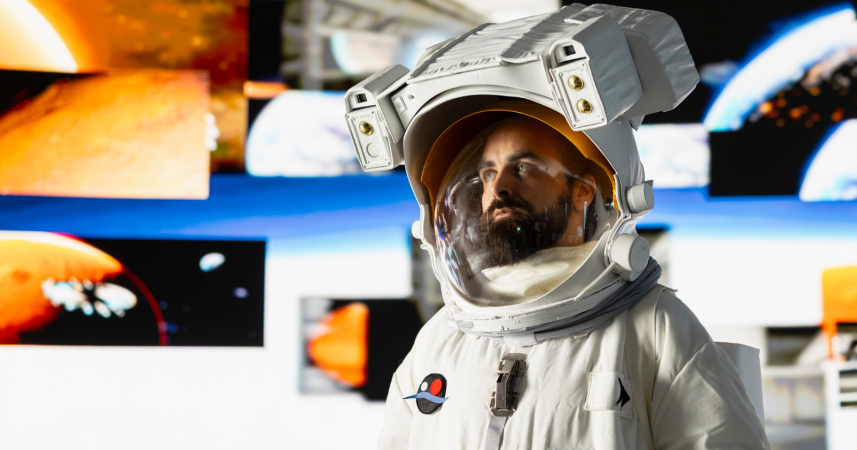
As NASA eyes Mars and the moon, scientists warn: the human brain may not bounce back from prolonged time in space.

Add VegOut to your Google News feed. 
As humanity prepares for missions to Mars and establishes a permanent presence on the moon, scientists are uncovering troubling evidence about how space travel fundamentally alters the human brain.
Recent brain imaging studies reveal that astronauts experience significant structural changes that can persist for years after returning to Earth, raising critical questions about the long-term health implications of extended space exploration.
The brain shifts upward in space
When astronauts spend time in microgravity, their brains physically move within their skulls. Research analyzing MRI scans from 26 astronauts found that the brain shifts upward by several millimeters during spaceflight, with sensory and motor regions showing the most dramatic deformations.
While this might seem like a small distance, neurologists emphasize that when discussing brain movement, even millimeters represent substantial displacement.
The upward shift occurs because fluids in the body naturally redistribute toward the head in the absence of gravity, a phenomenon astronauts call "puffy head bird legs" or the "Charlie Brown effect."
This fluid redistribution pushes the brain higher in the skull, causing cortical crowding and compression at the top of the brain. The changes contribute to disorientation and motion sickness during spaceflight, and balance problems persist even after astronauts return to Earth.
Brain cavities expand dramatically
Perhaps the most concerning finding involves the ventricles, hollow cavities in the center of the brain filled with cerebrospinal fluid.
A comprehensive study published in Scientific Reports examined 30 astronauts and found that those spending six months or longer on the International Space Station experienced ventricular expansion of up to 25 percent. The enlargement occurred primarily during the first six months in space before appearing to level off for longer missions.
The recovery process proves remarkably slow. Six to seven months after returning to Earth, astronauts showed only 55 to 64 percent recovery toward their pre-flight ventricular size. Some changes appear permanent, with certain structural alterations showing little to no recovery even after a year back on Earth.
The research suggests that astronauts require at least three years between missions for their ventricles to regain full elasticity and compensatory capacity.
Multiple flights compound the damage
The cumulative effects of repeated spaceflight present additional concerns.
Astronauts with previous spaceflight experience show different patterns of brain changes compared to first-time flyers. Those who had completed multiple missions demonstrated reduced capacity for ventricular expansion during subsequent flights, suggesting their brains had lost compliance from prior trips.
Crew members with less than three years of recovery time between missions showed little to no ventricular enlargement on their next flight, potentially indicating that their ventricles remained enlarged from previous missions and lacked space to expand further.
The implications extend beyond structural changes. While astronauts in these studies did not report significant cognitive impairments, researchers note that age-related ventricular expansion due to natural brain atrophy is typically associated with cognitive decline.
Whether the gravity-related ventricular changes in astronauts will eventually produce similar effects remains unknown, though scientists emphasize the need for more comprehensive long-term monitoring.
Critical gaps in astronaut health monitoring
Despite these findings, routine long-term brain imaging remains absent from NASA's standard medical protocols for astronauts.
Basic MRI scans occur as part of medical operations, but no systematic follow-up imaging tracks how astronaut brains recover years after missions. Several researchers have advocated for NASA to implement routine follow-up brain MRI scans for all astronauts, noting that the current approach of studying only small groups of participants provides insufficient data about long-term health effects.
University of Florida researcher Rachael Seidler emphasizes that understanding these long-term impacts is crucial because they could affect how astronauts recover and perform in their daily lives post-mission. Her team is conducting a new study tracking astronauts for up to five years after their flights to better understand the extended consequences of space travel on brain structure and function.
The research carries particular urgency as NASA prepares for the Artemis moon missions, which include plans for a permanent lunar research base where astronauts would stay long-term. Mars missions, potentially lasting years, represent an even greater unknown.
The collective findings about brain deformation, ventricular expansion, and incomplete recovery paint a disturbing picture for humanity's space exploration ambitions.
The question facing space agencies and mission planners is no longer whether spaceflight changes the brain, but whether these changes will ultimately limit humanity's ability to safely explore beyond Earth.
If You Were a Healing Herb, Which Would You Be?
Each herb holds a unique kind of magic — soothing, awakening, grounding, or clarifying.
This 9-question quiz reveals the healing plant that mirrors your energy right now and what it says about your natural rhythm.
✨ Instant results. Deeply insightful.

Avery White
Formerly a financial analyst, Avery translates complex research into clear, informative narratives. Her evidence-based approach provides readers with reliable insights, presented with clarity and warmth. Outside of work, Avery enjoys trail running, gardening, and volunteering at local farmers’ markets.
More Articles by Avery