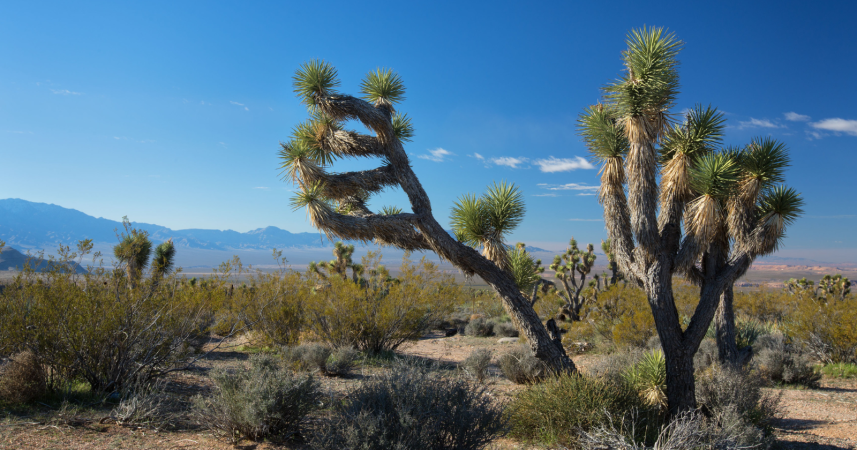
Bonus blooms may look beautiful, but for Joshua trees, they signal a reproductive crisis.

Add VegOut to your Google News feed. 
Across Southern California's Mojave Desert, an unusual spectacle has drawn the attention of scientists and desert dwellers alike.
Joshua trees, the iconic spiky succulents that typically flower between February and April, began blooming in mid-November 2025. Clusters of whitish-green flowers appeared on trees throughout the region, from Joshua Tree National Park to the high desert communities surrounding it.
The timing raises serious questions about what this means for one of America's most recognizable desert plants.
Jeremy Yoder, an associate professor of biology at California State University, Northridge, confirmed the phenomenon through observations uploaded to iNaturalist, a citizen science platform. The trees have produced what researchers call a "bonus bloom," flowering months ahead of their normal schedule. This represents the second documented instance of such an event in recent years, with a similar occurrence in autumn 2018 extending into winter 2019.
The probable cause stems from unusual weather patterns marked by significant early-winter rainfall. Lancaster, California recorded two and a half inches above normal precipitation for the season.
Research from Yoder's lab established that Joshua trees flower more frequently in wet years, particularly when wet conditions follow dry periods. A 2021 study by researchers at the Florida Museum of Natural History concluded that the 2019 off-season bloom resulted from cool temperatures combined with unexpected late-year rainfall events, conditions that mirror 2025.
The pollination problem
The early flowering creates a critical mismatch in the desert ecosystem.
Joshua trees depend entirely on yucca moths for pollination, and these specialized insects have evolved their entire life cycle around the trees' typical flowering schedule. The moths spend the period between flowering seasons buried in desert soil in a dormant state, using winter cold as their primary cue that a year has passed and flowering season has begun.
Adult moths emerge during the normal February-to-April bloom period, laying eggs in the flowers while depositing pollen. Larvae then develop inside the resulting fruits, consuming some seeds before chewing their way out and burrowing into the sand to form cocoons.
The relationship represents one of nature's most precise partnerships. When Joshua trees flower months early without triggering the moths' emergence, those flowers cannot be pollinated.
Yoder explained the predicament to the press. The unusual weather conditions that prompted the trees to bloom likely failed to provide the environmental signals necessary for the moths to emerge from their underground cocoons. Without pollination, the flowers produce no fruit and no seeds, effectively wasting the trees' reproductive effort for the year.
Climate stress compounds existing threats
The mistimed bloom compounds the numerous challenges Joshua trees already face from climate change. Rising temperatures threaten to eliminate up to 90% of their current habitat by the end of the century, according to research projections.
The trees require specific conditions to survive: well-timed precipitation, hot summers, and cold winters with temperatures ranging from negative 13 degrees Fahrenheit to 120 degrees. Suitable habitat typically exists between 2,000 and 6,000 feet in elevation, but warming temperatures are steadily shrinking this range.
Prolonged drought poses an additional threat despite the trees' adaptation to arid conditions. Increasingly frequent and severe wildfires have also taken a devastating toll.
The 2020 Lake Fire and Dome Fire killed over one million Joshua trees in the Mojave Desert. Because the trees grow slowly, gaining only one-half to three inches annually, burned areas require decades to recover. When combined with extreme heat and drought stress, recovery becomes even more tenuous.
Researchers have found that climate change has slightly increased the frequency of Joshua tree flowering since the early 20th century. This occurs because the trees flower more readily when wet years follow dry years, and climate change drives greater year-to-year variation in rainfall patterns.
However, increased flowering means little if environmental cues fail to synchronize the emergence of pollinating moths. Graduate student Kirsten Zornado from Yoder's lab emphasized the importance of tracking whether early-blooming trees produce fruit, which would indicate successful pollination occurred despite the timing disruption.
Conservation efforts and scientific investigation
The situation has prompted researchers to request public assistance in documenting the phenomenon. Scientists need comprehensive data on where flowering occurs, weather conditions in those locations, and whether the early flowers result in fruit production.
The Yoder Lab has called on anyone living in or visiting the Mojave Desert to photograph Joshua trees and upload observations to iNaturalist. The team will combine these observations with detailed weather data and use machine learning models to predict future flowering events and understand what triggers both tree flowering and moth emergence.
California passed legislation in 2023 specifically to protect western Joshua trees, one of two distinct species found in the state. The law requires property owners to obtain permits before removing trees and mandates the development of conservation plans identifying areas where Joshua trees may survive in a warming future.
The U.S. Fish and Wildlife Service has repeatedly declined to list Joshua trees under the Endangered Species Act, citing stable populations through mid-century. However, a federal judge ruled against this determination in May 2025, stating the agency must consider climate change effects on young trees rather than focusing solely on mature individuals.
The current out-of-season bloom serves as a visible reminder of how rapidly changing environmental conditions can disrupt even the most precisely evolved natural relationships.
Whether the trees and their moth partners can adapt to increasingly erratic weather patterns remains uncertain. What researchers know with certainty is that each disruption to the reproductive cycle threatens the long-term survival of these ancient desert dwellers that have stood as landmarks in the Mojave for centuries.