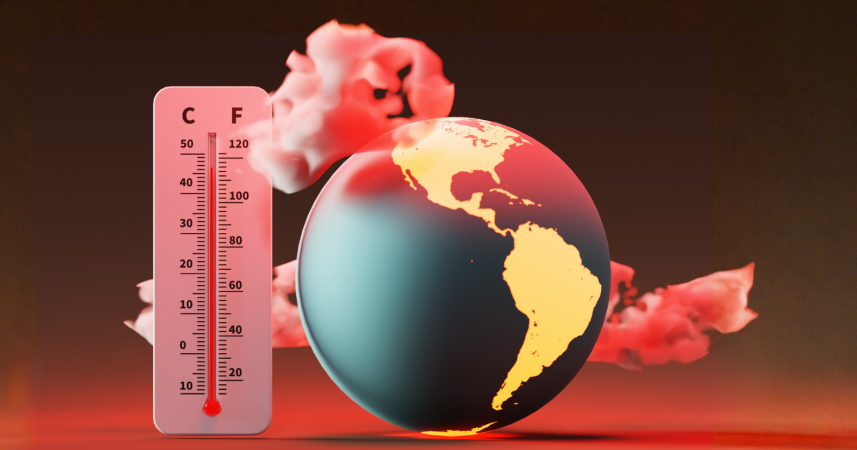
From deadly floods to billion-dollar wildfires, 2025 made it painfully clear that climate extremes are the new normal.

Add VegOut to your Google News feed. 
The year 2025 has been confirmed as the third-warmest year on record, according to data released by the Copernicus Climate Change Service.
The European monitoring agency reported that global temperatures in 2025 averaged 14.97°C, placing it just marginally behind 2023 and significantly below 2024, which remains the hottest year ever documented.
The findings underscore a troubling pattern that climate scientists have been tracking for over a decade. The past 11 years, from 2015 through 2025, have all ranked as the 11 warmest years in recorded history. More significantly, the three-year average for 2023-2025 exceeded 1.5°C above pre-industrial levels for the first time, marking a concerning milestone in the progression of global warming.
According to the Copernicus data, 2025's average temperature stood at 1.47°C above the pre-industrial baseline established between 1850 and 1900. While this represents a decrease of 0.13°C compared to 2024's record-breaking heat, the year remained extraordinarily warm by historical standards. Carlo Buontempo, Director of the Copernicus Climate Change Service, emphasized that the data provides further evidence of an unmistakable trend toward a hotter climate, warning that the world is rapidly approaching the temperature limit set by the Paris Agreement.
Devastating extreme weather defines the year
The elevated temperatures of 2025 translated directly into a cascade of deadly and destructive extreme weather events across multiple continents. The year began with catastrophic wildfires in Los Angeles that became the costliest wildfire disaster in U.S. history, causing over $60 billion in insured losses alone. The Palisades and Eaton fires, driven by hurricane-force Santa Ana winds, destroyed more than 16,000 structures and claimed approximately 31 direct deaths, with hundreds more dying from indirect causes including poor air quality.
Analysis from World Weather Attribution found that climate change made the hot, dry, and windy conditions fueling the Los Angeles fires about 35% more likely. The research organization documented 22 extreme weather events throughout 2025 that claimed thousands of lives, destroyed communities, and wiped out crops across the globe.
Flash flooding emerged as another major killer in 2025. Texas Hill Country experienced its deadliest inland flooding event in nearly 50 years when slow-moving storms dumped up to 20 inches of rain in just hours on July 4. The Guadalupe River surged 26 feet in under 90 minutes, killing at least 135 people including 27 young campers and counselors. The flash flood occurred despite the region being in extreme drought conditions, demonstrating how climate change can amplify multiple hazards simultaneously.
Tropical cyclones intensify across vulnerable regions
Tropical systems brought devastation to multiple regions throughout 2025, with particularly severe impacts in Southeast Asia and the Caribbean. Hurricane Melissa struck Jamaica as a Category 5 storm in late October before weakening to Category 3 and making landfall in Cuba, bringing extreme winds and torrential rainfall. In Sri Lanka, Cyclonic Storm Ditwah became the deadliest weather-related disaster since the 2004 tsunami, triggering the worst flooding and landslides the country had experienced in over two decades.
Spain suffered through its hottest summer on record, with average temperatures running 2.1°C above the 1991-2020 baseline. One in every three days fell under heatwave conditions, and temperatures exceeded 45°C at certain points. The extreme heat contributed to Spain's worst wildfire season in three decades, with record emissions tracked across Europe by the Copernicus Atmosphere Monitoring Service.
Even regions not typically associated with extreme heat experienced unusual conditions. Alaska received its first-ever official heat advisory in June as temperatures climbed into the mid-80s Fahrenheit. The unusual warmth triggered a sudden spike in wildfire activity, with more than 150 fires sparked by lightning across the state's interior, burning 56,000 acres within just seven days.
Polar extremes signal accelerating change
While tropical and temperate regions saw somewhat lower temperatures compared to the two previous years, the polar regions experienced record-breaking warmth.
Antarctica recorded its warmest annual temperature on record in 2025, while the Arctic experienced its second-warmest year. These extreme polar temperatures partially offset the cooler conditions observed in tropical areas, contributing to 2025's overall ranking as the third-hottest year.
The warming at Earth's poles carries profound implications for global sea levels and weather patterns. In February 2025, the combined sea ice cover from both poles fell to its lowest value since satellite observations began in the late 1970s. Annual average sea-surface temperatures for extra-polar regions reached 20.73°C, ranking third-highest behind only 2024 and 2023.
Scientists attribute the extreme polar warming to multiple factors. The higher temperatures of 2023 and 2024 were partially influenced by a strong El Niño event, which tends to elevate global temperatures. In contrast, 2025 experienced weak La Niña conditions, which typically have a cooling effect. Despite this natural cooling influence, global temperatures remained extraordinarily high due to the dominant effect of human-caused greenhouse gas emissions.
Economic costs shatter previous records
The financial toll of 2025's extreme weather reached staggering levels. According to a report by Christian Aid, the year's top 10 costliest climate disasters resulted in economic losses exceeding $120 billion. The United States alone experienced 14 billion-dollar disasters in just the first six months of 2025, well above the long-term annual average of nine such events per year.
The January Los Angeles wildfires topped the cost rankings at over $60 billion in insured losses, with total economic impacts surpassing $112 billion. This exceeded even Hurricane Katrina's inflation-unadjusted damage estimates from 2005. The remaining billion-dollar disasters consisted primarily of severe storms, tornadoes, and flooding events concentrated in the central and southeastern United States during spring months.
These mounting economic costs reflect both the increasing frequency and intensity of extreme weather events and the growing number of people, homes, and businesses exposed to climate hazards. Accelerated development in fire-prone areas, along coastlines, and in floodplains has multiplied the potential damage from extreme events, creating a compounding risk as the climate continues to warm.
Urgency grows as temperature targets slip away
The temperature data from 2025 carries sobering implications for international climate goals. Based on current warming rates, scientists estimate that the Paris Agreement's 1.5°C limit for long-term global warming could be reached by the end of this decade. This timeline represents more than a decade earlier than projections made when the agreement was signed in 2015.
Since the Paris Agreement was adopted, global warming has increased by 0.3°C. This seemingly modest rise has already made extreme heat significantly more frequent, adding an average of 11 extra dangerously hot days per year globally. Research on recent heatwaves in regions like the Amazon or West Africa found these events have become almost 10 times more likely since 2015, demonstrating that every fraction of a degree carries real-world consequences.
Climate scientists emphasize that while 2025 marked a slight cooling compared to the previous two years, the overall trajectory remains clear and concerning. The fact that all 11 years from 2015 through 2025 rank among the warmest on record provides unmistakable evidence of a sustained warming trend driven primarily by human activities. Only rapid and substantial reductions in greenhouse gas emissions can alter this trajectory and prevent even more severe impacts in the years ahead.