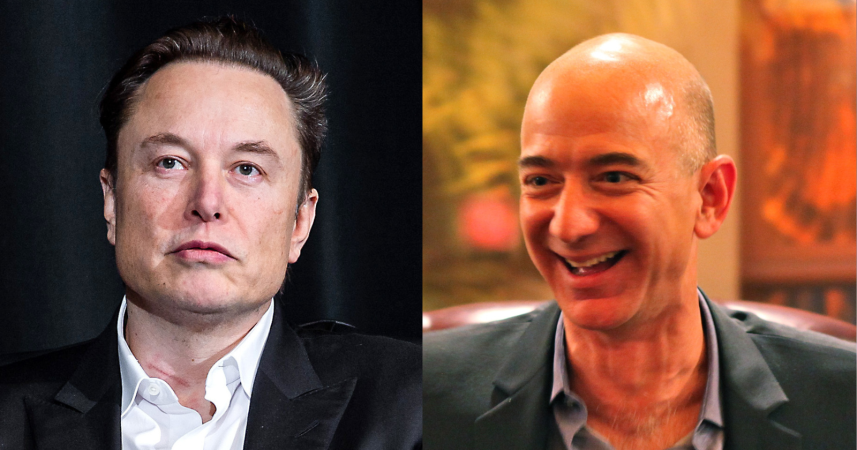
Two tech titans want opposite futures—one keeps us grounded, one aims for Mars; guess whose plan wins now.

Add VegOut to your Google News feed. 
If you squint, Jeff Bezos and Elon Musk want the same thing: a thriving human civilization that survives beyond the next few centuries.
But zoom in, and the roads diverge sharply.
Bezos, channeling physicist Gerard O’Neill, argues we should preserve Earth as our garden—“zoned residential and light industry”—while pushing heavy industry and much of our energy production off-world into giant space habitats.
Musk’s counter is blunt: make life multiplanetary by settling Mars, because a single-planet species is one bad day away from extinction.
The split isn’t just philosophical — it’s driving different technologies, timelines, and policy bets that will shape the next 20–30 years of spaceflight.
What Bezos really means by “Earth: residential, light industry”
At a 2019 Blue Origin event, Bezos laid out the plan: keep Earth livable by moving heavy industry and resource extraction to space, and house people in O’Neill-style rotating habitats with artificial gravity and “weather on demand.”
In this framing, Earth becomes a protected biosphere where humans mostly live, learn, and play, while factories, mining, and large power stations operate in orbit or on the Moon—fed by space-based solar power and off-Earth materials.
It’s a long-horizon vision, but it’s internally consistent: you reduce terrestrial pollution by exporting the dirtiest work to vacuum.
The nearer-term stepping stone is the Moon.
In 2023, NASA awarded Blue Origin a Human Landing System (HLS) contract to build the Blue Moon lander for a later Artemis mission (currently slated as Artemis V). That places Blue Origin squarely in the critical path of America’s lunar return and gives Bezos’ team practice with cryogenic propulsion, precision landing, and surface operations — skills you’d need for a cislunar economy where factories and depots live off-Earth.
Musk’s case for Mars (and why he thinks it can’t wait)
Musk’s argument is existential: sooner or later, something will end life on Earth—if not our own mistakes, then the Sun itself. The defense is redundancy: build a self-sustaining city on Mars while we still can.
Settling Mars demands a fully reusable super-heavy launcher (SpaceX’s Starship), on-orbit refueling, high-cadence flights, and life-support systems that can be closed-loop enough to thrive far from resupply. Musk says becoming multiplanetary is “insurance for life” and a moral imperative, not just an engineering challenge.
On capability, Starship has moved from concept to repeated flight tests and expanded envelopes, with SpaceX and regulators now discussing trajectories that include overflight of populated areas and precision returns as the system matures.
It’s still test-flight territory—not a transport network—but the cadence and ambition are unlike anything in the launch market.
If Starship reaches routine reusability and on-orbit propellant transfer, Musk’s Mars logistics shift from sci-fi to supply chain.
The NASA hinge: Artemis timelines that affect both visions
NASA’s Artemis program is the gravity well for both companies.
Artemis II—the first crewed lunar flyby of the program—is now targeted for early 2026, after schedule slips to address hardware issues. Artemis III, the first crewed landing of the program, is tracking to 2027 and hinges in part on Starship’s HLS variant readiness.
Meanwhile, Blue Origin’s Blue Moon enters later in the sequence under NASA’s “sustaining” lunar development plan.
The short version: Artemis is moving, but later than first advertised, and each slip reshuffles when Musk and Bezos can demonstrate the pieces of their bigger ideas.
The engineering philosophies behind the rhetoric
Bezos/O’Neill:
Build permanent habitats near Earth with rotation for gravity, harvest lunar/asteroid materials, and use space-based solar power. Keep transit times short to encourage commerce and family life to remain Earth-centric.
Big bet: manufacturing in microgravity and a cislunar logistics network will unlock new industries (pharmaceutical crystallization, fiber-optic materials, ultrapure semiconductors) without wrecking Earth.
Musk/Mars:
Push for a frontier settlement with surface gravity, atmosphere (thin), and local resources (water ice, CO₂) for fuel and building materials.
Big bet: high-rate fully reusable rockets drive launch costs low enough that thousands—not dozens—can go, and that a rugged, self-sufficient Martian city is achievable within decades, not centuries.
Notice the inversion:
Bezos imagines short-haul commuting among Earth, the Moon, and orbital habitats to preserve Earth. Musk imagines long-haul migration to another world to preserve humanity.
Who’s closer to their first big milestone?
Right now, SpaceX appears closer to a “proof of transport” milestone: making Starship reliably reach orbit, return, and eventually refuel on-orbit—capabilities that Artemis III also depends on for a lunar landing variant.
SpaceX flies often, iterates quickly, and has already transformed launch economics with Falcon 9. If Starship matures, it will set the mass-to-orbit price floor for everyone else.
Blue Origin’s near-term milestone is different: field Blue Moon on NASA’s schedule and ramp New Glenn into steady service.
New Glenn’s heavy-lift capacity plus Blue Moon’s precision landing would give Blue Origin real cislunar freight and surface chops—critical for the “move industry off-world” thesis.
NASA’s 2023 selection was a turning point because it anchors Blue Origin’s roadmap to government missions with firm requirements, not just slide decks.
The environmental ledger: two ways to be “green”
Bezos’ plan is explicitly environmental: export pollution, keep Earth’s biosphere intact.
The critique is that it requires massive upfront industrialization to create habitats and infrastructure—ironically, a near-term spike in resource and energy use to reduce long-term planetary load.
Musk’s plan is resilience-first: accept that Earth is fragile and build redundancy.
The critique is that Mars development could pull attention and capital away from fixing Earth now, and that even a million people on Mars doesn’t help the nine-plus billion who remain if climate impacts worsen here.
A likely truth is messy and dual-track: clean up Earth aggressively while building space systems that reduce supply-chain impacts (e.g., in-space manufacturing powered by sunlight) and provide off-world brakes on existential risk.
Bezos and Musk, despite the rhetoric, may be building complementary rungs of the same ladder.
Policy and geopolitics: who writes the rules of a space economy?
As Artemis firms up, the U.S.-led ruleset (Artemis Accords) is spreading, just as China accelerates its own lunar plans for a 2030 crewed landing and an international lunar research station.
The race is not just flags and footprints; it’s standards—from traffic coordination to resource use rights.
If Starship normalizes ultra-heavy logistics and Blue Moon normalizes precision surface ops, their capabilities will influence how regulators and partners write norms for refueling, debris, ISRU (in-situ resource utilization), and safety.
Artemis schedule updates in late 2025 underline that this governance period is here, not hypothetical.
What matters for you (and your lifetime)
-
Near-term wins you’ll notice: cheaper satellite internet and Earth observation (thanks to mass-to-orbit trends), more climate and disaster data, and likely lunar flyby tourism once crewed systems are proven safe across multiple flights. Starship’s eventual price curve could make university-class deep-space missions common.
-
Medium-term bets: lunar infrastructure (power, comms, surface mobility) that enables science and small-scale industry; New Glenn and Starship lanes for cargo; Blue Moon demos that set the tone for sustainable lunar ops.
-
Long-term forks: large-scale habitats (if O’Neill-style assembly becomes practical) vs. a Mars township (if reusability + ISRU click). Neither happens without steady Artemis progress and a stable regulatory environment, both of which are moving but delayed.
The philosophical crux—and a likely synthesis
Bezos asks: How do we protect Earth while allowing civilization to grow?
Musk asks: How do we protect civilization if Earth cannot be protected forever?
Those are not mutually exclusive questions. A plausible synthesis looks like this:
-
Use reusable heavy lift (driven by SpaceX and competitors) to drop costs and enable bulk cargo to cislunar space.
-
Use lunar missions (SpaceX/Blue Origin under Artemis) to derisk cryogenic storage, precision landing, and power systems.
-
Stand up first-gen off-Earth industry where it makes sense (fuel depots, materials processing) to reduce launch mass and Earth impact.
-
Pursue a sustained Mars program once transport economics and life-support reliability reach thresholds that make a city viable—not just a research outpost.
Under that synthesis, Earth benefits in the 2030s and 2040s from cleaner supply chains and better climate data, while a Mars foothold begins to look less like a gamble and more like a logical extension of a maturing space economy.
Bottom line
Bezos and Musk aren’t just feuding over bragging rights. They’re arguing over the organizing principle of human expansion into space: keep Earth as home base and export the mess, or spread humanity to hedge against catastrophe.
In 2025, the evidence on the ground looks like this: Artemis is inching forward with new target dates; SpaceX’s Starship is pushing the envelope toward high-cadence heavy lift; Blue Origin’s Blue Moon is on contract to join the lunar architecture.
Your lifetime will likely include both: Earth made cleaner by space-enabled industries—and the first serious attempt to build a town on another world.