There's an invisible system underneath daily life that most people never think about. This week, we got a glimpse of how it's protected.

Add VegOut to your Google News feed. 
If you're someone who likes to understand how things actually work—who notices when explanations don't quite add up, who suspects there's usually something underneath the surface—this is for you.
Because there's a question hiding in plain sight that almost nobody asks: How does the United States carry $38 trillion in debt, run permanent deficits, and never collapse?
Any other country doing this would have spiraled into crisis decades ago. The U.S. hasn't. There's a reason. And this week, a military raid on Venezuela revealed how that reason is defended.
What happened
On January 3rd, the United States military captured Venezuelan President Nicolás Maduro, flew him to New York in handcuffs, and announced that America would "run" his country until a transition could occur.
The official explanation was drug trafficking. Maduro had been indicted on narcoterrorism charges. But if you pay attention to how power actually operates, you know that official explanations often sit on top of deeper motivations.
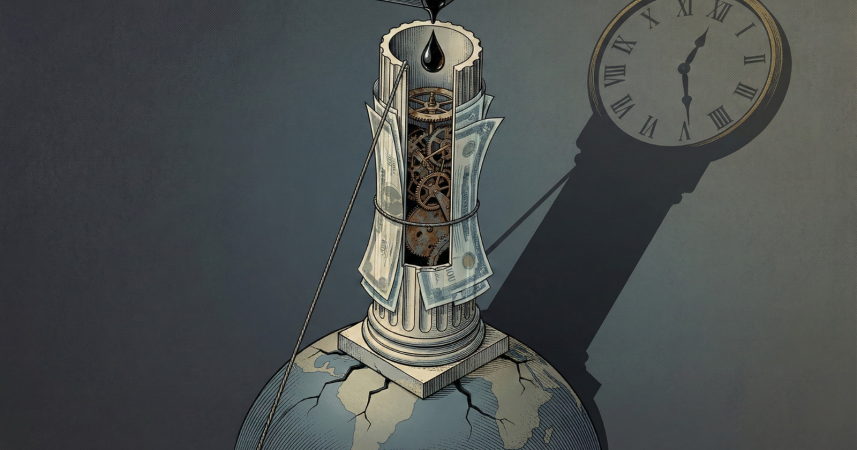
As I wrote this week, what happened in Venezuela is simpler and more significant than the headlines suggest: the United States moved to protect the economic architecture that allows American power to exist in its current form.
To understand why, you need to understand something most people have never heard of.
The privilege that makes it all possible
The U.S. government pays nearly $1 trillion per year just in interest on its debt—more than it spends on almost anything except Social Security. It runs deficits every year. It prints money to cover what it can't collect in taxes.
This should be catastrophic. For any other country, it would be.
The answer is something called the "exorbitant privilege"—a term coined in the 1960s by a French finance minister to describe the unique advantages of being the country whose currency the world uses.
Here's how it works: Because the world needs U.S. dollars to buy oil, settle international debts, and participate in global trade, there's constant demand for American currency. This demand allows the U.S. to borrow money more cheaply than anyone else. It means America can spend more than it earns, year after year, without the consequences other countries would face.
The foundation was laid in 1974, when the U.S. made a deal with Saudi Arabia: oil would be priced exclusively in dollars. In exchange, America would provide military protection. Other oil-producing countries followed. The "petrodollar" system was born.
For fifty years, this arrangement has funded American military dominance, enabled permanent government deficits, and shaped global trade in ways most people never see. It's invisible infrastructure—like the systems that bring electricity to your home. You don't notice it until something threatens it.
What Venezuela threatened
Venezuela sits on 303 billion barrels of proven oil reserves—the largest in the world, bigger than Saudi Arabia's.
And since 2018, Venezuela had been doing something that gets countries into serious trouble: selling oil in Chinese yuan instead of U.S. dollars.
About 80 percent of Venezuela's oil was going to China. Caracas had built payment systems that bypassed the U.S.-controlled financial network entirely. It was seeking membership in BRICS, the economic bloc building alternatives to dollar dominance.
In other words: a country with the world's largest oil reserves was proving you could function outside the American financial system—with Chinese support.
The pattern is hard to miss once you see it. Iraq switched to euros for oil in 2000; the regime was removed three years later. Libya's leader proposed a gold-backed African currency for oil; NATO intervened in 2011. Iran has sold oil outside the dollar system since 2012 and faces continuous sanctions and threats.
Venezuela is the latest chapter. The common thread isn't democracy or human rights. It's the currency in which oil is priced.
Why this matters for how you see the world
I'm not sharing this to make you feel cynical or helpless. I'm sharing it because understanding how things actually work is its own form of freedom.
Most of us move through life interacting with surfaces. We see news headlines but not the interests that shape what gets covered. We hear explanations but don't always notice when they don't quite fit. We participate in systems without realizing they exist.
The dollar system is one of those invisible structures. It shapes international politics, trade relationships, and which countries get labeled threats—all in ways that affect daily life without most people ever connecting the dots.
When Trump announced Maduro's capture, he didn't invoke democracy or human rights. He invoked the Monroe Doctrine—an 1823 declaration that Latin America belongs to America's sphere of influence. He said: "American dominance in the Western Hemisphere will never be questioned again."
That's unusually direct. And directness—even uncomfortable directness—is worth paying attention to. It tells you something true.
What to do with this
There's no tidy action item here. This isn't awareness that comes with a checklist or a product to buy.
What I do think is this: understanding the systems you exist within changes how you interpret everything else. It changes what questions you ask. It makes you less susceptible to explanations that don't add up.
Venezuela was captured for reasons that have very little to do with what most coverage tells you. If you understand the dollar system, you understand why. And that understanding extends outward—to trade wars, sanctions, why some countries become enemies and others stay friends despite similar behavior.
Living consciously means being awake to what's actually happening. Not just in your immediate choices, but in the larger structures that shape what choices exist in the first place.
The instinct that makes you want to understand how things work—that's the instinct to trust here. Follow it a little further than usual. See what you find.