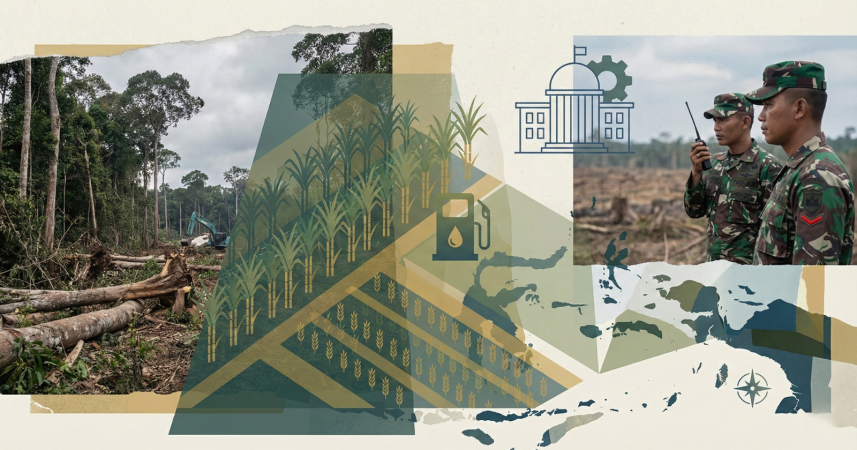
As fatal floods linked to deforestation kill over 1,000 people in Sumatra, the government is clearing 3 million hectares of Papua's pristine ecosystems for rice and sugarcane plantations.

Add VegOut to your Google News feed. 
Armed Indonesian soldiers have been filmed on TikTok posing with excavators deep in the forests of Papua, some carrying long firearms as they patrol alongside construction crews tearing through one of the planet's last great tropical wilderness areas. The videos, posted by the soldiers themselves, offer a rare glimpse into what environmental groups are now calling the largest single deforestation project currently underway anywhere on Earth.
The Indonesian government, under President Prabowo Subianto, is racing to clear approximately 3 million hectares of land in the eastern province of Papua for a massive state-backed agricultural project that will ultimately span an area five times the size of London, according to a Financial Times investigation published this week. Two-thirds of the targeted land is designated for sugarcane plantations to produce bioethanol, with the remainder earmarked for rice cultivation. Between May 2024 and November 2025, more than 40,000 hectares have already been cleared, satellite imagery analyzed by the Financial Times reveals.
The timing is jarring. Just weeks ago, catastrophic floods and landslides tore through the island of Sumatra, killing more than 1,000 people in what has become one of the deadliest weather events in Southeast Asia this year. Entire villages were buried under mud. Rivers swollen with rainwater carried something disturbing downstream: massive piles of neatly cut timber, evidence of the systematic logging that environmental groups say transformed a severe cyclone into a humanitarian catastrophe. The Indonesian Forum for the Environment estimates that 1.4 million hectares of forest in the affected provinces were cleared between 2016 and 2025 alone, stripping away the natural defenses that once absorbed rainfall and stabilized soil.
President Prabowo himself toured the devastated areas and vowed action. "Climate change, global warming and environmental damage. These are issues we must confront," he declared. "We must truly prevent the cutting down of trees and the destruction of forests." Yet simultaneously, his government continues to accelerate the Papua project, deploying five military battalions to the region and designating the food estate as a project of national strategic importance, a classification that grants the government eminent domain rights to evict communities from their land.
The contradiction has not gone unnoticed. In March 2025, United Nations human rights officials sent formal letters to both the Indonesian government and a key project developer, raising alarms over alleged human rights abuses and environmental destruction. The rapporteurs documented deforestation of more than 109,000 hectares, loss of biodiversity, and violations of Indigenous rights, including what they described as intimidation by military forces and a failure to obtain free, prior and informed consent from affected communities.
South Papua is home to approximately 50,000 Indigenous people spread across 40 villages, communities whose ancestors have lived sustainably in these forests for generations. The region harbors rare birds of paradise, tree kangaroos, and other endemic species found nowhere else on Earth. A government-sanctioned feasibility study from July 2024, obtained by the Financial Times, acknowledges that the development will overlap with protected forests, wildlife sanctuaries, and nature reserves. The same study estimates the land clearing will release 315 million tonnes of carbon emissions, though independent groups have forecast the figure could exceed double that amount.
Residents describe an atmosphere of fear. "The Indonesian National Armed Forces are working in the field with full weapons... some are holding long firearms. So, when landowners want to protest, they are afraid," Ambrosius Mulait, a researcher from Pusaka, an Indigenous rights advocacy group, told the Financial Times. Ariston Moiwen, whose family land in the town of Merauke has been taken over for rice cultivation, confirmed that soldiers are operating heavy equipment in addition to providing security. "Since the clearing of the forest, the military has been actively involved," he said. "The military operates the heavy equipment too."
The Indonesian defense ministry has defended the military presence, insisting it is not intended to intimidate local communities. Yusuf Jauhari, a defense ministry official, told journalists that patrols were standard operating procedure for maintaining the security of national strategic projects. Yet the scale of militarization is unprecedented in recent Indonesian agricultural policy. President Prabowo has created 100 new Territorial Development Battalions specifically to support his food security vision and appointed an active military general to lead Bulog, Indonesia's state-owned enterprise for food logistics, a decision critics say violates the 2004 Law on the Indonesian Armed Forces prohibiting active military personnel from holding civilian positions.
The project is being executed by two Indonesian companies with controversial track records. The Jhonlin Group, a coal mining and palm oil conglomerate owned by influential tycoon Haji Isam, is developing the rice fields and has ordered 2,000 excavators from China for the Papua project. The Merauke Sugar Group, controlled by the Fangiono family, is leading the sugarcane cultivation. Neither company responded to requests for comment from multiple news organizations. US chocolate maker Hershey has suspended both companies from its suppliers list due to their involvement in the project, according to a grievance log published on the company's website.
Scientists warn the entire endeavor may be doomed to fail. David Gaveau, founder of The Tree Map, a geospatial company researching deforestation, told reporters that Southern Papua's wetlands are characterized by high acidity unsuitable for rice cultivation. "If peat soils are present, rice farming will be even more difficult, as their high acidity and low fertility create a harsh environment for crops," Gaveau explained. He warned that draining the region's wetlands for agriculture risks turning the area into a tinderbox, vulnerable to the same catastrophic fires that have periodically devastated Indonesia's peatlands elsewhere.
Indonesia has attempted similar state-backed agricultural megaprojects before, and they have largely ended in disaster. The Mega Rice Project of the 1990s sought to convert 1 million hectares of peatland in Central Kalimantan into rice fields. It was abandoned after large-scale deforestation, draining of peatlands, and failed rice yields left the region vulnerable to fires and floods. An earlier iteration of the Merauke food estate project in the 2010s, despite promises of diverse crops, saw much of the land ultimately converted into monoculture plantations dominated by oil palm and sugarcane, leading to deforestation and social conflicts with Indigenous Papuans. Less than 9 percent of the land cleared under previous administrations was ever successfully cultivated.
The government justifies the project as essential for food and energy security. Indonesia, the world's fourth-most populous nation, currently relies on imports of rice and other staple commodities. Prabowo has made food self-sufficiency a centerpiece of his presidency, promising not to import rice throughout 2025 and launching a flagship free nutritious meals program for schoolchildren that requires vast food supplies. His brother and envoy for energy and the environment, Hashim Djojohadikusumo, has pledged that the government will reforest 6.5 million hectares of degraded land to mitigate negative impacts.
But experts say reforestation cannot match the ecological benefits of old-growth ecosystems, which store vast amounts of carbon in their soils and biomass, regulate water cycles, and support irreplaceable biodiversity. "It's hard to justify this project from any perspective... environmental, climate and the wellbeing of local communities," Glenn Hurowitz, chief executive of environmental group Mighty Earth, told the Financial Times. "Usually, deforestation is a product of government not doing its job. But in this case, it's actually the state saying we want to clear some of our last remaining forests, carbon-rich peatlands, habitat for rare animals."
The food estate stands in stark contrast to the climate pledges Prabowo has made to achieve net zero emissions before 2060. Indonesia is currently the world's fifth-largest emitter based on CO₂ emissions, producing approximately 660 million tonnes annually from fuel combustion alone, according to the International Energy Agency. The Papua project, by independent estimates, could add more than 600 million additional tonnes of emissions from land clearing alone.
The development also involves massive infrastructure: a 135-kilometer road, a seaside port, and a new airport. About 59 kilometers of the road have been completed as of November 2025 since construction began in July 2024. State-owned construction company PT Hutama Karya recently won a contract worth 4.8 trillion rupiah to build an additional 80-kilometer stretch of highway linking the coast to the interior. The deputy energy minister has said building the food estate and the initial infrastructure for the bioethanol supply chain would cost approximately $8 billion.
Several environmental and Indigenous groups have called for the project to be halted immediately. "These are carried out without due diligence and consideration of ecological balance, natural resource sustainability and the continuity of intergenerational rights," said Franky Samperante, executive director of Pusaka. "They ignore the rights of indigenous communities, simply for the economic benefit of a handful of corporations." The Indonesian government has rejected all allegations, claiming compliance with national laws and insisting that Indigenous rights and environmental safeguards are respected.
Yet as the bulldozers continue their advance through Papua's ancient forests, the graves are still being dug in Sumatra. More than 900 confirmed dead, nearly 400 missing, over 3 million people displaced. The floodwaters have receded, but the viral images of cut timber washing through devastated communities remain seared in the national consciousness. For many Indonesians, the question is no longer whether the government's policies will lead to environmental catastrophe. The question is whether the catastrophe unfolding in Papua can still be stopped before it becomes the next Sumatra.
If You Were a Healing Herb, Which Would You Be?
Each herb holds a unique kind of magic — soothing, awakening, grounding, or clarifying.
This 9-question quiz reveals the healing plant that mirrors your energy right now and what it says about your natural rhythm.
✨ Instant results. Deeply insightful.

Justin Brown
Justin Brown is a writer and entrepreneur based in Singapore. He explores the intersection of conscious living, personal growth, and modern culture, with a focus on finding meaning in a fast-changing world. When he’s not writing, he’s off-grid in his Land Rover or deep in conversation about purpose, power, and the art of reinvention.
More Articles by Justin