The emails look damning. I thought they were damning. But I was wrong.
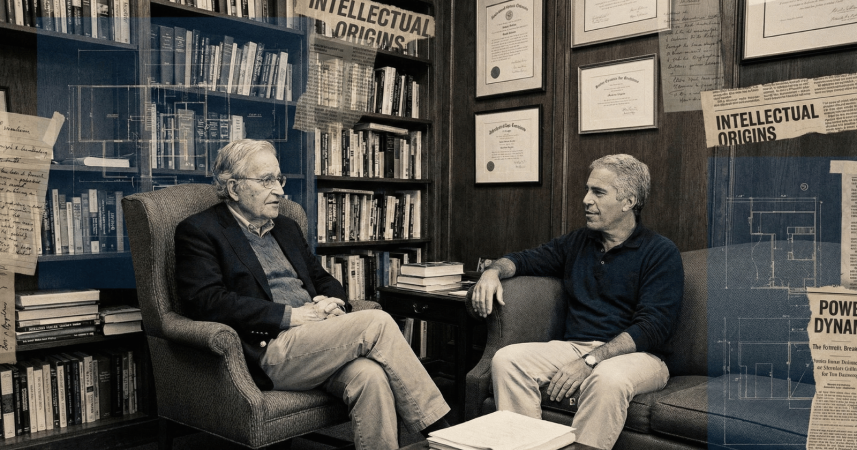
I know what you're thinking. You've seen the headlines. You've read the emails. Noam Chomsky — the 97-year-old linguist, the man who spent six decades holding the powerful to account — was friends with Jeffrey Epstein. Close friends. "Deep and sincere and everlasting" friends, according to one email released in the latest DOJ tranche. His wife Valeria called Epstein "our best friend. I mean 'the' one."
And then there's that 2019 email. The one where Chomsky advised Epstein on handling press scrutiny, writing: "That's particularly true now with the hysteria that has developed about abuse of women, which has reached the point that even questioning a charge is a crime worse than murder."
It looks damning. I thought it was damning. But I was wrong, and I think you might be too.
Let's start with what nobody is actually alleging
No one — not the DOJ, not the journalists covering the files, not even the most hostile commentators — is suggesting Chomsky was involved in or aware of Epstein's crimes. There are no accusations of participation, no evidence of knowledge, nothing. Valeria Chomsky's statement, released on February 7, says they "never went to his island or knew about anything that happened there" and "never witnessed any inappropriate, criminal, or reproachable behavior from Epstein or others."
Strip away the emotional charge of the name "Epstein" and what you're left with is an elderly academic who maintained a friendship with someone who turned out to be a predator. That's it. That's the full extent of it.
"But he was a convicted sex offender"
This is where most people's outrage starts. Epstein pleaded guilty in 2008. How could Chomsky not know?
Here's the reality: the 2008 deal was specifically designed to be invisible. Federal prosecutors under Alexander Acosta had a 53-page indictment ready, identifying 36 victims. Instead of pursuing it, they brokered a secret plea agreement that reduced the charge to a state-level offence — "soliciting prostitution" — with 13 months in a county jail and work-release privileges that let Epstein leave the facility six days a week. The non-prosecution agreement was sealed. The victims were not informed.
This wasn't justice being served. It was justice being buried. And it worked. Before Julie K. Brown's investigation in the Miami Herald in November 2018, the details of what Epstein had done and how he'd been protected were not in general circulation. His Harvard and MIT colleagues continued to meet with him. Institutions continued to accept his money. The information existed, but it existed in obscurity.
Chomsky and Valeria say they were introduced to Epstein in 2015 and were unaware of his 2008 conviction. Is that plausible? For a 87-year-old professor being introduced to someone at a professional event, who presented himself as a "philanthropist of science and a financial expert" — yes, it's entirely plausible. It would have required Chomsky to independently Google the criminal background of someone he was meeting in an academic setting. That's a standard we don't apply to anyone else.
The 2019 email isn't what you think it is
This is the piece of evidence that seems to seal the case. Chomsky advising Epstein, in early 2019, to ignore press criticism, dismissing it as "hysteria about abuse of women." Read in isolation, with full knowledge of what Epstein did, it's horrifying.
But Chomsky didn't have full knowledge of what Epstein did. And the email wasn't written in a vacuum.
Chomsky had spent decades being subjected to media pile-ons. He'd been called a genocide denier for his positions on Cambodia and the Balkans. He'd been called an anti-semite for his criticism of Israel. He'd been called a terrorist sympathiser. He had deep, lived experience of how public discourse manufactures outrage, and his skepticism of media-driven campaigns wasn't some ad hoc rationalisation — it was central to his intellectual work for half a century.
So Epstein tells Chomsky he's being unfairly targeted by the press. Chomsky pattern-matches this to his own experience. He gives the same advice he would give to anyone in that situation — advice he'd followed himself many times: ignore it, don't feed the cycle, the vultures want a reaction.
The "hysteria about abuse of women" line? Chomsky was talking about what is now commonly called cancel culture — a phenomenon he'd critiqued publicly and consistently. He wasn't dismissing abuse victims. He was, in his view, warning a friend about how media dynamics work. The fact that the friend was actually guilty doesn't retroactively make the advice sinister. It makes Chomsky someone who was lied to and believed the lie.
As Valeria put it: "Epstein created a manipulative narrative about his case, which Noam, in good faith, believed in."
If a friend told you they were being falsely accused of something, and you said "people get destroyed by allegations these days, keep your head down" — that would be normal, decent advice. The fact that your friend was actually guilty would be your friend's moral failing, not yours.
The real story is the manipulation
What the files actually reveal, once you set aside the outrage, is a textbook case of predatory manipulation targeting a vulnerable person.
By 2018, Chomsky was dealing with what he described to Epstein as "the worst thing that's ever happened to me" — a painful family dispute over money and inheritance, relating to trusts set up with his first wife Carol, who had died of brain cancer in 2008. As The Nation details, Epstein inserted himself directly into this crisis, offering financial expertise and emotional support.
Epstein also offered the couple use of his apartments, organised intellectually stimulating dinners with academics and public figures, paid Chomsky $20,000 for developing a linguistics challenge, and helped recover $270,000 of Chomsky's own retirement funds.
This is what professional manipulators do. They identify vulnerability. They offer help. They create dependency. They normalise the relationship. And then, when the truth comes out, everyone looks at the person who was targeted and asks: how could you?
The warmth of the emails — the "we're with you all the way," the "you're constantly with us in spirit" — reads as complicity if you assume Chomsky knew who Epstein really was. But if you accept, as the evidence suggests, that he didn't? It reads as an elderly couple expressing genuine gratitude to someone who helped them during an extremely difficult period of their lives.
Epstein was a professional at this. He cultivated relationships with hundreds of powerful and prominent people. The entire system was designed to produce exactly these kinds of compromising associations, so that anyone who got close would be tainted by proximity after the fact.
The double standard
Here's what bothers me most about the Chomsky pile-on. Epstein maintained relationships with sitting presidents, intelligence officials, tech billionaires, and Wall Street titans. Many of these people had far more resources and access to information than a 90-year-old academic. Many maintained their relationships with Epstein long after his 2008 conviction, with full knowledge of it.
The energy being directed at Chomsky — a man who cannot speak or defend himself after a devastating stroke in 2023 — is energy not being directed at the system that allowed Epstein to operate for decades. The prosecutors who gave him a sweetheart deal. The institutions that kept taking his money. The intelligence connections that may have shielded him. The powerful figures whose involvement went far deeper than attending dinner parties.
Instead, we're condemning an old man for being befriended in bad faith by someone who was very good at befriending people in bad faith. We're treating the target of manipulation as though he were a collaborator.
Where I actually land
I started where many of you are right now — convinced the emails spoke for themselves. But the more I looked at what Chomsky actually knew, when he knew it, and the circumstances under which this relationship developed, the less the outrage held up.
Chomsky wasn't an accomplice. He was a mark. A particularly valuable one for Epstein, precisely because of his moral authority. And the tragedy is that the very qualities that made Chomsky valuable to Epstein — his willingness to engage with anyone, his instinct to see good faith in people, his skepticism of media narratives — were the qualities Epstein exploited.
The real scandal of the Epstein files isn't that a 90-year-old professor was naive. It's that the systems that were supposed to stop Epstein — law enforcement, prosecutors, regulatory bodies — failed for decades. And now, instead of reckoning with that failure, we're arguing about whether Noam Chomsky should have Googled his dinner companion.
Chomsky spent his life telling us to look at systems, not individuals. It would be ironic if, in the end, we did the opposite to him.