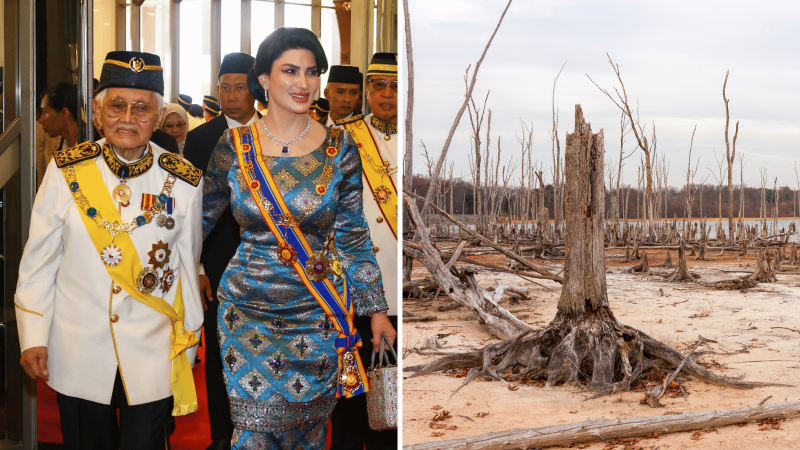
A Malaysian dictator's 1985 blueprint for forest theft—dissolve oversight, pocket billions—spread from Borneo to Brazil to the Congo. Forty years later, his machine is still running on three continents.

Add VegOut to your Google News feed. 
The chainsaw squeals as it bites into dead wood, joining what sounds like dozens more echoing through Cambodia's Central Cardamoms National Park. The heat is oppressive. Diesel fumes hang in the morning air.
In a 2023 Mongabay investigation, a logger named Saroeun described the daily reality: "Going into the forest is dangerous, some people die when trees fall on them, but they are desperate. They don't know what else to do: if we don't go to cut trees, we don't have money."
This scene repeats across the world's rainforests. In Indonesia's Papua region, authorities just seized 422 containers packed with illegally harvested timber. In the Congo Basin, a Chinese company called Congo King Baisheng exported $5 million worth of illegal timber in just six months, even after the government suspended its permits.
But this global catastrophe has a single origin point: Sarawak, Malaysia, 1985.
That year, a politician named Abdul Taib Mahmud made a decision that would reshape the world's rainforests. As I documented in my investigation into how his family amassed $21 billion destroying Borneo's ancient forests, Taib didn't just steal a forest. He invented a machine for stealing forests.
Now, forty years later, that machine is still running. From the Amazon to the Congo, from Indonesia to Cambodia, the blueprint Taib created has become the operating manual for ecological destruction on an industrial scale. The dictators and timber barons who studied his methods have stripped millions of hectares of rainforest using his exact template: dissolve oversight, concentrate power, create patronage networks, launder the profits offshore.
The cost has been catastrophic. But to understand how we got here—how one man's greed became a virus that infected three continents—you have to understand what Taib figured out that his predecessors didn't.
The Blueprint
When Taib became Chief Minister of Sarawak in 1981, he inherited a system where officials took bribes from logging companies. It was profitable, but inefficient. Money leaked out at every level. Environmental assessments slowed things down. Bureaucrats asked inconvenient questions.
Taib saw a better way. First, he appointed himself Finance Minister and Natural Resources Minister simultaneously, concentrating unprecedented power in one pair of hands. Then, in 1985, came his masterstroke. According to Lukas Straumann's investigation in "Money Logging": "In 1985, Taib dissolved Sarawak's forestry department and placed logging concessions and plantation licences directly under his watch."
Think about the audacity of that move. With a single decision, he eliminated environmental assessments. No more bureaucrats asking questions. No more oversight. Just one man's signature between virgin rainforest and chainsaw.
But Taib understood something crucial: you can't run a machine this big alone. So he created the "Big Six"—timber companies that would become the enforcers of his system. Samling, Rimbunan Hijau, WTK, KTS, Shin Yang, and Ta Ann weren't just logging companies. They were the components of a vast extraction machine, each controlling territories larger than some countries.
The money flowed in amounts that stagger comprehension. Japanese tax investigators uncovered just one scheme where nine shipping companies paid 1.1 billion yen ($9.7 million) in kickbacks to Hong Kong shell company Regent Star, controlled by Taib's brother Onn Mahmud. These "brokerage fees" were mandatory—no payment, no export permit.
By 2012, these six companies collectively controlled over 3.7 million hectares of Sarawak's forests. The result? Today less than 5 percent of the state's once vast rainforests have been spared from logging or conversion to plantations.
But here's what made Taib's system truly insidious: it was designed to spread.
The Infection Spreads
In 2007, a governor in Indonesian Borneo named Suwarna Abdul Fatah was watching his neighbor's success with interest. East Kalimantan province had forests. It had indigenous communities who could be ignored. It had a government that could be bought.
Suwarna didn't need to reinvent the wheel. He simply copied Taib's blueprint, point by point. According to Indonesia's Corruption Eradication Commission investigation, his scheme worked like this: "Claiming it would establish oil palm plantations, the firm obtained licenses from Suwarna to clear a vast area of rainforest in Borneo. The governor also allowed the firm to avoid providing a bank guarantee to cover the expected taxes from the timber revenue."
The result? "Martias's firm felled almost 700,000 cubic meters of timber, but the land was never planted." Both the timber baron and the governor were convicted and imprisoned. But the blueprint survived.
Today in Central Kalimantan, the machine has new operators. As The Gecko Project revealed: "The current governor of Central Kalimantan, Sugianto Sabran, is a nephew of Abdul Rasyid, the one-time illegal-timber baron. The latter is now a near billionaire, the main source of his wealth a collection of vast oil palm estates."
Cambodia's adoption of the blueprint was even more brazen. Global Witness found that "Cambodia's most powerful logging syndicate is led by relatives of Prime Minister Hun Sen and other senior officials." The modus operandi is identical to Sarawak: hand out concessions that vastly exceed legal limits, collect payments before elections, silence anyone who complains.
Try Pheap, a tycoon who once served as an adviser to Hun Sen, exemplifies how the system works. According to a report by the Cambodia Human Rights Task Force, he has been "granted state land concessions that are nearly seven times above the limit under the law." The report also alleged that Try Pheap "channeled around U.S. $1 million to Hun Sen's family and the ruling Cambodian People's Party (CPP) for unspecified expenditures before the July 28 elections."
But nowhere has the model been more devastating than in the Democratic Republic of Congo. Here, Chinese companies discovered they didn't even need local politicians to run the machine—they could operate it themselves.
Congo King Baisheng Forestry Development provides a textbook example. According to Global Witness, the company "obtained extensive concessions in the provinces of Équateur and Mongala in 2018—a time when a moratorium on allocation of industrial forestry concessions was in place."
When the DRC's Environment Ministry finally suspended their permits in April 2022, the company simply ignored the order. Global Witness tracked how "in the second half of 2022, it shipped more than $5 million worth of illegal timber from its bases in the DRC to a port near Shanghai."
Even Brazil, with its sophisticated environmental movement and democratic institutions, couldn't resist the infection. Here the blueprint evolved, adapted to local conditions. Instead of concentrating power in one politician, the machine distributed it through campaign finance.
A Washington Post investigation found staggering numbers: "More than 1,590 people and 717 companies cited for environmental wrongdoing made at least 5,546 contributions over the past two decades, amounting to nearly $37 million."
The virus had mutated, but its DNA remained unchanged: those who destroy forests buy the power to keep destroying them.
The Carriers
If Taib created the blueprint, Malaysia's Big Six timber companies became its evangelists. Flush with profits from stripping Sarawak bare, they expanded across the globe—and brought the corruption model with them.
Take Rimbunan Hijau, controlled by Malaysian billionaire Tiong Hiew King. Today, the company has operations in Indonesia, Papua New Guinea, Equatorial Guinea, Gabon, Vanuatu, New Zealand and Russia. In PNG alone, Rimbunan Hijau is the single biggest logging operator and runs the country's largest sawmill.
The company's modus operandi remains consistent wherever it goes. In Papua New Guinea, campaigners report that "billions of dollars worth of valuable timber has been carelessly ripped out of Papua's native owned lands" by Malaysian companies including Rimbunan Hijau and WTK. "At least 5 million hectares of valuable hardwood has been cleared out according to present statistics and 90% of the logging has been conducted by Malaysian companies."
The human cost has been devastating. According to testimonies collected by Sarawak Report, communities in PNG describe treatment that echoes the abuse in Sarawak: "They treated us like animals and we know our human rights have been violated to a great extent," said one female villager after Rimbunan Hijau forcibly removed her community from land they had occupied for 40-50 years.
Local activists in PNG say the police have been bankrolled by Rimbunan Hijau to terrorize indigenous communities: "The police have mistreated the locals by abusing them with sticks, fan belts, telling them to sit in the sun for five hours, swearing at them, arriving in the villages at night forcing them to sign papers with the people not understanding the content."
Samling, another of the Big Six, has spread the infection just as effectively. The company has been "internationally condemned for environmental destruction in regions such as Guyana in South America, Cambodia and Papua New Guinea."
In Liberia, companies linked to Samling were exposed for grasping "nearly a quarter of the largest remaining area of the Liberian rainforest" through a system of abusing local permits meant for forest dwellers. Their partner in that scandal? Taib's own cousin, Hamed Sepawi.
These companies didn't just export timber—they exported an entire system of corruption. Wherever they went, the pattern repeated: bribe officials for concessions, ignore environmental laws, use police and military to suppress local opposition, declare no profits to avoid taxes, move the money offshore.
The blueprint had gone global.
The Perfection of Destruction
Like a virus mutating to survive in new hosts, Taib's blueprint evolved as it spread. Each country that adopted it added its own innovations, making the machine more efficient, more ruthless, more difficult to stop.
Indonesia added a layer of democratic legitimacy through regional autonomy laws. Now, instead of one dictator controlling everything, you had dozens of regional politicians—governors, regents, mayors—all running their own versions of the machine. The corruption became cellular, harder to track, impossible to eradicate.
As former Corruption Eradication Commission deputy Laode Syarif noted, recent cases show the pattern: "East Kalimantan governor Suwarna Abdul Fatah in land-permit issuance. The KPK also arrested former Riau governors, Rusli Zainal and Annas Maamun, in forest-exploitation cases."
Cambodia perfected the art of forced evictions. Where Taib had to at least pretend to respect native customary rights, Cambodia's elite simply removed entire communities. Human Rights Watch documented how "with the opposition at bay, more political killings followed in 2007" and how the government "forcibly evicted thousands of families, claiming the land was owned by private companies or needed for public projects."
The latest innovation? Using protected areas and carbon credits as cover. Companies clear-cut forests, then declare the devastated land a "conservation concession" to prevent communities from returning. In the DRC, investigators found a European logging firm "may have illegally converted more than a dozen of its timber concessions" into conservation concessions after harvesting the most valuable timber.
But perhaps the most chilling evolution has been in Brazil, where the machine learned to work within a democracy. As documented by Earthsight, environmental criminals don't need to seize power—they simply buy it: "131 federal deputies—25% of the lower chamber of congress—and 17 senators—21% of the senate—received a total of R$8.3m ($2.2m) from businessmen implicated in environmental or labour violations."
The machine had evolved from dictatorship to democracy without missing a beat.
The Accounting
The numbers are so large they lose meaning. Since Taib dissolved Sarawak's forestry department in 1985, the machine he created has consumed forests at a pace that defies comprehension.
Start with Sarawak itself. Between 2019 and 2023 alone, the state lost 423,500 hectares of forest. That's 0.16 hectares every minute. In the time it takes to read this article, another three hectares have fallen—trees that stood for centuries, ecosystems that took millennia to evolve, gone forever.
Now multiply that devastation across three continents.
In Indonesia, Human Rights Watch calculated that "more than half of all Indonesian timber from 2003 through 2006 was logged illegally." The cost to the Indonesian economy: $2 billion annually in lost revenue. That's equal to the amount that would be "sufficient to provide a package of basic health care benefits to 100 million of the nation's poorest citizens."
Cambodia has lost forest at one of the world's fastest rates. According to Forest Trends, "95 percent of the timber harvested between 1997 and 1998 was illegally felled." The country that was once 73% forested now struggles to protect its remaining fragments.
In the Congo Basin, home to the world's second-largest rainforest, the machine grinds on. The Democratic Republic of Congo had its highest primary forest loss on record in 2024, with illegal logging for charcoal and timber driving the destruction.
Papua New Guinea, once pristine, has been ravaged. At least 5 million hectares of valuable hardwood has been cleared, with 90% of the logging conducted by Malaysian companies using Taib's blueprint.
Brazil's Amazon, despite having the world's most sophisticated forest monitoring systems, couldn't escape. During Jair Bolsonaro's presidency alone, deforestation across the Brazilian Amazon amounted to 35,193 km². Even Indigenous territories—the last bastions against deforestation—saw a 129% increase in forest loss.
But the environmental toll is only part of the accounting. The human cost has been catastrophic.
Millions of Indigenous people have been displaced. In PNG, a landmark court decision found that logging had caused not just environmental destruction but that "the way of life of the people was completely destroyed."
The violence has been systematic. In Cambodia, a journalist covering environmental issues was shot and killed in December 2024. Six environmental activists were arrested while investigating illegal logging in November 2024. This follows what the Global Initiative documented as a pattern where "environmental defenders face a David and Goliath battle to protect some of the most valuable forests remaining in South East Asia."
The climate impact multiplies every other consequence. Each hectare of rainforest destroyed releases centuries of stored carbon. The forests that once regulated rainfall patterns are gone, leaving drought and flood in their wake. The very countries that adopted Taib's blueprint are now its victims—their cities choke on smoke from burning forests, their farms fail as rainfall patterns collapse.
There's a bitter irony here. The machine Taib built to extract wealth has impoverished entire nations. It promised development but delivered destruction. It concentrated billions in the hands of a few while condemning millions to poverty.
And it's still running.
The Machine Outlives Its Creator
Abdul Taib Mahmud died on January 21, 2024, at age 87. The man who dissolved a forestry department, who turned Sarawak's rainforests into $21 billion of family wealth, who created the blueprint for ecological genocide, was gone.
But death hasn't stopped the machine he built.
Right now, as his family fights over his fortune in Malaysian courts, chainsaws are screaming through forests on three continents. In Cambodia, companies are still shipping timber from protected areas using networks established decades ago. In Indonesia, the president just drafted the military to lead forest reclamation—not from corporations, but from Indigenous communities.
In the Congo, the machine runs with brutal efficiency. Chinese companies have discovered they don't even need to hide anymore. When caught with illegal timber, they simply keep operating. When governments suspend their permits, they ignore them. The blueprint Taib created has evolved beyond the need for subterfuge.
The saddest part? We know how to stop it. Study after study shows that Indigenous-managed forests have the lowest deforestation rates. Where communities control their land, forests survive. But the machine Taib built is designed precisely to strip communities of that control.
Forty years ago, one man looked at an ancient rainforest and saw only money. He built a machine to extract that money, a blueprint so effective it spread across the world like a virus. That machine has consumed millions of hectares of forest, displaced millions of people, and pushed our climate to the brink.
Taib is dead. His blueprint lives on.
In boardrooms from Sibu to Shanghai, in presidential palaces from Jakarta to Kinshasa, in logging camps from the Amazon to the Congo, the machine keeps running. The chainsaw keeps screaming. The forest keeps falling.
He created the perfect crime and taught it to the world.
And we're all paying for it.
Now watch
If You Were a Healing Herb, Which Would You Be?
Each herb holds a unique kind of magic — soothing, awakening, grounding, or clarifying.
This 9-question quiz reveals the healing plant that mirrors your energy right now and what it says about your natural rhythm.
✨ Instant results. Deeply insightful.

Justin Brown
Justin Brown is a writer and entrepreneur based in Singapore. He explores the intersection of conscious living, personal growth, and modern culture, with a focus on finding meaning in a fast-changing world. When he’s not writing, he’s off-grid in his Land Rover or deep in conversation about purpose, power, and the art of reinvention.
More Articles by Justin