Scientists have discovered something that should concern anyone worried about climate change: Australia has a carbon bomb that's been detonating in slow motion for at least 6,000 years, and there's absolutely nothing we can do to stop it. Every hour of every day, an underground fire beneath Mount Wingen in New South Wales pumps carbon […]

Add VegOut to your Google News feed. 
Scientists have discovered something that should concern anyone worried about climate change: Australia has a carbon bomb that's been detonating in slow motion for at least 6,000 years, and there's absolutely nothing we can do to stop it.
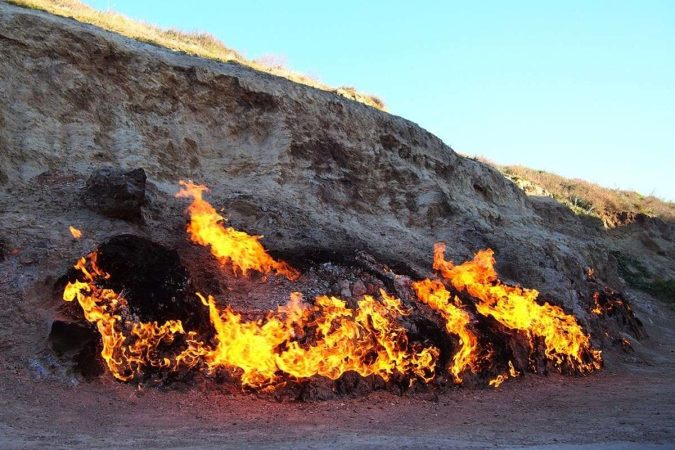
Every hour of every day, an underground fire beneath Mount Wingen in New South Wales pumps carbon dioxide and toxic fumes into our atmosphere. Not from a coal plant we can regulate. Not from vehicles we can electrify. But from an ancient, unstoppable fire burning through a coal seam 30 meters underground that will likely outlive human civilization.
This is Burning Mountain, and it's just one of thousands burning at any one time around the globe. Together, these underground coal fires release 40 tons of mercury into the atmosphere annually, and three percent of the world's annual carbon dioxide emissions.
"It's not just that it's 6,000 years old… it's at least 6,000 years old. It could actually be hundreds of thousands of years old," Guillermo Rein, a fire science professor at Imperial College London, told ScienceAlert. He's one of the few scientists who has studied this ancient inferno up close, visiting the site in 2014. "No one knows the size of the fire under Burning Mountain, you can only infer it. It's likely a ball of around 5 to 10 meters in diameter, reaching temperatures of 1,000 degrees Celsius."
Think about what that means. While world leaders gather at climate summits, while we agonize over carbon credits and argue about fossil fuels, the earth itself is adding to every target we set. These fires don't care about the Paris Agreement. They were burning before humans discovered fire. They'll be burning after the last car runs out of gas.
The smoke rises from fissures in the earth like the mountain's own breath, visible proof of an inferno that has outlasted civilizations. Tourists who make the four-hour pilgrimage from Sydney find themselves walking through a landscape that seems borrowed from another planet. The ground radiates heat through their shoes. The air tastes of sulfur. Around the active vents, nothing grows—a 50-meter dead zone where the constant heat has cooked the soil into sterility.
When farmhand Smart first saw this smoke rising from Mount Wingen in 1828, he did what any rational person would do—he assumed he'd discovered a volcano. The colonial settlers were still mapping this strange new land, still trying to make sense of its alien landscapes. But when geologist Reverend C.P.N. Wilton arrived in 1829 to investigate, what he found defied explanation. This was no volcano. The mountain itself was burning from within, had been burning for "far preceding the memory of man," as he wrote.
Scientists calculate the fire's age by measuring its path—a 6.5-kilometer trail of devastation that scars the landscape. The fire creeps south at precisely one meter per year like a geological clock that never needs winding.
The Wanaruah people, the traditional custodians of this land, have their own understanding of the fire's origins. In one story, a woman waited on the cliff edge for her warrior lover to return from battle. When he never came, she begged the sky god Baayami to end her life. As he turned her to stone, she wept tears of fire that ignited the mountain.
Science offers different theories: lightning strikes hitting exposed coal seams, spontaneous combustion from the oxidation of minerals in the coal, ancient volcanic activity. Studies show that the self-heating point for coal can range from just 35 to 140 degrees Celsius. But the truth is, nobody really knows what sparked this eternal flame.
What we do know is what it's doing to our planet. Burning Mountain is just one of an estimated hundreds of coal seam fires burning anywhere large coal deposits exist. In China alone, fires are expected to keep burning well into the next century. In Pennsylvania, the abandoned town of Centralia has been on fire since 1962.
But Centralia is an infant compared to Burning Mountain. The United States has 112 documented underground fires, along with many more not yet known or counted. These fires recognize no borders, acknowledge no protocols. They just burn.
"The impact of climate change on coal seam fires and the impact of coal seam fires on climate change is definitely something we are very concerned about," Rein explained. It's a feedback loop written in flame and time: as our planet warms, conditions become more favorable for new fires to start through spontaneous combustion.
During his 2014 visit, Rein noticed something that added urgency to his academic interest. The fire is approaching a cliff face above a small river. "The coal seam might break through and come out very close to the surface of the cliff, which could result in flames with much more heat," he explains. After 6,000 years of smoldering invisibly underground, Burning Mountain might finally reveal its fire to the world.
Or something else might happen. "If the coal seam goes very deep it will extinguish itself and smolder out – which would be very dramatic if that happens during our lifetime after burning for possibly hundreds of thousands of years," Rein said.
The thought is almost incomprehensible. Imagine being the generation that witnesses the end of the world's oldest fire. In an era where we measure environmental destruction in quarterly reports and election cycles, Burning Mountain measures time in geological epochs.
Standing on Burning Mountain, you can feel the heat through your boots. The surface temperature near the vent is around 350°C. You can smell the sulfur, see the smoke, touch the discolored rocks stained yellow and red from minerals baking in the heat. But what you're really experiencing is deep time made tangible, the earth's processes laid bare.
The Wanaruah people understood this. They incorporated the fire into their lives, using it for warmth, for cooking, for crafting tools. They didn't try to extinguish it or control it. They simply acknowledged its presence and adapted.
As I write this, Burning Mountain is still burning. Right now, at this very moment, ancient coal is oxidizing into carbon dioxide 30 meters beneath the Australian soil. The fire that was burning when the Egyptians were planning the pyramids continues its slow consumption. It will be burning when you finish reading this article. It will be burning tomorrow. Next year. Next century, in all probability.
"Smouldering fires, the slow, low-temperature, flameless form of combustion, are an important phenomena in the Earth system, and the most persistent type of combustion," as Rein explained to the New York Times. "Once ignited, these fires are particularly difficult to extinguish despite extensive rains, weather changes or firefighting attempts, and can persist for long periods of time (months, years), spreading deep (5 meters) and over extensive areas of forest subsurface."
Perhaps that's the real lesson of Burning Mountain: not that we're powerless, but that we're not the only power at work. The earth has its own processes, its own timeline, its own indifference. Our task is not to control these forces—we can't—but to understand our place among them.
The fire burns on. It always has. It always will. And somewhere in the Australian outback, the smoke continues to rise from the earth, a signal fire that no one lit and no one can extinguish, marking the passage of time in meters and millennia, in carbon and coal, in the slow breath of a burning mountain that has outlasted everything we've ever built or believed.
If You Were a Healing Herb, Which Would You Be?
Each herb holds a unique kind of magic — soothing, awakening, grounding, or clarifying.
This 9-question quiz reveals the healing plant that mirrors your energy right now and what it says about your natural rhythm.
✨ Instant results. Deeply insightful.

Justin Brown
Justin Brown is a writer and entrepreneur based in Singapore. He explores the intersection of conscious living, personal growth, and modern culture, with a focus on finding meaning in a fast-changing world. When he’s not writing, he’s off-grid in his Land Rover or deep in conversation about purpose, power, and the art of reinvention.
More Articles by Justin