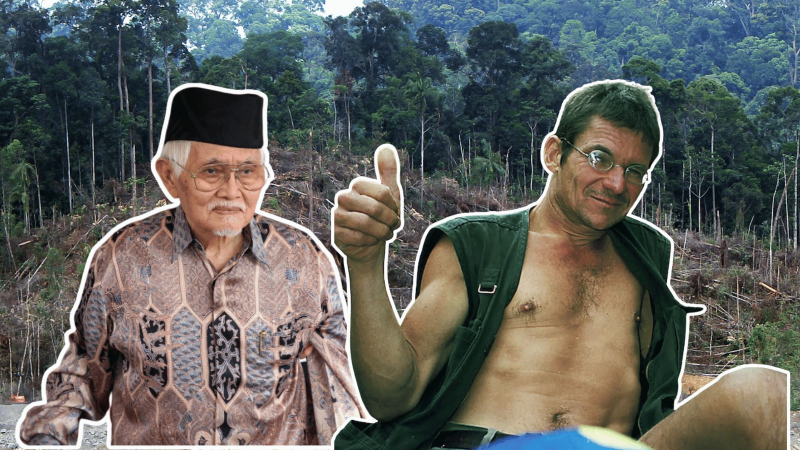
I'd spent weeks investigating one of the greatest environmental crimes you've never heard of. In the Malaysian state of Sarawak, on the island of Borneo, a single politician named Abdul Taib Mahmud had orchestrated the destruction of one of Earth's oldest rainforests — turning trees that had stood for centuries into $21 billion of personal […]

Add VegOut to your Google News feed. 
I'd spent weeks investigating one of the greatest environmental crimes you've never heard of. In the Malaysian state of Sarawak, on the island of Borneo, a single politician named Abdul Taib Mahmud had orchestrated the destruction of one of Earth's oldest rainforests — turning trees that had stood for centuries into $21 billion of personal wealth.
The numbers were staggering: an area of forest the size of England, gone. 2.5 million indigenous people driven from their ancestral lands. Between 2019 and 2023 alone, another 423,500 hectares destroyed — that's a football field every two minutes, around the clock, for four straight years.
After mapping how Taib built his corruption machine — appointing himself both finance minister and natural resources minister, dissolving environmental protections, granting logging licenses to relatives — I felt crushed. The system seemed unstoppable. Perfect, even, in its total fusion of political power and environmental destruction.
I needed something else. Not more spreadsheets of devastation, but a human story. Someone who had tried to stop it.
That's when I opened Carl Hoffman's The Last Wild Men of Borneo.
The book tells two stories, but I found myself drawn to one: Bruno Manser, a Swiss shepherd who in 1984 walked into the same Malaysian rainforest Taib was destroying. What happened next is one of the most extraordinary — and heartbreaking — environmental stories of our time. It's a story most people have never heard, about a man who gave everything to save a forest and a people, only to vanish without a trace.
But it's also a story about what his sacrifice taught the environmental movement — lessons we're still learning today.
Bruno Manser grew up middle-class in Basel, Switzerland, but he'd always been different. In the 1970s, while his peers chased careers, he chose to become a shepherd in the Swiss Alps, living without electricity or running water, making his own tools, seeking a simpler existence. By 1984, at age 30, he wanted to go deeper — to find people still living in harmony with nature, untouched by modern civilization.
He found the Penan.
The Penan were one of the last nomadic tribes on Earth, roughly 10,000 people living in Borneo's interior rainforest as their ancestors had for thousands of years. They owned nothing and everything — no permanent homes, but an entire forest. They hunted wild boar with blowpipes and poison darts, gathered sago palm to make flour, moved when the resources thinned, leaving the forest to regenerate behind them.
Hoffman brings this world alive through Bruno's journals and sketches. Here's Bruno learning to read the forest like a book — which trees fruit in which season, which vines hold drinking water, how to build a shelter from palm fronds that would keep you dry through torrential rain. The Penan taught him their language word by word: kayeu for tree, ba for water. They gave him a name: Laki Penan. The Penan man.
For two years, it was paradise. Then the chainsaws arrived.
What Bruno didn't know when he entered the forest was that Sarawak's new Chief Minister, Abdul Taib Mahmud, had just launched one of the most audacious resource grabs in history. While previous leaders had merely taken bribes from logging companies, Taib revolutionized corruption. He appointed himself minister of both finance and natural resources, giving him control over both the forests and the money they generated. He dissolved the forestry department entirely in 1985, eliminating environmental assessments and oversight. Then he handed out logging concessions covering millions of hectares — not through competitive bidding, but to his relatives, friends, and political allies.
These weren't small operations. Companies like Rimbunan Hijau and Samling were given territories larger than some European countries. In return, they kicked back millions through elaborate schemes — "consulting fees" paid to Taib's family members, shares in companies registered to his relatives, property deals that enriched his children. One Japanese investigation found timber companies paid $9.7 million in kickbacks through Hong Kong shell companies controlled by Taib's brother. The genius was its circularity: timber money bought political power, which granted more timber licenses, which generated more money.
While Bruno was learning to hunt with blowpipes, Taib's companies were pushing deeper into Penan territory each day. Clear blue streams turned brown with erosion. The wild boar fled. Sago palms were bulldozed. Sacred burial sites were destroyed.
The Penan didn't understand what was happening. They had no concept of land ownership — the forest had always been there, like the air. Now men with chainsaws were telling them it belonged to companies in faraway cities.
This is where Bruno transformed from observer to activist. He helped organize the first blockades in 1987 — entire communities standing across logging roads, armed with nothing but their presence. Old women, young children, hunters who had never protested anything, linking arms in front of bulldozers.
The image was so powerful it went global. Hoffman describes how international media descended on Sarawak. Al Gore, then a US Senator, condemned the logging. Prince Charles called the treatment of the Penan "genocide." The BBC, National Geographic, and major newspapers sent crews. For a moment, it seemed like international pressure might actually work.
But Taib was smarter than that. While Bruno was teaching the Penan to blockade roads, Taib was building something far more sophisticated — a machine that turned trees into money and money into power. He controlled which companies got logging licenses. Those companies kicked back millions to his family. That money bought more political power, which granted more licenses. It was a perfect circle of corruption.
The Malaysian government put a bounty on Bruno's head — 50,000 ringgit for his capture. He became enemy of the state number one, hiding in the jungle, moving constantly. In 1990, after six years in the forest, he was smuggled out of Sarawak to bring the Penan's story to the world.
This is where Hoffman's book becomes both inspiring and tragic. Bruno threw everything at the cause. He organized a world tour — "Voices for the Borneo Rainforest" — bringing Penan leaders to speak at the UN. He went on a 60-day hunger strike in front of the Swiss parliament, demanding a ban on tropical timber imports. He chained himself to buildings, scaled cathedral walls to hang banners, paraglided over Taib's mansion wearing a sheep costume.
The stunts made headlines. They also made him easy to dismiss.
While Bruno was staging dramatic protests, Taib was moving billions through Swiss banks, British real estate, Canadian shell companies. While Bruno testified at the massive 1992 Earth Summit in Rio — attended by 117 heads of state — Taib's companies were clearing 10,000 hectares a month. While Bruno appealed to conscience, Taib appealed to greed — and greed was winning.
The Malaysian government's response was telling. Prime Minister Mahathir Mohamad wrote Bruno a series of increasingly angry letters. In one, he accused Bruno of "European superiority," writing: "You are no better than the Penan." In another, he got more specific: "As a Swiss living in the laps of luxury with the world's highest standard of living, it is the height of arrogance for you to advocate that the Penans live on maggots and monkeys in their miserable huts, subjected to all kinds of diseases."
This was clever propaganda — painting Bruno as a romantic colonialist who wanted to keep the Penan primitive for his own satisfaction. But Mahathir was creating a false choice. Bruno wasn't telling the Penan to reject modernity; he was trying to stop their forest from being stolen before they had any say in their own future. The choice wasn't between "maggots and monkeys" or development — it was between sustainable development that included the Penan or theft that enriched Taib.
By 2000, Bruno knew he had failed. The forest was still falling. Many Penan had been forced to settle in villages, their nomadic life impossible without forest. Some young Penan now worked for the very logging companies destroying their homeland. Bruno told friends he was deeply depressed. His success rate, he admitted, was "less than zero."
In May 2000, he returned to Sarawak one last time. He was last seen heading toward Batu Lawi, a sacred mountain. The Penan searched for months but found no trace. He had simply vanished. To this day, they call him Laki e'h metat — "the man who disappeared" — because speaking the names of the dead is taboo.
Here's where the story could end: idealist takes on corruption, loses everything, disappears. The machine wins. The forest falls. The end.
But that's not what happened.
Bruno Manser failed to save the forest. But he succeeded in something else — making the invisible visible. Before Bruno, nobody outside Sarawak knew the Penan existed. Nobody knew their forest was being destroyed. Nobody knew about Taib's corruption machine.
After Bruno, everybody knew. And that knowledge became power.
Take Clare Rewcastle Brown, a British journalist who grew up in Sarawak. In 2010, she started a website called Sarawak Report, investigating the very corruption Bruno had protested. But where Bruno brought moral outrage, she brought forensic accounting. She traced money from logging companies through offshore accounts to London real estate. She published leaked documents showing exactly how Taib's family profited from each logging license.
Her work was only possible because Bruno had already made people care. He'd shown the human cost — the faces of the Penan, their children singing on blockades. Now she could show the financial crime behind it. Together, the moral case and the legal case became undeniable.
Or look at the Bruno Manser Fund today. The organization Bruno founded still fights for the Penan, but differently. They provide lawyers for land rights cases. They use GPS technology to map traditional territories. They file complaints with international bodies. They lobby governments. They do the patient, systematic work Bruno couldn't or wouldn't do.
Would any of this exist without Bruno's spectacular failure? Would lawyers care about filing land claims if Bruno hadn't first shown us the people who needed them? Would journalists investigate timber corruption if Bruno hadn't made us care about trees?
This is what my years of reading Howard Zinn and Noam Chomsky have taught me: movements need different kinds of people. Zinn wrote about how social change comes from "millions of small acts" by ordinary people doing what they can. Chomsky showed how power systems require multiple forms of resistance — those who expose, those who organize, those who inspire. They need the prophets who make us care and the prosecutors who make change happen. They need the idealists who live their values and the pragmatists who work the system. They need people willing to disappear into the forest and people willing to disappear into spreadsheets.
Bruno Manser was never going to file the right paperwork or trace money through shell companies. That wasn't his gift. His gift was simpler and more essential — he lived his values so completely that he made the rest of us question ours.
The forest is still falling. Just last June, two Penan men were arrested for blocking logging roads — the same crime Bruno taught them in 1987. The machine he fought is still running. Taib died in 2024, but his system outlived him.
What's changed is how we fight. No more lone heroes. Instead, a movement that understands power — how it works, how to track it, how to challenge it. Journalists following money. Lawyers filing cases. NGOs building coalitions. Indigenous communities using smartphones to document violations, international law to claim their rights.
It's less romantic than Bruno's way. It's also more effective. But here's the crucial thing: it wouldn't exist without him.
Bruno Manser showed us that one person could make the invisible visible, the ignorable urgent. He made us care about a forest on the other side of the world and people we'd never meet. That's what prophets do. They don't win — they witness. And their witness becomes the foundation for others to build on.
Carl Hoffman's book arrives at exactly the right moment — when we can finally see both Bruno's heroism and his limitations, his necessity and his insufficiency. When we can honor what he gave while learning from what he couldn't achieve alone.
The man who disappeared still lives in Penan stories. But he also lives in every environmental lawsuit filed, every corruption story exposed, every forest defender who knows that someone, once, thought their forest was worth everything.
The machine that consumed Bruno Manser is still running. But so is the movement he inspired. And now we know what it takes to stop it: not just prophets but prosecutors, not just passion but patience, not just heroes but systems. Not just one person willing to give everything, but millions of people doing what they can.
Bruno Manser failed to save the forest. He succeeded in teaching us how to try.
View this post on Instagram
What’s Your Plant-Powered Archetype?
Ever wonder what your everyday habits say about your deeper purpose—and how they ripple out to impact the planet?
This 90-second quiz reveals the plant-powered role you’re here to play, and the tiny shift that makes it even more powerful.
12 fun questions. Instant results. Surprisingly accurate.