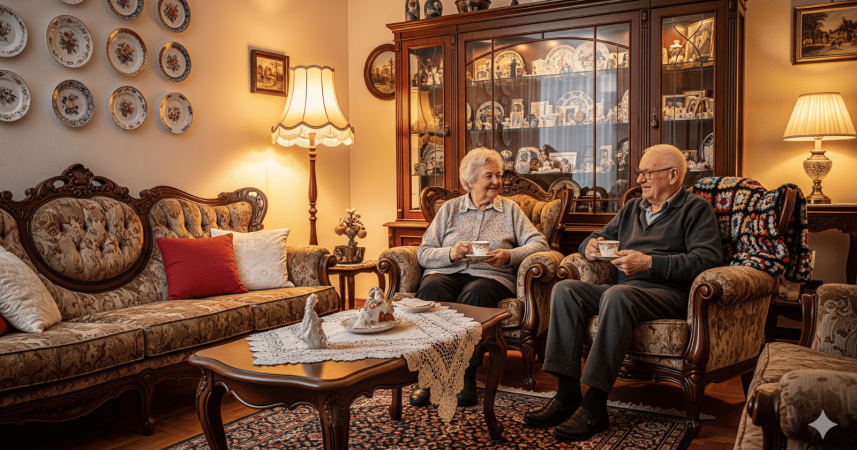
What you choose to keep in your living room might not just reveal your taste—it could be telling the story of who you used to be.
Ever walk into a living room and immediately feel like you’ve stepped into a time capsule?
The furniture might still look polished. The room might even smell faintly of furniture polish and potpourri. But something about it screams, “This place hasn’t changed in decades.”
That’s often the giveaway—you’re in a boomer living room.
Now, before we dive in, let me be clear: there’s no shame in hanging onto what you love. I’m a firm believer that your home should reflect your story. If your story includes a shiny brass table or lace doilies, then that’s part of who you are.
But style is also cultural. It evolves. What once seemed sophisticated or cutting-edge can now feel dated. Some of these décor choices were status symbols back in the day. Today? They might be quietly aging your space.
So let’s take a playful but honest walk through the living room. If any of these items are still hanging around, chances are, you’re a boomer—or at least living like one.
1. The glass coffee table with brass trim
Remember when glass-and-brass was the ultimate combo? Sleek. Modern. Elegant.
In the ’80s and ’90s, these tables were the centerpiece of every “fancy” living room. Guests would place their drinks on carefully arranged coasters, and you could practically see the pride in the homeowner’s eyes.
But here’s the truth: nothing gives away a dated room faster. These tables might still gleam when you Windex them, but the look doesn’t exactly scream contemporary anymore.
Psychologically, our décor choices reflect what we associate with “arrival.” If a shiny brass edge once symbolized luxury, it makes sense why people held onto it. But modern design has moved toward warmth—wood tones, matte metals, and earthy textures.
I once visited a friend’s house who inherited her parents’ glass-and-brass table. She admitted she hated it, but it felt wrong to replace something her mom had “worked so hard to afford.” That’s the emotional hold décor can have—it’s not just furniture, it’s memory.
2. The formal china cabinet
Do you actually use the china in there? Be honest.
China cabinets were once the crown jewel of a “grown-up” living room. A symbol of hospitality and tradition. Rows of gleaming porcelain, crystal goblets, maybe even a silver tea set or two.
Here’s the twist: most of it was never touched. The china cabinet became less about function and more about display. A subtle way of saying, “See? We’re doing well.”
Today, though, open shelving, multipurpose storage, and minimalism have edged out these massive display cases. They eat up space, collect dust, and rarely serve a functional purpose.
As interior designer Nate Berkus once said, “Your home should tell the story of who you are now—not just who you were.” Holding onto a china cabinet might be more about nostalgia than practicality.
I get it, though. My mom still has hers, stuffed with crystal glasses and dishes she hasn’t used in twenty years. Every time I suggest clearing it out, she laughs and says, “But what if I host Thanksgiving for 20 people?” (Spoiler: she never will.)
3. Lace doilies and crocheted armrest covers
I have a soft spot for these, I’ll admit. My grandmother always had little lace mats under every lamp and vase. The “antimacassars” on armchairs were meant to protect from hair oil (yes, really).
But unless you’re going for full vintage cottagecore, doilies read more “grandma’s parlor” than chic.
There’s also something psychologically fascinating here. According to design researchers, layering protective fabrics was less about style and more about maintaining order. A pristine, perfect living room meant you were respectable, disciplined, even a little aspirational.
Historically, antimacassars and doilies served a practical purpose—protecting upholstery from oil and wear—while also signifying that the household cared enough to keep surfaces pristine.
The catch? Life today leans toward ease and authenticity. People want homes that feel lived in, not staged. That shift alone makes the delicate doily feel fussy.
A friend of mine confessed she still has one crocheted runner her aunt made for her wedding. She doesn’t love it, but she feels guilty putting it away. That’s the thing about these small, fussy touches—they’re loaded with love, memory, and obligation.
4. Wall-to-wall mirrors
Ah, the illusion of space.
Whole walls covered in mirror panels were once a status move. They made modest homes look bigger, shinier, more glamorous. If you grew up in the ’70s or ’80s, chances are you’ve eaten dinner while staring at your own reflection.
Step into a boomer living room, though, and you can almost bet there’s a wall of mirrors behind the sofa or dining area.
Here’s the issue: while mirrors do bounce light, entire mirrored walls often feel overwhelming. They also reflect clutter, which can actually create the opposite effect of calm.
Environmental psychologists have pointed out that overly reflective surfaces can increase overstimulation — producing glare, visual distortion, or too much visual “noise” in a room, which taxes attention and makes relaxation harder.
I once helped a neighbor peel mirrored tiles off her dining room wall. Behind them was faded floral wallpaper. She sighed and said, “I don’t know what’s worse—the mirrors or the flowers.” That’s boomer décor in a nutshell: a battle between two outdated trends.
5. The oversized entertainment center
You know the one—massive, dark wood, built to hold a bulky TV, stereo system, maybe even a VHS collection. These “wall units” were once a living room must-have.
The problem? Technology shrunk. Flat screens, streaming services, and Bluetooth speakers don’t require massive furniture. Yet many boomers still have these imposing structures dominating their living spaces.
On a deeper level, these entertainment centers represented permanence. A big purchase. An anchor for the family room. Letting go of one can feel symbolic—like acknowledging a shift in lifestyle.
But I’ve seen people get stuck here. A couple I know downsized into a condo but insisted on dragging their huge oak entertainment center with them. It swallowed the entire wall. They admitted it made the room feel cramped, but they couldn’t bear to let it go.
Here’s the truth: sometimes letting go of furniture is also letting go of an era. And that can be harder than we think.
6. Heavy drapes and valances
If your windows are still layered with tasseled valances, scalloped swags, or triple-layered drapes, congratulations—you’re keeping the textile industry alive.
In boomer homes, window treatments were the ultimate sign of sophistication. The more fabric, the fancier the vibe. But modern homes lean toward light and air. Clean roller shades, breezy linens, or even bare windows (if privacy allows) create a sense of openness.
There’s also a psychological angle here. Dark, heavy drapes create a cocoon-like effect—privacy, safety, control over what the outside world sees. But too much of that can feel stifling. As lifestyles have shifted toward openness and connection, our homes have followed suit.
A designer friend once told me that pulling down heavy drapes is one of the quickest ways to “de-age” a room. She compared it to getting rid of shoulder pads in fashion—suddenly, the whole silhouette feels lighter.
7. Faux flowers in crystal vases
Last but not least: the eternal bouquet.
Silk roses. Plastic ivy. Maybe a dust-coated fern perched on the mantle. In the boomer heyday, artificial flowers were the epitome of “set it and forget it” elegance. No watering, no wilting, no mess.
But now? They often look lifeless. Design psychologists even argue that humans are wired to respond positively to natural cues. Real plants—whether lush greenery or a simple vase of tulips—bring vibrancy and boost mood in ways fake ones never will.
This is backed by environmental psychologist Sally Augustin, who in “Bring the Plants In!” argues that plants in indoor spaces help reduce stress, enhance emotional tranquillity, and improve focus by giving people a living connection to nature.
So if your living room still features a stiff bouquet of dusty silk lilies, it might be time to swap them for something alive. Even a simple pothos on a side table can change the entire vibe.
Final thoughts
If you recognized your living room in this list, don’t panic. Style evolves, and what once felt fancy will eventually cycle back around. (Velvet sofas are already making a comeback, after all.)
But here’s the thing: our homes should reflect who we are today. Not just who we were thirty years ago. If your living room feels stuck in a different era, maybe it’s less about furniture and more about letting yourself evolve, too.
Start small. Replace one piece. Add something modern that sparks joy now.
Because in the end, décor isn’t just about trends—it’s about creating a space that matches the life you’re living today. And maybe that’s the real mark of “fancy”—not what impresses others, but what feels right for you.