Your parents decorating was meant to create safety; to give you a home that felt respectable, even if money was tight or the future felt uncertain.
We don’t talk about it enough, but home decor is basically a family diary.
The quiet stuff that sat in the corner of your living room for a decade, silently announcing what your parents valued, what they were proud of, and what they were trying to protect.
If you grew up in the 90s, you probably still remember the feeling of walking into a “nice” house.
A place that felt put together, safe, respectable, and the kind of home where you instinctively took your shoes off, even if nobody asked.
If certain items were in the mix? Yeah, that house was very likely solidly middle-class.
This is about noticing what those choices meant because, the truth is, the way we grew up around “stuff” can shape our money mindset, our comfort level, and even how we define success today.
Let’s take a little nostalgic walk through the living rooms of the 90s, and see what they might still be teaching us:
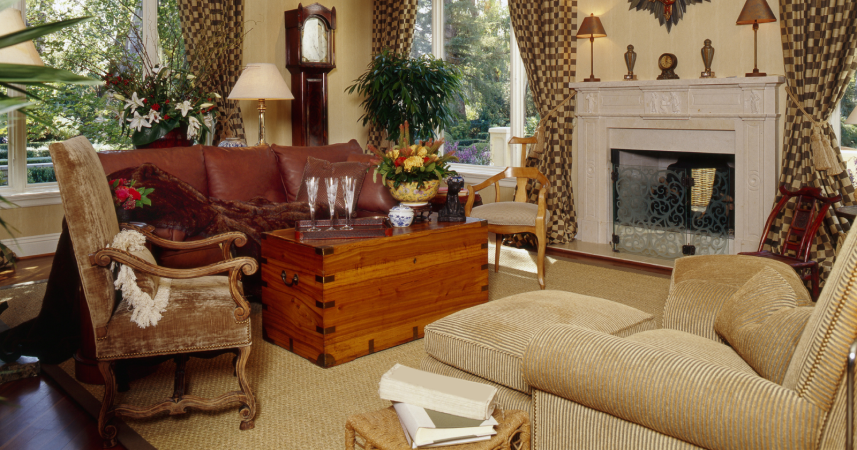
1) The matching living room set
You know the one: Couch, loveseat, and maybe a chair that nobody actually sat on because it was “for company.”
Bonus points if the fabric was patterned, vaguely floral, and slightly scratchy.
Extra bonus points if the throw pillows were permanently arranged like museum pieces.
A matching set was an announcement: We have our act together.
Middle-class families often didn’t have endless money, but they had a strong sense of order and pride.
A coordinated living room meant you didn’t look like you were piecing life together, even if you were.
Looking back, I think a lot of parents were trying to create stability with what they could control.
Bills might fluctuate and work might be stressful, but the living room? The living room could look respectable.
2) The oak entertainment center that swallowed the TV
Before flat screens, TVs were chunky, heavy, and basically a piece of furniture on their own.
So, what did solidly middle-class homes do? They built a shrine for it.
That big oak entertainment center with shelves for VHS tapes, a slot for the VCR, and maybe a glass door for the “nice” electronics was a status symbol.
It meant you had enough disposable income to buy something that was not strictly necessary, but made your home feel complete.
It also signaled something else: Family time mattered.
A lot of 90s homes revolved around shared TV nights, movie rentals, and the ritual of rewinding tapes.
I can still picture the stacks of movies and the subtle pride around having a “proper setup.”
It was the feeling of having arrived.
3) The curio cabinet filled with “do not touch” treasures
Ah yes, the glass-front cabinet.
Sometimes with mirrored backing, sometimes with tiny lights, yet always with items that were somehow both priceless and completely impractical.
Porcelain figurines, crystal animals, souvenir spoons, and a delicate tea set that never met actual tea.
This was middle-class psychology in its purest form: We may not be wealthy, but we have valuables.
Curio cabinets held proof of milestones, or at least proof that your family participated in the rituals of adulthood.
There was usually a rule: Don’t touch (which, honestly, is a fascinating lesson to teach a kid).
It says, some things are for looking successful, not for living.
If you grew up around this, you might still struggle with letting yourself actually enjoy what you own.
You save the “good candles,” you don’t wear the “nice outfit,” and you keep things for a future that never quite arrives.
Train your brain to believe your life is worthy of your good stuff now.
4) The wallpaper border or sponge-painted accent wall

The 90s loved a themed wall moment.
A little ivy border near the ceiling, a strip of fruit in the kitchen, or maybe that sponge-painted texture in the dining room that made the wall look like it belonged in a Tuscan restaurant.
This kind of decorating often showed a specific middle-class sweet spot: Enough time, energy, and money to care about aesthetics, but not so much that you hired someone to do it for you.
It also reflected optimism, people were trying to make their homes feel elevated like a “real” home.
Honestly, I respect that.
There’s something deeply human about wanting your environment to feel special.
5) Vertical blinds or those heavy, serious curtains
Vertical blinds were everywhere.
Sliding doors, big windows, and sometimes even in rooms where they made absolutely no sense.
They were practical, affordable, and gave a very specific vibe: We are grown-ups here.
Same with the heavy curtains in “formal” colors: Burgundy, hunter green, navy, or any other color that made your living room feel like it had responsibilities.
Window treatments are a sneaky class marker because they’re not fun spending.
Nobody gets excited to buy blinds as a kid, but adults do it because it’s what you do when you’re building a stable life.
Stability is the heart of the middle-class identity, just the sense that things are handled.
6) The glass coffee table with brass or chrome details
If you had a glass coffee table, your house was trying to be fancy and that’s just fact!
The glass top, the shiny metal frame, and the way fingerprints showed up if you breathed near it? Why, it was equal parts stylish and stressful!
This is the kind of item that shows a family had stepped beyond pure practicality.
If you grew up in a house with “nice things you had to be careful around,” you might have a complicated relationship with comfort now.
Some people become meticulous adults, while others swing hard in the opposite direction and refuse to own anything that feels fragile.
7) The wall-to-wall carpet in a “neutral” shade
Nothing screams 90s middle-class quite like wall-to-wall carpet, especially in a shade that lived somewhere between beige, oatmeal, and “we hope this hides stains.”
Carpet was cozy; it was quiet and it made a home feel warm and complete.
It also said something important: We’re investing in comfort.
Middle-class families were often big on comfort as a form of success.
If you think about it, that’s a powerful value; it’s also why so many of us equate adulthood with having the right kind of home.
Final thoughts
Here’s what I hope you take from this little decor time capsule: Your parents were communicating.
They were saying, “We’re doing okay,” they were creating safety, and they were trying to give you a home that felt respectable, even if money was tight or the future felt uncertain.
Whether you loved those choices or swore you’d do everything differently, you probably absorbed a few beliefs along the way.
Let me ask you this: When you picture a “successful” home today, whose image are you seeing?
If it’s still the 90s living room with the matching set and the curio cabinet, you’re not alone.
Just make sure the life you’re building now is based on your values, not just your conditioning!
The most middle-class thing of all, in the best way, might be this: The desire to create a space that feels stable, kind, and lived in.
You get to decide what that looks like now.
If You Were a Healing Herb, Which Would You Be?
Each herb holds a unique kind of magic — soothing, awakening, grounding, or clarifying.
This 9-question quiz reveals the healing plant that mirrors your energy right now and what it says about your natural rhythm.
✨ Instant results. Deeply insightful.