
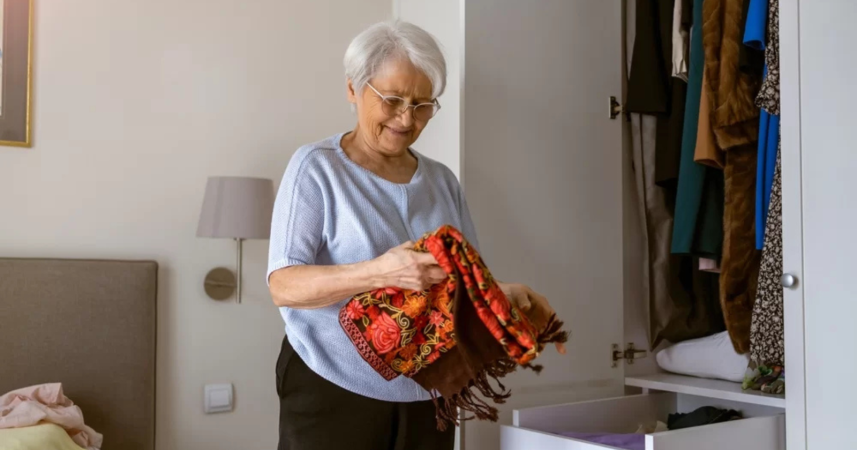
After watching her parents transform their cramped ranch into a spacious sanctuary by purging decades of hidden clutter, one daughter discovered the eight specific categories that secretly steal square footage from millions of homes.

Add VegOut to your Google News feed. 
Remember that feeling when you walk into someone's home and it just feels... spacious? Not because it's huge, but because there's room to breathe?
I discovered this firsthand when I helped my parents downsize last year. As we sorted through decades of accumulated stuff, I watched their modest three-bedroom ranch transform into what felt like a completely different house.
The ceilings seemed higher. The windows brighter. Even my mother, who'd been resistant to letting anything go, stood in her newly decluttered living room and said, "I forgot how big this room actually is."
That experience got me thinking about all the types of clutter that quietly steal our space without us even realizing it. And here's what I've learned: The Boomer generation has become masters at identifying and eliminating these space-stealers.
Maybe it's retirement bringing clarity, or perhaps it's watching their own parents struggle with too much stuff, but they're onto something powerful.
If your home feels cramped despite having decent square footage, you might be harboring some of these eight types of clutter that Boomers have learned to ruthlessly eliminate.
1) The sentimental paper trail
You know what we found boxes and boxes of in my parents' attic? Report cards. Mine from third grade. My brother's from high school. Random certificates of participation from events we couldn't even remember.
My dad had kept every single performance review from his 40-year engineering career.
The thing about paper clutter is that it multiplies in the dark corners of our homes. Old tax returns from 1987. Instruction manuals for appliances you threw out a decade ago. Birthday cards from people whose names you can't recall.
When my parents finally tackled this category, they kept one small memory box for each family member. Everything else went to the shredder or recycling. The result? Three empty filing cabinets and a closet that could suddenly hold actual things they use.
Ask yourself: If your house caught fire, would you risk your safety to save those old electric bills from 2003? If not, it's time to let them go.
2) The hobby graveyard
Here's a confession: I once bought a complete set of watercolor supplies after watching one YouTube tutorial. They sat in my closet for three years before I admitted defeat.
Boomers are particularly good at recognizing when a hobby has run its course. That bread maker used twice in 2015? Gone. The scrapbooking supplies from that phase in the early 2000s? Donated. The exercise equipment that became an expensive clothes hanger? Sold.
My neighbor recently cleared out what she called her "craft room of broken dreams." She kept the hobbies she actually does (knitting and gardening) and let everything else go.
Now that room is a cozy reading nook where she actually spends time, instead of a storage unit that made her feel guilty every time she walked past.
3) The gift guilt collection
This one hits close to home. How many of us keep things we don't like, don't use, and don't have room for, simply because someone gave them to us?
I watched my mother agonize over a crystal vase from her late aunt. She hated it. Never used it. But felt terrible about giving it away. Until my dad pointed out that keeping something out of obligation isn't honoring the giver, it's just creating resentment.
The Boomers I know have adopted a simple rule: Appreciate the thought behind the gift, then let the physical item go if it doesn't serve you.
That ugly sweater from Aunt Martha? Someone at Goodwill might genuinely love it. Those fancy wine glasses you never use because you're afraid of breaking them? There's someone out there who would use them every Friday night.
4) The duplicate dynasty
How many spatulas does one kitchen really need? If you're like most of us, you probably have three or four, plus multiple versions of pretty much everything else.
During my parents' declutter, we found seven can openers. Seven! They kept the best one and donated the rest. Same with sheets (they had enough for a small hotel), towels (ditto), and coffee mugs (28 for two coffee drinkers).
The duplicate problem extends beyond the kitchen. Multiple phone chargers tangled in drawers. Three hammers in the garage. Four umbrellas when you always grab the same one.
Boomers have learned that having backups of backups doesn't provide security, it provides clutter. Keep what you use, maybe one spare, and free up that space.
5) The digital debris that takes physical space
This might sound contradictory, but hear me out. How many old phones, tablets, cameras, and random cables are hiding in your drawers?
My friend's parents just cleared out what they called their "technology cemetery." Old flip phones. Digital cameras from when 3 megapixels was impressive. Miles of mystery cables that might go to something, somewhere, but probably don't.
They also ditched the physical manifestations of digital life. Hundreds of CDs when everything's on Spotify now. DVDs they haven't watched since getting Netflix. Computer software in boxes for computers that died years ago.
The space this freed up was staggering. An entire closet became available for things they actually use.
6) The expired everything
When was the last time you checked the dates on your spices? Your medications? That sunscreen from who knows when?
Boomers doing their big cleanouts consistently find expired products taking up prime real estate. Vitamins from 2018. Face cream that separated two years ago. Paint cans with more rust than paint.
Beyond the safety issues, this stuff creates visual and physical clutter. Those half-empty shampoo bottles under the sink. The condiments cramming your fridge door that expired during the last administration.
Clearing this category alone can free up shocking amounts of space in kitchens, bathrooms, and garages.
7) The clothing fantasy closet
We need to talk about those jeans from 2005. You know the ones.
Boomers have become brilliant at clothing reality checks. They're ditching the "someday" clothes, the "special occasion" outfits that never see daylight, and yes, the multiple sizes of clothing they're keeping "just in case."
One woman I know followed a simple rule: If she wouldn't buy it today, it goes. Her closet went from packed-and-stressful to organized-and-functional. She can actually see what she owns and, surprise, she wears more of her clothes now because she can find them.
8) The furniture that doesn't function
That formal dining set used twice a year. The uncomfortable chair no one sits in. The coffee table that's too big for the room but you keep because it was expensive.
Boomers are embracing the radical idea that furniture should actually work for how you live now, not how you thought you'd live when you bought it. They're swapping formal dining rooms for comfortable spaces where people actually gather. They're ditching the decorative furniture that just collects dust.
My parents replaced their massive entertainment center (from when TVs were the size of refrigerators) with a simple floating shelf. The room instantly felt twice as big.
Final thoughts
Here's what I learned from watching the Boomer generation tackle their clutter: It's not really about the stuff. It's about reclaiming your space so you can actually live in it.
Every item you keep is a choice to give it your space, your energy, and your attention. When you clear out these eight types of clutter, you're not just making your home feel bigger. You're making room for the life you actually want to live.
Start with one category. Just one. Pick the one that made you think "oh, that's me" and tackle it this weekend. You might be amazed at how much space has been hiding in your home all along.
The Boomers are onto something here. Our homes don't need to be bigger. They just need to hold less of what doesn't matter and more of what does.
What’s Your Plant-Powered Archetype?
Ever wonder what your everyday habits say about your deeper purpose—and how they ripple out to impact the planet?
This 90-second quiz reveals the plant-powered role you’re here to play, and the tiny shift that makes it even more powerful.
12 fun questions. Instant results. Surprisingly accurate.












