
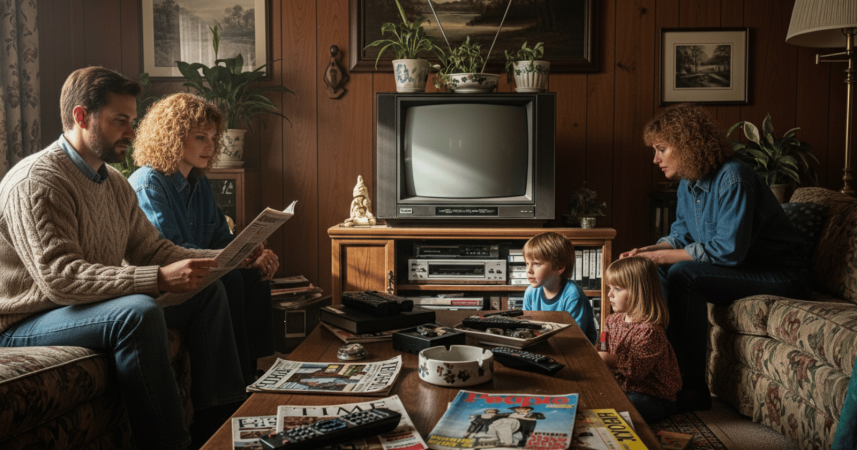
Beneath the plaid couches and potpourri bowls, 80s living rooms told deeper stories—of comfort, class, and the silent hopes families carried.

Add VegOut to your Google News feed. 
Step into any middle-class home in the 1980s, and you’ll notice a familiar pattern.
The living room was more than just a space to watch TV—it was a showcase. It reflected what families valued, what they aspired to, and sometimes even what they wished others would believe about them.
Looking back, it’s fascinating to see how much psychology was embedded in the furniture, the gadgets, and the décor. These weren’t just “things.” They were cultural symbols of security, status, and belonging.
And if you grew up in that era, chances are you can still picture them vividly.
Let’s take a trip down memory lane.
1. The giant wooden entertainment center
Do you remember those towering units that seemed to swallow an entire wall?
They often held a bulky TV, a VCR, maybe even a record player or cassette deck. Some had glass doors to showcase VHS collections or display “fancy” ornaments that rarely moved. A few had mirrors built into the back, which made them look even bigger than they already were.
The psychology here is pretty clear: families wanted their living room to revolve around a central hub. It wasn’t just about watching TV—it was about gathering. The entertainment center gave the home a focal point, a sense of importance and structure.
It also said something about prosperity. These weren’t cheap pieces of furniture. If your family had one, it meant you were investing in technology, entertainment, and the image of “having it all.”
Studies of consumer behavior consistently show that furniture and home-appliances serve as visible status symbols in middle-class households—objects that communicate not just utility but value, identity, and aspirations.
2. The floral or plaid couch
Nothing screams 80s quite like a floral sofa set—or its equally bold cousin, plaid.
These couches weren’t subtle. They shouted “cozy” but also “durable.” Many were scratchy to sit on, often with cushions that swallowed you whole.
Why did everyone have them? Because they signaled practicality and middle-class sensibility. You could spill a soda, drop popcorn, or let the dog sneak a nap on it—and nobody would know. Patterns camouflaged life.
Psychological studies in environmental psychology show that home furnishings often reflect underlying values: people choose furniture that feels solid and resilient to express priorities like durability, security, and everyday utility.
The 80s couch said: comfort matters, but so does resilience. Families didn’t want something fragile or high-maintenance—they wanted something that could withstand kids, pets, and visiting relatives without showing wear.
3. A cabinet full of glassware nobody used
In almost every home, there was a glass-front cabinet—or at least a hutch—filled with “special occasion” stemware. Crystal goblets. Delicate wine glasses. Maybe even an ornate decanter.
Here’s the irony: they were rarely used. Most families didn’t drink out of them except on holidays, if at all. They were less about utility and more about aspiration—a quiet nod to sophistication and upward mobility.
Sociologists often note that middle-class families use these kinds of displays as signals of class aspiration. Individuals tend to select visible symbols—like fine glassware—that subtly communicate cultural capital and refined tastes.
You may not have been wealthy, but that collection of glassware told visitors you had taste, refinement, and the ability to celebrate in style—even if the “celebrations” never actually happened.
4. A landline phone with an extra-long cord
Picture it: a beige or off-white phone mounted on the wall with a curly cord that stretched halfway across the room.
It was more than a communication device—it was a stage for teenage drama. The cord allowed you to pace, to hide in the hallway, or to slam the receiver down after a heated conversation.
Phones symbolized connection but also control. If someone was using it, everyone knew. And heaven forbid you tied up the line too long when someone was waiting for an important call.
One friend of mine still jokes about the unspoken “family phone rules.” Five minutes tops. No calls during dinner. And if you were a teenager, expect someone to pick up the extension and say, “It’s time to get off.” That shared landline created boundaries that today’s smartphones have completely erased.
5. Houseplants in macramé hangers
The 80s loved a good spider plant dangling in the corner. Macramé hangers became almost a rite of passage for living rooms.
These weren’t just about greenery. They represented nurturing, bringing nature indoors, and softening the heavy wood-and-fabric vibe that dominated furniture at the time. In a decade before “self-care” was mainstream, tending to plants was one of the closest things many families had to daily mindfulness.
There’s also something interesting about how plants bridge identity. As one design historian noted, “Houseplants in the 1980s became both decoration and a subtle expression of domestic care—proof that a household was alive and thriving.”
It wasn’t just about the plants. It was about the family’s ability to keep them alive, a tiny metaphor for stability.
6. A framed family portrait over the mantel
Whether it was a posed Sears photo or a carefully arranged candid, the family portrait had pride of place. Usually right above the mantel or in the most visible wall spot.
This wasn’t just decoration. It was symbolic. Family was the centerpiece of identity in middle-class culture, and the portrait was a reminder—for both guests and the household—of unity and belonging.
I still remember visiting a friend’s house where the portrait included everyone dressed in matching sweaters. At the time, I thought it was cheesy. Looking back now, I see it differently: it was a way of saying, “We are together. We are whole.”
That sense of stability mattered in the 80s, especially with cultural shifts happening so quickly. The family photo was a grounding image, a visual anchor in a decade of change.
7. A coffee table stacked with magazines
Think Reader’s Digest, National Geographic, or maybe Good Housekeeping. Some homes even had glossy travel brochures or a Sears catalog within arm’s reach.
Coffee tables became a silent way of signaling interests—or at least projecting them. A stack of magazines suggested curiosity, sophistication, or even a subtle “we’re keeping up with the world.”
There was also a social element. Guests could leaf through magazines while waiting, which made living rooms feel welcoming. These stacks told a story before anyone in the house even spoke.
And if we zoom out, it’s another example of how the middle class balanced real life with aspiration. You might not be traveling to Paris, but flipping through National Geographic gave you a taste of possibility.
8. The afghan blanket
Usually handmade, sometimes gifted, the crocheted afghan blanket lived draped across the back of the couch.
It wasn’t just for warmth. It was about comfort, familiarity, and that sense of “home.” The afghan said: this is where we relax, where we let our guard down.
It’s interesting how even now, psychologists point out the power of tactile comfort—soft blankets, cozy textures—to regulate stress and create safety in a space. The 80s afghan was ahead of its time in that sense.
And because many were handmade, afghans also carried emotional weight. They connected households to grandparents, neighbors, or friends who crafted them. That blanket wasn’t just décor—it was lineage woven into yarn.
9. A decorative bowl of potpourri
Finally, the potpourri. Usually sitting on a side table, often dusty, sometimes smelling faintly of cinnamon or roses.
Potpourri was less about fragrance and more about creating the illusion of sophistication. It hinted at an attention to detail, a little “extra touch” to make the space feel cared for.
It also shows how much sensory cues matter in memory. Even today, a whiff of potpourri can instantly take people back to their grandmother’s living room.
It’s funny—while modern design leans toward essential oils and minimalist candles, the goal hasn’t changed. Scent remains a quiet but powerful way to make a home feel intentional.
Final thoughts
Middle-class living rooms in the 80s weren’t just decorated spaces—they were psychological landscapes.
Every oversized couch, every untouched wine glass, every crocheted afghan carried meaning. They told stories of aspiration, belonging, and comfort.
When I think about these rooms now, I don’t just see furniture. I see how families tried to balance practicality with aspiration, comfort with status. They were creating spaces that both reflected their reality and hinted at their dreams.
And in many ways, isn’t that still what our living rooms are about today? We still want a mix of comfort and style, durability and beauty. The details have changed, but the deeper impulse—to make our homes a reflection of who we are and who we hope to be—hasn’t gone anywhere.












