
When something cost a month's salary, you learned to fix it instead of scrolling for replacements on your phone.

Add VegOut to your Google News feed. 
Last year, I helped my parents downsize from the house where I grew up. As we sorted through kitchen cabinets, I kept finding these sturdy, decades-old appliances still in working order. My mother, a former teacher who stretched every dollar, looked at each one like an old friend.
"That mixer made every birthday cake you ever had," she said, holding a cream-colored Sunbeam that had to be from the early '80s.
It got me thinking about how different our relationship with stuff has become. These weren't just appliances. For lower-middle-class families, wedding gifts represented a kind of investment in a future household. You didn't buy another one just because a new model came out. You used what you had until it literally couldn't be fixed anymore.
The economics of this fascinate me. As someone who spent years analyzing spending patterns, I can tell you that the shift from "buy once, use forever" to "replace every few years" represents a massive change in both manufacturing and consumer behavior.
But there's something else here too. A certain pride in making things last. A creativity born from necessity.
Let me walk you through the kitchen workhorses that defined a generation.
1) The stand mixer that mixed everything but expectations
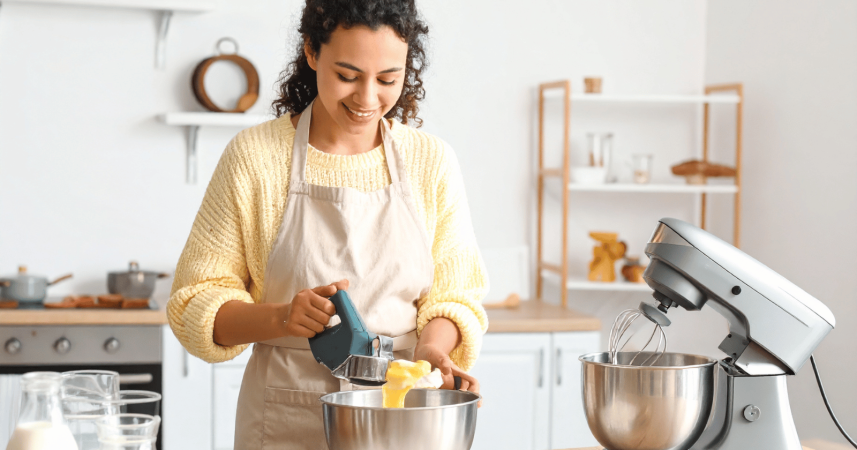
Every lower-middle-class bride in the '70s and '80s received some version of a stand mixer. KitchenAid if they were lucky, Sunbeam or Hamilton Beach more typically.
These machines were built like tanks. Heavy enough to stay put while kneading bread dough. Powerful enough to whip egg whites into stiff peaks without smoking.
My mother used hers for everything. Not just cakes and cookies, but mashed potatoes, meatloaf mixture (before I went vegan and rewrote that family recipe), even shredding cooked chicken. The attachments might get lost over the years, but the base motor kept going.
Here's what strikes me now: these mixers represented a kind of domestic aspiration. The idea that you'd be baking from scratch, that you'd have time and energy for homemade everything. For working mothers especially, that mixer became both a tool and a reminder of impossible standards.
But they kept using them anyway. Because when you've invested in something, when it was given with love and expectation, you make it work.
2) The slow cooker that saved weeknight sanity
If the stand mixer represented aspiration, the Crock-Pot represented survival.
For families where both parents worked, the slow cooker was revolutionary. Throw ingredients in before leaving for work, come home to dinner already made. The original meal prep, decades before Instagram made it trendy.
These things lasted forever too. The simple heating element rarely failed. The ceramic insert might crack eventually, but even then, people would wrap it in aluminum foil and keep using it.
I remember the smell of pot roast (again, pre-vegan me) hitting us when we walked in the door after school. My mother worked long hours teaching, and that slow cooker meant she could still provide home-cooked meals without the guilt or exhaustion of starting from scratch at 6 PM.
Now I use mine differently, of course. Dried beans, lentil stews, vegetable curries. But the principle remains the same: making the most of limited time and energy.
3) The electric percolator that perked for decades
Before drip coffee makers became ubiquitous, there was the electric percolator. Stainless steel or aluminum, making that distinctive percolating sound every morning.
These machines were indestructible. Simple mechanics: water heats, rises through a tube, drips through grounds, repeats. Nothing to break except the heating element, and even that rarely went.
My father, an engineer who appreciated anything that worked reliably, insisted his percolator made better coffee than any modern machine. He might have been right, or he might have just been attached to the familiar. Either way, that percolator lasted from his wedding day until he finally conceded to a drip maker in the late '90s.
There's something about morning routines and the tools that anchor them. That percolator represented stability in a changing world.
4) The toaster that survived burnt bread and busy mornings
Not fancy. Not smart. Just two or four slots that heated bread.
The toasters given as wedding gifts in the '70s and '80s were simple chrome or white plastic affairs. No digital displays, no bagel settings, just a dial for darkness and a spring-loaded lever.
And they worked. For years. Decades, even.
Sure, the heating elements might get uneven over time. Crumbs would accumulate despite the removable tray. The exterior might yellow or the chrome might dull. But they kept making toast.
When I started volunteering at farmers' markets a few years ago, I met an older couple who still used their wedding toaster from 1976. "Why would we replace it?" they asked, genuinely confused by the question. "It still makes toast."
That simple logic feels almost radical now. We've been conditioned to expect obsolescence, to assume newer is better. But sometimes better just means it still does the one job it was designed to do.
5) The electric can opener that opened decades of dinners
This one might seem silly. How hard is it to open a can manually?
But for families cooking multiple meals a day, that electric can opener was a small mercy. Especially for anyone with arthritis or hand strength issues as they aged.
The wall-mounted ones, usually white or that distinctive '70s avocado green, became permanent kitchen fixtures. The blade might dull over the years, requiring more passes to fully open a can. The magnet that held the lid might weaken. But they kept working.
My parents' can opener lasted 35 years before my mother finally replaced it. And even then, she felt guilty about it. Like she was giving up on an old friend who'd faithfully served the family through countless tuna casseroles and green bean sides.
There's a whole psychology there about attachment to objects, about what it means to discard something that still functions. About waste and value and the stories we tell ourselves about being good stewards of our resources.
6) The blender that blended boundaries between frugal and fancy
The blender occupied an interesting space in the lower-middle-class kitchen. Practical enough for everyday smoothies and soups, but also fancy enough for the occasional frozen margarita that made you feel like you were living large.
The heavy glass pitcher, the metal base with speed settings, the removable blade assembly that you'd better remember to put back correctly or face a kitchen flood. These were substantial machines.
Oster was the go-to brand. Those chrome-based blenders that looked sleek enough to display but worked hard enough to crush ice for decades.
When I transitioned to veganism five years ago, I discovered a whole new relationship with my blender. Cashew cream, date-sweetened smoothies, pureed vegetable soups. The same tool, completely different uses.
And you know what? I'm still using a 20-year-old Oster I picked up at a thrift store. Because unlike the high-powered modern blenders that cost as much as a month's groceries, this one was built to last.
7) The electric skillet that cooked everything everywhere
Here's one younger people might not even recognize: the electric skillet.
These large, rectangular or round pans with their own heating element and temperature control were incredibly versatile. You could cook an entire meal in one without heating up the kitchen in summer. Take it camping (if you had electricity). Make pancakes at the table for a crowd.
Lower-middle-class families often received these as wedding gifts because they solved multiple problems at once. Extra cooking surface when the stove was full. Portable cooking for potlucks or family gatherings. Temperature control that (theoretically) prevented burning.
They lasted forever because there was so little to break. Heating element, thermostat, done. The non-stick coating might wear off eventually, requiring extra oil and more careful cleaning. The cord might get finicky. But the actual cooking function persisted.
My parents still have theirs, buried in a cabinet but brought out occasionally when they're hosting brunch for my father's old engineering colleagues. It's older than I am, and it still makes perfect pancakes.
Final thoughts
Looking back at these appliances, I see more than just kitchen tools. I see an entire economic worldview.
These were purchased or gifted with the expectation of longevity. Manufacturers built them to last because that's what the market demanded. Consumers took care of them because replacement wasn't a casual decision.
Somewhere along the way, we shifted to a disposable mentality. Planned obsolescence became standard. The idea of repairing instead of replacing started to seem quaint, even foolish.
But I think there's wisdom in the old approach. Not just environmentally, though that matters. Not just financially, though that matters too. But in the relationship it creates with our possessions.
When you expect something to last decades, you treat it differently. You clean it carefully. You store it properly. You fix small problems before they become big ones.
As I write this from my kitchen, I can see my old Oster blender and my second-hand slow cooker. Neither is new. Neither is smart or connected or optimized. But both work perfectly for what I need.
Maybe that's the real lesson from those wedding gift appliances. Knowing what you actually need, using it until it's truly done, and resisting the constant pressure to upgrade just because you can.
The lower-middle-class families who used these appliances for decades weren't just being frugal. They were practicing a kind of sustainability we're now desperately trying to relearn.












