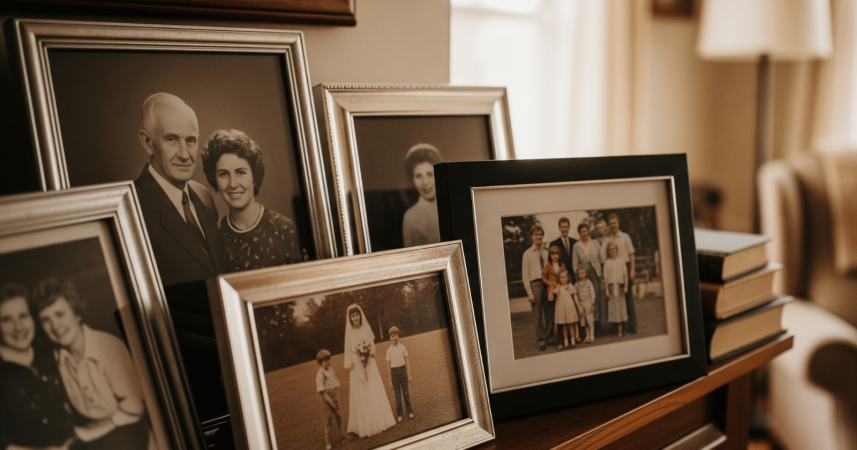
The photos hanging in modest living rooms weren’t just memories—they were quiet declarations of pride, resilience, and the stories families wanted remembered.
Walk into almost any lower-middle-class household from the 70s, 80s, or 90s, and you’ll find a story told in frames. Not stories of luxury vacations or yacht parties. But stories of resilience, pride, and togetherness.
These photos weren’t just decorations. They were proof that, despite financial strain, love and dignity had a place in those homes. They were cultural glue—visual reminders of belonging, perseverance, and what mattered most.
And if you grew up in one of these households, I bet you can picture the exact spot where the family photos were displayed. Maybe above the television with its rabbit-ear antenna. Maybe on a living room wall covered in faux wood paneling. Or tucked into the big collage frame bought on sale from the discount store.
The details varied, but the message was the same: these pictures mattered. They anchored the family’s story.
Let’s revisit seven of the most common ones.
1. The school portrait with the awkward haircut
Who else remembers those stiffly posed, laser-background school photos? For lower-middle-class families, they were a rite of passage. Parents paid for the cheapest package but displayed it like a prized painting.
Sometimes the kid’s bangs were uneven because Mom gave a “kitchen haircut” the night before. Sometimes the outfit was a bit too big because “you’ll grow into it.” And if your shoes looked scuffed in the photo, nobody blinked—shoes were worn until the soles gave out.
None of that mattered. The framed photo on the mantle shouted: We made it through another school year.
And on a deeper level, it symbolized upward striving. Education was seen as the golden ticket. That glossy little print carried more weight than most outsiders realized—it was the family’s quiet investment in hope.
Every time a parent looked at that school picture, they weren’t just seeing their child’s face. They were seeing possibility.
2. The wedding photo of the couple who built it all
Every household had one—the wedding picture of Mom and Dad (or whoever raised the family). Sometimes it was a full-color print, other times a grainy black-and-white. Either way, it was always front and center.
It didn’t matter if the dress was homemade or borrowed, or if the reception was held in a church basement with potluck casseroles. The photo wasn’t just about romance. It represented the foundation. The commitment that allowed the family to push through job losses, long shifts, and nights spent counting pennies.
Psychologists have noted that family identity often rests on “origin stories.” And for many working-class homes, that wedding photo was the mythic beginning. It gave kids the sense: This is where we started. This is why we keep going.
Even in households where the marriage later crumbled, the wedding photo often stayed up for years. It was less about the reality of the relationship and more about honoring the belief that love and unity could endure.
3. The graduation picture—cap, gown, and radiant smile
If one child graduated—high school or, even more dramatically, college—you can bet the photos went up on every wall. Sometimes in a dollar-store frame, sometimes taped right to the fridge.
For families living paycheck to paycheck, that milestone was monumental. The cap and gown weren’t just fabric—they were armor against the generational cycle of struggle.
I still remember my cousin’s graduation photo hanging in my aunt’s living room for decades. She’d tell guests, “She’s the first one in the family to go that far.” And every time she said it, her pride was palpable.
That single photo carried the weight of collective dreams. It wasn’t just her achievement—it belonged to everyone. The whole family saw their sacrifices reflected in that smile.
And let’s be honest: sometimes the cap didn’t quite fit, or the gown was rented and a little too short. But the imperfections didn’t matter. What mattered was the symbol: We made it. Someone in this family crossed the finish line.
4. The baby picture in the living room
Even the most modest households found a way to display baby photos. Sometimes they were professionally taken at the mall portrait studio, complete with lace bonnets or bow ties. Other times, they were snapped with a disposable Kodak and developed at the drugstore.
What mattered wasn’t the quality—it was the symbol of possibility. A new child in the family represented fresh hope, a reason to keep grinding, and a reminder of innocence in a hard world.
And have you noticed? These baby pictures were often displayed long after the “baby” was a grown adult. Because for the parents, that moment never lost its glow.
I’ve seen baby photos taped inside plastic covers on walls that had peeling wallpaper. I’ve seen them slipped behind glass in frames that had been cracked and mended with tape. These weren’t just pictures—they were emotional anchors.
In households where resources were scarce, the future was often uncertain. But a baby photo whispered, At least we started with love.
5. The family reunion group shot
Did your family also have one of these? A giant photo with everyone crammed together at a park or a rented hall—cousins, aunts, uncles, and grandparents all squinting into the sun.
These pictures were often chaotic. Somebody’s eyes were closed, somebody else was mid-blink, and the toddlers were crying. But they captured something precious: solidarity.
In families where resources were tight, extended kinship networks were survival systems. Someone always had a spare bed, a hand-me-down coat, or an extra casserole.
That reunion photo on the wall said: We’re not alone. We have each other. Even if fights broke out and grudges lingered, the photo told a more generous story.
Family researchers often note that collective identity is forged in rituals. Reunions were one of those rituals, and the group photo was the evidence. It reminded everyone: We belong to something bigger than ourselves.
6. The holiday snapshot in front of the tree
It didn’t matter if the tree leaned a little, or if the presents were few. Come December, someone snapped a picture of the kids in pajamas, grinning in front of the lights.
These weren’t about material abundance—they were about tradition. The photo was proof that joy existed in the household, even if money was scarce.
I remember one neighbor’s holiday photo where the tree was decorated with popcorn garlands and homemade paper ornaments. The gifts underneath were wrapped in brown grocery bags dressed up with markers and ribbons. And yet, the photo radiated happiness.
Family therapist Monica McGoldrick once said, “Rituals anchor us through instability.” And she’s right. Those Christmas or New Year snapshots provided continuity when life felt unpredictable. They reminded everyone: Yes, we’re struggling—but we still celebrate.
7. The military portrait or work uniform photo
For some families, it was a son or daughter in uniform, standing proud in front of an American flag. For others, it was Dad in his factory jumpsuit or Mom in her nurse scrubs.
These photos weren’t just about career—they were about sacrifice. Military service meant both danger and opportunity. A work uniform symbolized the grind that kept the lights on.
One of my neighbors growing up had a framed photo of her father in his postal service blues. She’d say, “That’s the man who gave us everything we have.” And you could tell it wasn’t just a photo—it was a badge of honor.
Sociologists often describe these images as “status symbols of endurance.” They may not have carried glamour, but they carried weight. They said: We work. We serve. We endure.
The walls told the story
When I think back on the homes I grew up around, the photos often said more than the furniture or the décor. The couch might sag, the carpet might be worn thin, but the walls told stories of resilience.
Even in houses where there wasn’t much extra money, you could always count on those walls being alive with images. They gave the family something priceless: a sense of identity.
And in many ways, that’s the heart of it. These weren’t glamorous images. They weren’t Instagram-worthy or meant to impress outsiders. But they were rich with meaning.
They told stories of sacrifice, resilience, hope, and tradition. They showed that even in households where budgets were tight, there was always space for pride.
Final thoughts
Maybe you grew up with some of these photos yourself. Maybe you remember walking past them daily, barely noticing them at the time. And maybe, now, looking back, you see just how important they were.
Because when you walk into a lower-middle-class home and see those photos, you don’t just see images—you see a family declaring: We’re here. We’ve made it this far. And we’re not giving up.
If You Were a Healing Herb, Which Would You Be?
Each herb holds a unique kind of magic — soothing, awakening, grounding, or clarifying.
This 9-question quiz reveals the healing plant that mirrors your energy right now and what it says about your natural rhythm.
✨ Instant results. Deeply insightful.