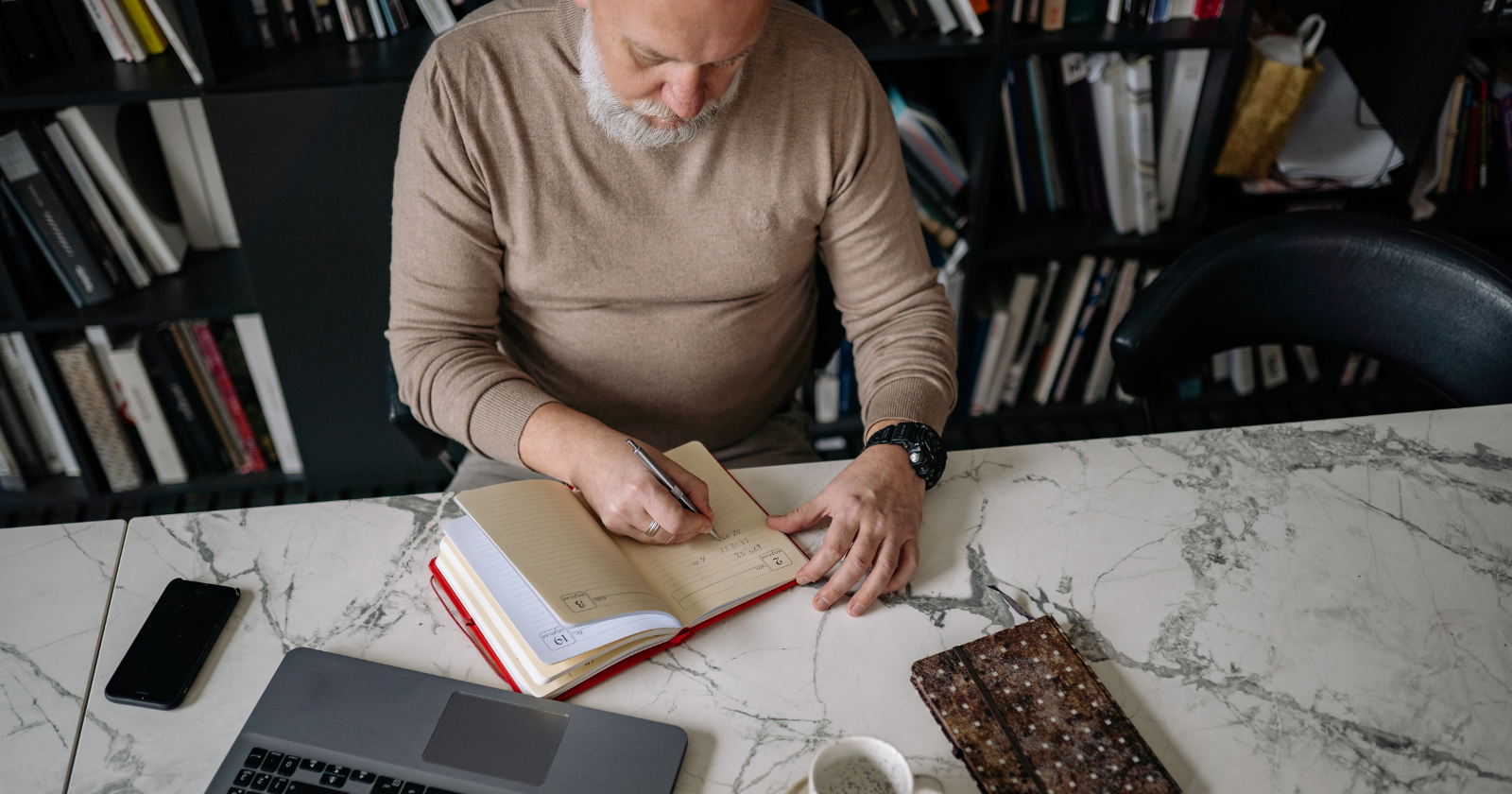
You know that person in your meeting who pulls out a notebook while everyone else opens their laptops? Well, they might be onto something more profound than nostalgia.
We live in an age where digital tools promise to make everything faster, more efficient, more connected. Yet here's what's fascinating: some still carry physical notebooks.
Perhaps, they're not behind the times. Perhaps, they've discovered what neuroscience suggests - that the act of writing by hand does something to our brains that typing simply cannot replicate.
What happens in your brain when you write
Have you ever noticed how you remember handwritten notes better than typed ones?
Scientific American explains that "Engaging the fine motor system to produce letters by hand has positive effects on learning and memory." This isn't just about nostalgia or preference - it's about how our brains actually work.
When you write by hand, you're not just recording information. You're creating a multi-sensory experience. Your brain coordinates the movement of your hand, processes the visual feedback of watching letters form, and engages the areas responsible for language and comprehension all at once. This creates what neuroscientists call "embodied cognition" - learning that involves the whole body, not just the mind.
Typing, by comparison, is almost passive. Every letter requires the same basic movement. Your fingers find keys through muscle memory while your conscious mind races ahead.
The myth of "efficiency"
Here's the trap we've fallen into: we've confused speed with effectiveness.
Typing can be fast, but speed does not always mean depth. A person can type an entire paragraph quickly and still realize afterward that they were barely present for the thought itself.
Handwriting changes the pace. Because it is slower, it forces the mind to stay with one idea a little longer. That slowness can act less like a limitation and more like a filter, helping weaker thoughts fall away while stronger ones have time to take shape.
Laura Deutsch, author of Writing from the Senses, puts it perfectly: "Writing by hand connects you with the words and allows your brain to focus on them, understand them and learn from them."
This connection isn't simply metaphorical. It's neurological. The physical act of writing engages pathways in your brain that typing simply doesn't activate.
Digital overwhelm and the analog antidote
How many browser tabs do you have open right now? How many notifications are waiting on your phone?
Our digital tools are designed to fragment our attention. Every app, every platform, every device is optimized to pull us in multiple directions at once. We've become so accustomed to this fractured state that we've forgotten what focused thinking feels like.
A blank page and a pen offer something radical in this context: constraint.
There are no hyperlinks to follow, no notifications to check, no auto-correct to second-guess your spelling. Just you, your thoughts, and the slow, deliberate act of making marks on paper. This constraint isn't limiting - it's liberating. It forces you to stay with one thought long enough to actually complete it.
Finding your balance
Are we suggesting we abandon our keyboards and go fully analog? Of course not.
Digital tools have their place. They're incredible for editing, for sharing, for storing vast amounts of information. But they're not the only tools we need.
Think of it this way: you wouldn't use a hammer for every home repair job, would you? Sometimes you need a screwdriver, sometimes a wrench. Our thinking tools work the same way.
For quick communication? Type away. For capturing fleeting thoughts? Use your phone. But for deep thinking, for working through complex problems, for really understanding something? Perhaps,pick up a pen.
Wrapping up
The next time you see someone writing in a notebook during a meeting or at a coffee shop, don't assume they're being old-fashioned. They might just be giving their brain the time and space it needs to actually think.
We've spent so much energy trying to speed up our thinking that we've forgotten the value of slowing it down. Writing by hand isn't about resisting progress. It's about recognizing that the most sophisticated computer we have - our brain - sometimes works best at the speed of a pen moving across paper.
So maybe it's time to buy a notebook. Not because you're rejecting technology, but because you're embracing what your brain actually needs. The future of thinking might just involve more ink-stained fingers than we expected.