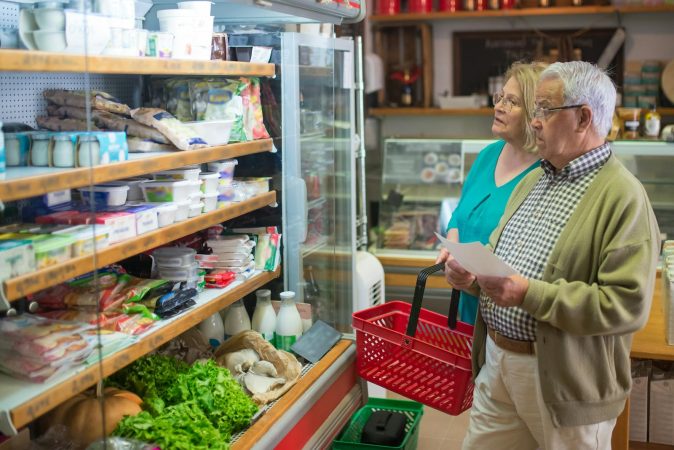
The anxiety you feel choosing between two cereal boxes mirrors the paralyzing weight of bigger life decisions. What looks like commitment fear might actually be the grief of knowing every choice means abandoning countless other possible lives.
You're standing in the cereal aisle of a grocery store at 8:47 on a Sunday morning, holding two boxes. One is the oat cluster granola you've bought for years. The other is a plant-based, turmeric-and-adaptogenic-mushroom blend you picked up out of mild curiosity, the kind of thing that signals a whole different version of you — the version who makes cashew milk from scratch and knows what ashwagandha does. You put the new one in the cart, then take it out, then put it back. The whole thing takes ninety seconds, and the stakes are absolutely nothing, and yet some dim engine in your chest is firing on the same frequency it does when you think about whether to move cities, leave a relationship, or accept the job that would change everything. You choose the usual box. You walk away feeling oddly defeated by a breakfast cereal.
If you've ever stood in that aisle debating whether to go fully plant-based — not just for a meal or a week, but as a life — you know the feeling scales. It's never really about the cereal. It's about the identity attached to the choice, and the identities you'd have to release to make it.
Scale that feeling up. Way up. Apply it to a life.
The popular read on people who struggle with commitment is that they're afraid of being trapped. Afraid of intimacy, afraid of failure, afraid of settling. The self-help shelves are full of books that treat hesitation like a deficiency to overcome, a wall to knock down through willpower or therapy homework. And sometimes that framing fits. Sometimes avoidance really is avoidance.
But there's another version of commitment hesitation that gets misdiagnosed constantly, and it doesn't look like fear of closeness at all. It looks more like someone standing at a trailhead where six paths branch out, understanding with full clarity that walking down one means the other five go dark forever. The problem isn't the path they're choosing. The problem is the five funerals they'd have to hold on the way in.
The lives you'll never live
Psychologists have a term for this: counterfactual thinking. It means imagining alternative outcomes, the roads not taken, the versions of yourself that exist only in hypothesis. For years, most therapeutic frameworks treated counterfactual thinking as a trap, a cognitive distortion to be corrected. If you're spending time grieving a life you never lived, conventional wisdom said, you're wasting energy that should go toward the life you have.
More recent work complicates that. A piece in Psychology Today argues that "what if" thinking, far from being purely destructive, can serve an adaptive function. Imagining alternative outcomes isn't always rumination. Sometimes it's the mind rehearsing, weighing, preparing. The question is whether you're using counterfactual thought as a compass or as a cage.
The difference matters, because people who grieve unchosen lives aren't necessarily paralyzed by indecision. Many of them are deeply thoughtful. They understand trade-offs at a level that people who commit easily sometimes don't. Their problem isn't a lack of courage. It's an excess of imagination.

And imagination, when it runs unchecked, can turn into something that closely resembles mourning.
Grief without a death
Judith Herman, whose 1992 book Trauma and Recovery remains one of the foundational texts in trauma psychology, observed that "the conflict between the will to deny horrible events and the will to proclaim them aloud is the central dialectic of psychological trauma." That observation was aimed at survivors of violence, but the structure it describes, two contradictory impulses pulling a person apart, applies to a wider range of human experience than we typically acknowledge.
An exploration of lives unlived in Psychology Today extends this idea, examining how the loss of future possibilities can produce a kind of grief that doesn't have a clear object. There's no funeral, no casket, no socially recognized loss. There's just the persistent ache of something that never existed but felt real enough to miss.
This is the kind of grief that shows up when someone turns down a job abroad because they chose stability at home. When they end a relationship that was good but not the relationship, knowing the person they left will build a life that might have been theirs. When they pick one city and feel the ghost of the city they didn't pick hovering at the edges of their daily life for years.
The grief is real. The loss is hypothetical. That combination confuses people, including the person experiencing it.
Why this isn't just privileged indecision
The strongest objection to taking this seriously is obvious: isn't this just the anxiety of having too many choices? Isn't grieving your unlived lives a luxury problem, the emotional equivalent of complaining about a wine list that's too long?
Fair enough, up to a point. Access to multiple life paths is absolutely a function of privilege. Someone working two jobs to keep the lights on isn't agonizing over whether to move to Lisbon or stay in Portland.
But the emotional mechanism underneath isn't limited to the privileged. Research on existential anxiety has found that these concerns are widespread, encompassing anxieties about fate and death, emptiness and meaninglessness, and guilt and condemnation. These aren't boutique worries. They're structural features of being a conscious creature that knows its time is limited.
The fear of choosing one life and losing the others plugs directly into this. It's a fear about meaninglessness, a terror that the one life you chose might not have been the meaningful one. It's a fear about fate, about the randomness of which opportunities appeared and when. And it carries guilt, the nagging sense that you owe something to the versions of yourself you abandoned.
Studies have also found that higher levels of existential anxiety are associated with symptoms of depression and suicidal ideation. Which means this isn't a conversation about comfort. It's a conversation about the psychological cost of living with unresolved existential tension.
Naming it changes it
Here's where something useful happens. Research on emotional granularity suggests that the ability to make fine-grained distinctions between emotional states helps people regulate them more effectively. Psychology Today articles on the feelings wheel concept describe how many people collapse distinct feelings under broad labels like 'stressed' or 'anxious,' and how learning to differentiate between emotions can change how someone relates to their inner life.
If you've been calling your commitment hesitation "avoidance" or "fear of intimacy," and it's actually grief over unlived possibilities, you've been applying the wrong treatment to the wrong diagnosis. You've been trying to be braver when what you needed was to mourn.
There's a meaningful difference between those two actions. Bravery involves pushing through resistance. Mourning involves sitting with loss. The first asks you to override your feelings. The second asks you to feel them fully and then, slowly, let them change shape.
I've thought about this a lot in my own life, if I'm honest. Having lived in more than one place, I developed early the habit of imagining the life happening in the place I wasn't in. When I was in one city, the other felt like a film I'd paused. Every place I lived became a place I was also not living, and over time, that double vision became less a burden and more a permanent condition.
It made me a good travel writer. It also made me someone who has trouble staying anywhere for more than eighteen months without the restlessness kicking in. Whether I'm running toward something or away from something is a question I've stopped trying to answer definitively.
The door in the boundary
So what do you actually do with this? You can't live six lives. You can't choose all the paths. The math doesn't work.
One approach comes from acceptance and commitment therapy, or ACT, which doesn't ask people to eliminate uncomfortable thoughts or emotions. It teaches them to hold those thoughts without being controlled by them, and then to act in alignment with their values anyway. The discomfort doesn't have to disappear for you to move.
Applied to the grief of unlived lives, this means something specific: you don't have to stop mourning the paths you didn't take. You just have to stop waiting for the mourning to finish before you walk the path you did.

The self-compassion research supports this too. Studies cited in the lives unlived piece, including work by Kristin Neff and Christopher Germer, found that self-compassion interventions measurably reduced PTSD symptoms and depression. The mechanism isn't complicated: when people stop punishing themselves for having feelings, the feelings become less overwhelming.
If you're someone who has spent years berating yourself for not being able to "just commit," this is worth sitting with. The self-punishment hasn't worked. It hasn't made you more decisive. It's just added a layer of shame on top of the grief.
The friendships that survive decades, as we've written about before, tend to be the ones where both people give each other permission to change, to become unrecognizable versions of who they once were. The same principle applies to your relationship with your own life. The version of you that chose this path is allowed to be a different person from the version that almost chose a different one. You don't owe those ghost selves loyalty. You owe them acknowledgment.
Living with the ghost
There is no clean resolution to this. I don't think there's supposed to be. The awareness that your life is one life, that choosing means losing, that every yes carries a silent no: this doesn't go away because you've read the right article or done the right therapy protocol.
But it can change from something that freezes you into something that moves alongside you. The grief becomes a companion rather than a warden. You stop expecting it to leave. You make room for it.
Research suggests that existential anxiety, when addressed rather than avoided, can actually be channeled toward adaptive action. The fear itself contains information. It tells you what matters. A person who grieves the life they didn't choose is a person who cares deeply about how their time gets spent. That's not a flaw.
I think about this often in the context of the choices that bring many of you here — to this magazine, to this way of eating and living. Choosing a plant-based life is one of those commitments that looks simple from the outside (it's just food, people say) but carries the full weight of identity within it. It means choosing one relationship to the world and letting go of another. It means mourning the ease of the life you had before — the restaurants you didn't have to think about, the family dinners where you didn't feel like a footnote, the version of yourself who didn't carry the knowledge you now carry about where your food comes from and what it costs the planet.
That mourning is real. The person who hesitates at the threshold of going fully plant-based isn't always lacking willpower or conviction. Sometimes they're standing at that trailhead, seeing all the paths, understanding the trade-offs with painful clarity, and needing a moment to grieve the simplicity they're about to leave behind. That's not weakness. That's the same excess of imagination that makes a person thoughtful enough to care about the consequences of their choices in the first place.
The cereal aisle version of this is silly. The life version is not. But the structure is the same: you're standing in front of options, aware that choosing is a form of losing, and the weight of that awareness is real even when nobody around you can see it.
Call it what it is. Not avoidance. Not commitment phobia. Not immaturity or indecisiveness or any of the other labels people reach for when someone hesitates at the threshold of a major life choice.
Call it grief. Because that's what it is. And grief, unlike avoidance, has a process. It moves. It changes. It doesn't require you to be fixed. It requires you to be present.
Which, if you think about it, is the only version of commitment that ever actually works. Not the kind where you white-knuckle your way into a decision and refuse to look back. The kind where you choose with open eyes, carry the weight of what you didn't choose, and keep walking anyway — into the life that's yours, the only one you'll get, the one that becomes more fully chosen every single day you stay.