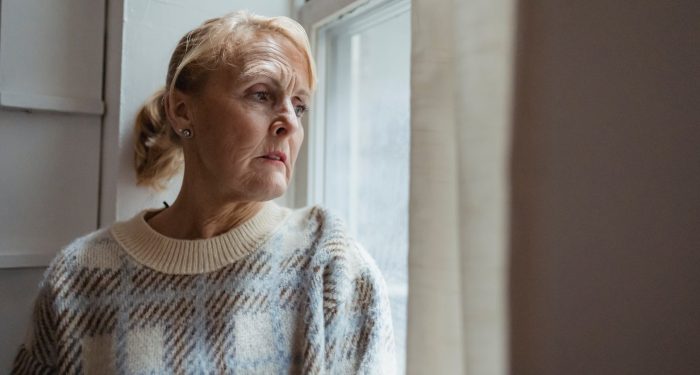
And why that's not the tragedy I thought it would be.

Add VegOut to your Google News feed. 
I was standing in my kitchen at 2 a.m., eating leftover pad thai straight from the container, when my phone lit up with a notification. Instagram, telling me that someone I hadn't thought about in months had posted for the first time in a while. I almost didn't look—muscle memory had taught me that 2 a.m. scrolling never leads anywhere good. But something made me tap.
There she was, radiant in someone else's arms at what looked like a wine tasting in Napa. The caption was simple: "Four years ❤️." Four years. Which meant she'd met this person six months after we'd ended things. Six months after I'd told her I needed to "figure myself out," that coward's phrase.
The thing about realizing the love of your life has already come and gone is that it doesn't happen the way you'd expect. There's no dramatic soundtrack. It happens while you're eating cold Thai food in your underwear, looking at someone else's happiness on a screen that's too bright for the darkness of your apartment.
The myth of perfect timing
We tell ourselves stories about love that follow a particular arc: meet, overcome obstacles, realize you're meant to be, live happily ever after. The internet is particularly good at reinforcing this narrative. Every algorithm-served story about high school sweethearts reuniting after decades, every viral tweet about chance encounters that led to marriage—they all suggest that real love finds a way, that timing sorts itself out, that the universe conspires to bring soulmates together.
But Northwestern University's longitudinal study of relationships found something different: timing—not compatibility, not attraction, not even love—was the single biggest predictor of whether a relationship would last. Two people could be perfect for each other on paper, could have what the researchers called "high dyadic adjustment," but if they met at the wrong point in their individual development, the relationship was likely to fail.
I think about this study a lot now. About how Emma and I had uncanny compatibility. We'd finish each other's sentences in an almost unsettling way, like we were operating from the same source code. She'd text me about a song right as I was queuing it up. I'd buy her a book she'd just added to her private wishlist.
But I was 28 and convinced that committing to anything—a person, a city, a career—meant closing off infinite other possibilities. I'd just quit my job to freelance, was sleeping on couches half the time, and had this idea that I needed to be some fuller version of myself before I could really love someone. Emma was 31, had just made partner at her firm, and knew exactly what she wanted: Sunday farmers market runs, a dog named something literary, children before 35.
The timing was off by maybe three years. Just three years.
The mathematics of missed connections
There's this concept in behavioral economics called the "secretary problem" that basically asks: if you're interviewing candidates for a position and you have to decide on the spot whether to hire them (no take-backs), when do you stop looking and commit? The mathematical answer is that you should interview 37% of your candidate pool without hiring anyone, just to establish a baseline, then hire the next person who's better than everyone in that first group.
Applied to dating, if you assume you'll date seriously from age 18 to 40, you should date without committing until you're about 26, then settle down with the next person who's better than everyone who came before. It's coldly logical, and also, I think about it every time I open a dating app now at 34.
Emma came into my life when I was 28. According to the secretary problem, I should have been ready. But I was still in what I thought was my "gathering data" phase, except I wasn't really gathering data—I was just scared. I had this image of my thirties as this wide-open expanse where I'd travel to Estonia on a whim and learn to make pottery and maybe start that newsletter about obscure electronic music that eleven people would read. Emma didn't fit into this imaginary life, not because she would have stopped me from doing any of those things (she wouldn't have), but because choosing her meant admitting that my actual life—the one where I mostly work from my apartment and get excited about finding good produce—was my real life.
The particular ache of the almost-relationship
We weren't together long—just eight months. But there's something about relationships that end at their peak that marks you differently than the ones that drift on for years. It's like the difference between a sharp knife cut that heals clean and a bruise that takes months to fully fade.
Brain imaging studies at Rutgers have shown that romantic rejection activates the same pain centers as physical injury. But what their study couldn't capture is the specific texture of rejecting someone not because you don't love them, but because you do, and it terrifies you.
I remember the night I ended things. We were at her apartment, the one with the clawfoot tub and the neighbor who practiced violin at weird hours. She'd made salmon with this maple glaze she'd been wanting to try. We both knew what was coming—I'd been distant for weeks, picking fights about nothing, staying late at coffee shops to avoid the weight of her expectation that I be a real person with real feelings who made real decisions.
"I just need some time to figure out what I want," I said.
"You mean you need time to figure out if what you want is me," she corrected, not unkindly.
She was wrong, though. I knew I wanted her. That was the problem. Wanting her meant wanting the whole thing—the shared calendar, the joint vacation planning, the merging of friend groups, the inevitable discussions about where to spend holidays. It meant admitting that my carefully cultivated identity as someone who needed nothing and no one was a lie.
The year of magical thinking
After Emma, I dated with the fervor of someone trying to prove a point. There was the startup founder who collected vintage synthesizers, the bartender who was getting her MFA, the woman who ran ultramarathons and had strong opinions about electrolyte replacement. Each of them was interesting, accomplished, attractive. None of them were Emma.
I kept waiting to feel that click again, that sense of recognition. But comparing everyone to Emma was like comparing every meal to the best thing you've ever eaten—nothing tastes right anymore, even things that would have been perfectly satisfying before.
I started keeping a list in my phone of things I wanted to tell her. Small things, mostly. How the coffee shop we used to go to had changed their music from lo-fi hip-hop to aggressive EDM. How I'd finally read that Sally Rooney book she'd recommended and yes, okay, she was right about the ending. How I'd seen a corgi wearing a raincoat and it looked exactly like her boss, whom she'd always said looked like a corgi in a raincoat.
The neuroscience of regret
Our brains are wired to feel more regret about inaction than action—psychologists at NYU call it the "action effect." We're more likely to regret the things we didn't do than the things we did. This makes evolutionary sense: our ancestors who regretted not running from the maybe-a-tiger bush were more likely to survive than those who regretted running from what turned out to be just wind.
But knowing the science doesn't make the regret any lighter. If anything, it adds a meta-layer of frustration: I know why my brain is torturing me with what-ifs, but I can't make it stop.
What if I'd been ready? What if I'd gone to therapy sooner? What if I'd just been brave enough to say "yes, this is terrifying, but let's do it anyway"?
The parallel universe where I chose differently plays on a loop in my mind. In that universe, we're probably married by now. We definitely have the dog (named Fitzgerald or something equally pretentious). In that universe, I'd wake up next to someone who knows that I need coffee before conversation, who doesn't find it weird that I read the same book every December.
But that universe would require a different version of me, one who understood at 28 what I'm only beginning to understand at 34: that closing doors isn't a limitation but a form of freedom, that choosing one life doesn't mean mourning all the others, that love isn't something you find when you're ready but something that makes you ready.
The unexpected grace of acceptance
Here's what they don't tell you about realizing the love of your life has already passed through it: it's oddly liberating. There's a relief in knowing the best thing has already happened, that you've already fumbled the cosmic moment. The pressure's off in a weird way.
I'm not saying I've given up on love. I'm dating someone now who laughs at my worst jokes. It's good. It's healthy. We meal prep together on Sundays and have rational discussions about our feelings. She doesn't read my mind, but she does read my texts and responds thoughtfully. When we have the same thought at the same time, it's a pleasant surprise, not an expectation.
Harvard's Study of Adult Development, one of the longest-running studies on happiness, found that the quality of our relationships is the strongest predictor of life satisfaction. But they also found something else: it's not about finding one perfect person. It's about the accumulated effect of all our connections, the web of relationships that hold us.
I think about this when we're cooking together, music playing, talking about nothing important. It's not the same electric connection I had with Emma, but it's something else—sustainable, nourishing, kind. I'm not constantly worried about fucking it up, maybe because I've already fucked up the big one, or maybe because I've finally learned that love isn't just the lightning strike but also the steady warmth that follows.
The love that remains
I found out through a mutual friend that Emma is pregnant. Due in spring. When I heard, I felt something shift in my chest—not heartbreak exactly, but something adjacent to it. The final closing of a door I'd been holding cracked open with my foot for six years.
I pulled up our old text thread, which I'd never deleted. The last exchange was about returning each other's stuff. But if I scrolled up just a bit, there we were, planning a weekend trip to Big Sur that we never took, debating whether robots would ever truly experience emotions, sending each other the same meme at the exact same moment.
There's a concept in physics called quantum entanglement, where two particles that have interacted remain connected even when separated by vast distances. Change one, and the other responds instantly, regardless of the space between them. It's not a perfect metaphor for human connection—nothing in physics ever is—but sometimes I think about how Emma is out there, living her life in a parallel track to mine, and how we're both different because of those eight months when our paths converged.
I never responded to that Instagram story. But in my head, I've written her one letter that says everything: Thank you. I'm sorry. I hope you're happy. I really, genuinely hope you're happy.
Because here's what I've learned: the love of your life might come and go, but the love itself—the capacity you discovered in yourself, the spaces they opened up in you—that stays. It becomes part of your architecture. Emma taught me that I could be known, fully, and still be loved. That I could be myself—anxious, overthinking, perpetually convinced I'm saying the wrong thing—and someone would find that not just tolerable but delightful.
I carry that knowledge into every relationship now, even the ones that don't shake me to my core. Especially those.
The future imperfect
Last week, I was at a dinner party where someone asked that question that always comes up after a few glasses of wine: "Do you believe in soulmates?"
The table divided predictably—the coupled people mostly said yes, the single people mostly rolled their eyes. When it came to me, I said something that surprised myself: "I believe we get multiple chances at different kinds of love, and the tragedy isn't missing one—it's thinking that was your only shot."
I'm 34 now. If I'm lucky, I have another 50 years of loving people in various ways. Some will be passionate, some comfortable, some brief, some lasting. None will be Emma, but they don't need to be. She was the love of my life for that version of my life—the one where I needed to learn that I could be loved, fully and intensely, exactly as I was. Now I need different things: stability, partnership, someone to build something real and lasting with, even if it's quieter.
The love of my life came and went. And I'm still here, still capable of loving, still writing lists of things I want to share with someone. Just different someones now. And that's not settling or giving up or accepting less. It's just life, in all its messy, imperfect, endlessly renewable glory.
Emma, if you ever read this: thank you for the eight months. They changed me in ways I'm still discovering. I hope your spring baby inherits your laugh. I hope they know how lucky they are.
And I hope you know that somewhere, in a parallel universe where I was braver sooner, we're sitting on a porch somewhere, that literary-named dog at our feet, still finishing each other's sentences.
But in this universe, the real one, we're both okay. More than okay. We're living our actual lives, the ones we chose through action and inaction, through bravery and cowardice, through perfect timing and terrible timing.
And maybe that's everything.