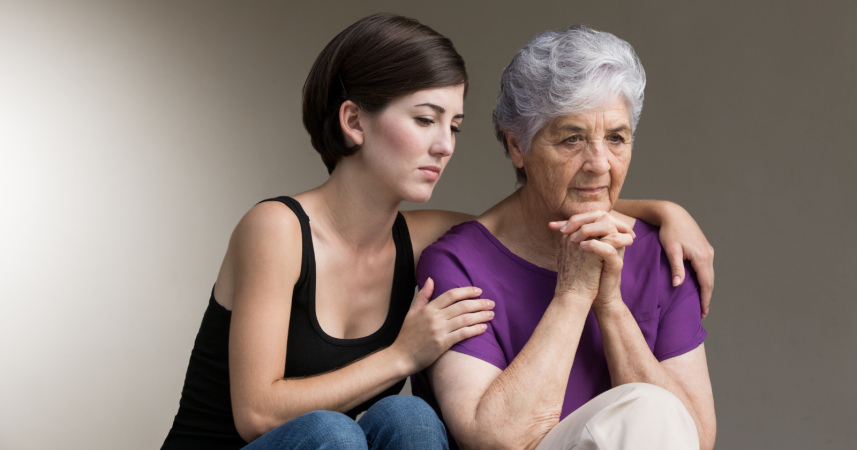
When she stopped defending her homemade remedies and questioning every decision you made, you thought she'd finally accepted your wisdom — but she'd simply learned that gray hair means your voice no longer counts in the checkout line, the doctor's office, or even your own living room.

Add VegOut to your Google News feed. 
Last Thursday, I watched my 89-year-old mother fold her hands in her lap while I explained why she needed to move from her beloved garden apartment to assisted living.
She nodded quietly, her eyes focused somewhere beyond my shoulder. "Whatever you think is best, dear," she said, and something inside me cracked like winter ice.
This wasn't my mother. My mother was the woman who once drove three hours to tell me, face-to-face, that the curtains I'd chosen for my first apartment were "a tragedy against natural light." She was the force who debated every teacher, challenged every doctor, and had opinions about everything from the proper way to fold fitted sheets to the moral implications of buying non-organic strawberries.
But there she sat, agreeing with me. And instead of feeling relieved, I felt like I'd lost something precious.
When the fighter stops fighting
Have you noticed it too? That moment when your parent stops pushing back against your suggestions, stops insisting they know better, stops treating you like you're still twelve and don't understand how the world works? We tell ourselves they've finally recognized our competence, finally accepted us as adults.
We might even joke about it with siblings: "Can you believe Mom didn't argue about the doctor's appointment?"
But here's what I've learned after years of watching this dance between aging parents and their adult children: that silence isn't acceptance. It's exhaustion. It's the terrible recognition that the world has moved past them, that their voice carries less weight than the helpful stranger at the bank who speaks louder when they see gray hair.
My mother didn't suddenly decide I was wise. She simply ran out of currency in a world that stopped accepting her experience as legal tender.
The invisible transfer of power
Virginia Woolf wrote about women needing "a room of one's own," but what happens when age slowly strips away not just the room but the very door you might close? The transfer of power from parent to child doesn't happen in some ceremonial passing of a torch. It happens in a thousand tiny surrenders, each one dressed up as agreement.
I think about this when I remember helping my parents navigate their finances while also managing my teenager's college applications. The impossible choices piled up like unopened mail.
One afternoon, my father handed me his checkbook without a word. He'd balanced that checkbook every Sunday morning for fifty years, sharp pencil in hand, adding machine humming. The gesture looked simple, but I recognized it for what it was: not trust, but defeat.
The world had become too fast, too digital, too impatient with his careful calculations. Online banking might as well have been written in ancient Sanskrit. When I cheerfully said I'd handle it, he nodded, but I saw his shoulders drop an inch, saw him shrink into his chair like he was trying to take up less space in a world that had already decided he was taking up too much.
The lies we tell ourselves
Why do we adult children so eagerly misread this surrender as growth? Maybe because the alternative is too painful. If we acknowledge that our parents' compliance comes from powerlessness rather than agreement, we'd have to face our own complicity in diminishing them. We'd have to admit that we've become part of the very system that dismisses them.
I wrote once about learning patience while caring for my mother through her Alzheimer's journey. But even before the disease took hold, society had already begun its slow erasure of her relevance.
Every time a store clerk looked past her to me for decisions, every time a doctor directed answers to my questions toward me instead of her, every time someone spoke louder and slower as if age had affected her hearing and comprehension rather than just her patience for condescension.
We mistake their exhausted surrender for peaceful acceptance because it's easier than recognizing we've become the authority figures in a play nobody auditioned for.
What remains when authority fades
After we moved my mother to assisted living, I found her old recipe box while cleaning out her apartment. Inside, beyond the index cards covered in her precise handwriting, was a note she'd written to herself years ago: "Remember - they need to make their own mistakes, just like you did."
She knew. She'd always known. Every argument, every piece of unsolicited advice, every stubborn insistence on her way - it was never about being right. It was about still being seen as someone whose thoughts mattered, whose experience counted for something.
When did we start treating wisdom like milk, as if it had an expiration date? When did we decide that competence with a smartphone trumped competence with life?
The choice we still have
So what do we do with this recognition? How do we honor our parents' experience when the world has stopped listening to them?
Sometimes I catch myself about to dismiss my mother's suggestion simply because it comes wrapped in outdated references or because she doesn't understand the current context. B
ut then I remember my son's wedding, how I bit my tongue when he chose someone I had reservations about, how that marriage proved me beautifully, completely wrong. My mother bit her tongue a thousand times too, watching me stumble through choices she wouldn't have made.
The difference is, she still had her voice when she chose silence. Now, when the world has taken that voice away, perhaps our job is to give it back, even in small ways. To ask not just what she wants for dinner, but what she thinks about the larger questions. To listen not just with patience but with genuine curiosity. To recognize that her agreement might be surrender, and to be gentle with that recognition.
Final thoughts
These days, when my mother quietly agrees with my decisions, I've learned to pause. "But what do you really think?" I ask. Sometimes she shrugs, too tired to fight. But sometimes, given permission and space, she tells me.
And in those moments, I glimpse my real mother again - the one who hasn't changed her mind about a single thing, who simply learned that the world stopped caring what she thinks.
The least I can do is prove the world wrong, one conversation at a time.
If You Were a Healing Herb, Which Would You Be?
Each herb holds a unique kind of magic — soothing, awakening, grounding, or clarifying.
This 9-question quiz reveals the healing plant that mirrors your energy right now and what it says about your natural rhythm.
✨ Instant results. Deeply insightful.
Marlene Martin
Marlene is a retired high school English teacher and longtime writer who draws on decades of lived experience to explore personal development, relationships, resilience, and finding purpose in life’s second act. When she’s not at her laptop, she’s usually in the garden at dawn, baking Sunday bread, taking watercolor classes, playing piano, or volunteering at a local women’s shelter teaching life skills.
More Articles by Marlene